
Development
JWST maps the weather on a hot gas giant 700 light-years away
May 22, 2026 Development Source: Ars Technica
Share this article



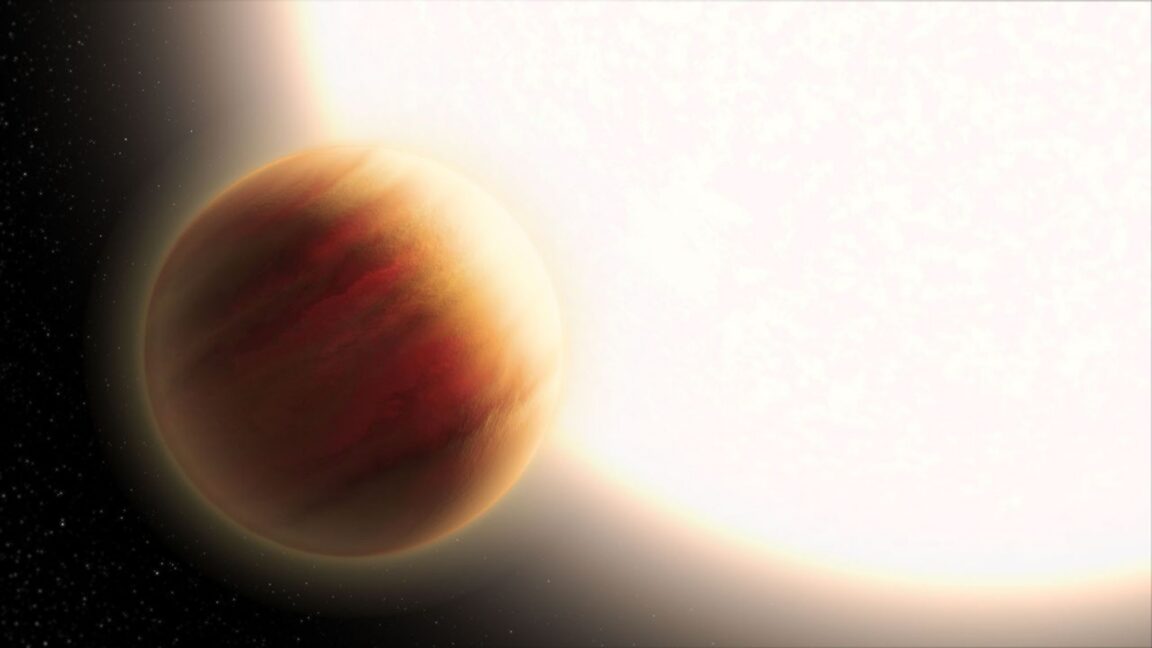
On tidally locked worlds, there are massive temperature swings between day and night sides, which usually lead to differences in atmospheric density between the day side and the night side. These differences, combined with the Coriolis effect that stems from the planet’s slow rotation, cause a phenomenon called equatorial super-rotation. This is where winds on the equator blow eastward faster than the planet is spinning. Circulation models predicted this is exactly what’s happening on WASP-94B a.
The leading edge of the planet’s disk, called the morning limb, is the region where the local atmosphere is rotating out of the colder night side and into the hot day side. The trailing edge at the evening limb is where the heated daytime gases are crossing over into the dark side. To catch this process in motion, Mukherjee and his colleagues employed a technique called limb-resolved spectroscopy.
Because it takes a little bit of time for the planet to fully cross the star’s edge during the beginning and end of the transit, the telescope sees the leading morning limb block the starlight slightly before the trailing evening limb does. Using JWST’s Near Infrared Imager and Slitless Spectrograph (NIRISS), the team measured the light curves as WASP-94A b transited and split the signal. This way, they managed to extract two separate chemical transmission spectra for the exoplanet: one for its morning, and one for its evening limb. And there was quite a difference between the two.
The morning limb’s spectrum was just a sloped line, rising at shorter wavelengths, which indicated high-altitude aerosols blocking the light from deeper in the atmosphere. “You would see a lot of dust and cloud particles at very high altitudes,” Mukherjee says. “Going deeper, the clouds likely clear up, and you would probably find water vapor and these kinds of gases.”
On the evening limb, the spectrum showed no substantial evidence of aerosols and revealed spikes of gaseous water vapor. “This would be a different view where you do not encounter many clouds through your journey, but what you see is just gas—water vapor mostly and other gases, maybe like carbon dioxide,” Mukherjee suggests.
By feeding the JWST data into computer models, the team could also predict what the weather engine on WASP-94 b looks like in motion.
The team even managed to calculate how the atmosphere keeps the clouds aloft. The equatorial wind is apparently strong enough to push the heavy mineral droplets through the night side faster than gravity can pull them down.
Finally, the researchers ran an experiment where they took their precise JWST data and reanalyzed it without splitting it into two to resolve the limbs. “This had a huge effect on our understanding of the composition of this planet,” Mukherjee says. The results the researchers got when they averaged the atmosphere in a traditional model turned out a bit alarming for exoplanet science in general.
Because the thick morning clouds diluted the clear water vapor signals from the evening, the single-sphere model concluded that the planet’s metallicity—the abundance of elements heavier than hydrogen and helium—was suspiciously high. “With the limbs resolved, we’ve got an oxygen enrichment of this planet that was three to five times higher than our Sun,” Mukherjee explains. When the team averaged the spectrum, the oxygen enrichment came out about 100 times higher.
This bias in the composition estimates, he argues, probably affects other tidally locked exoplanets, including sub-Neptunes and super-Earths that are smaller than WASP-94A b. For now, though, we have not been able to resolve the morning and evening asymmetries in these smaller planets, even using the JWST. But the team thinks there is still a lot we can do before concluding we need an even bigger telescope.
“We need to think harder about how to mitigate this bias,” Mukherjee says. The answer, he suggests, might be figuring out how to disentangle morning and evening limbs in smaller planets based on the data we get from the instruments we have. “And even if we don’t have this kind of measurements, we can think about how to develop our theoretical models to mitigate this even if we have an averaged spectrum of the planet,” Mukherjee claims.
Science, 2026. DOI: 10.1126/science.adx5903