
Development
The Internet can't stop watching Figure AI's humanoid robots handling packages
May 20, 2026 Development Source: Ars Technica
Share this article



That Helix 02 system runs “entirely onboard” each robot’s hardware, with AI inference being done on the device, Adcock explained in his X post. However, the robots are networked together for communication purposes, so they can autonomously request another robot to step in if they need to recharge their batteries—each robot is expected to work about three to four hours before its batteries run low. The robots may also swap out if they encounter hardware or software issues.
By the time Figure had livestreamed eight hours of the robots performing “autonomous, unsupervised work,” Adcock was declaring that the team had decided to keep going with the livestream 24/7. He also highlighted YouTube comments that named several of the robots Bob, Frank, and Gary.
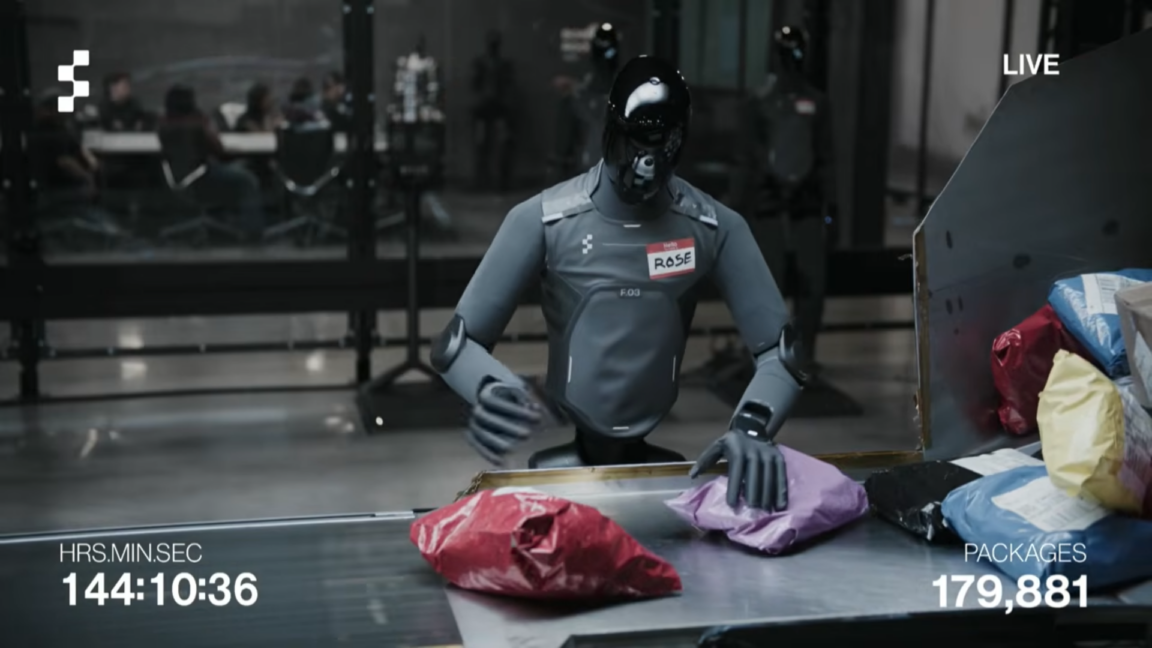
On May 14, the robots had surpassed 30 hours of collective work, with individual robots taking turns swapping in and out. Adcock was capitalizing on the attention by wearing a T-shirt with the image of the robot dubbed “Frank,” all while touting the company’s merch store to viewers. He also welcomed another robot to the team by attaching a nametag with the name Rose.
Adding to the spectacle, people began placing bets through the prediction market Polymarket on how long the robots could run without failure and how many packages they could handle.
By May 15, the robots had seemingly achieved “48 hours of nonstop autonomous operation without a failure,” Adcock posted on X. “We are now running this until a failure to perform the use case,” he added.
David McCall, Figure’s head of design, also appeared briefly on the livestream to give another robot a “Jim” nametag. That particular robot would feature prominently in the Figure team’s next attention-grabbing scheme in response to one viewer’s comment—pitting robot against human on the same task.
The Figure event may appear especially compelling because it’s relatively rare for companies to present livestreamed endurance runs featuring humanoid robots. Such livestreams can convey seemingly greater transparency than short videos by allowing viewers to see robotic flaws and fumbles in real time. That may encourage viewers’ belief in the robots’ demonstrated capabilities, which in this case is limited to the Figure 03 robot’s ability to handle packages in one specific warehouse-style setup.
Even taking this particular demonstration at face value, what does this mean for Figure AI’s broader vision? The company is one among many betting on AI-powered humanoid robots becoming general-purpose workers capable of performing various tasks normally done by humans. To gain widespread adoption, humanoid robots will need to prove as capable and cost-effective as either human workers or industrial robots, with more specialized forms suited for specific tasks.