
Development
Civilization VII finally lets you build a civ that stands the test of time
May 19, 2026 Development Source: Ars Technica
Share this article



Starting a new game of Civ 7 with the patch, the biggest change was immediately apparent. As of the last update before this one, you could pick from just 14 civs when starting a game in the Antiquity Age. This time, I saw more than 40.
I could play as America from the Age of Antiquity now, for example. When I set up the game, I was also given the option to choose the AI’s civ-switching behavior; I could prohibit it, allow it, or pick an option that makes the AI follow suit on whatever choice I make.
“We actually had a designer go through and write up a document for, ‘what is the core identity of each civilization and what should really be embodied by their unique ability and be what you see sort of foremost in how you play them during their Apex Age,’” he explained. “And then what we do is, we sort of disperse that out into the other adjacent ages and sort of make them echoes of the primary ability. And so that kind of gives us a—it’s not like it’s 129 totally unique pieces of content. It’s more like 43 different flavors of civilizations, and we have to provide three different power levels of each one.”
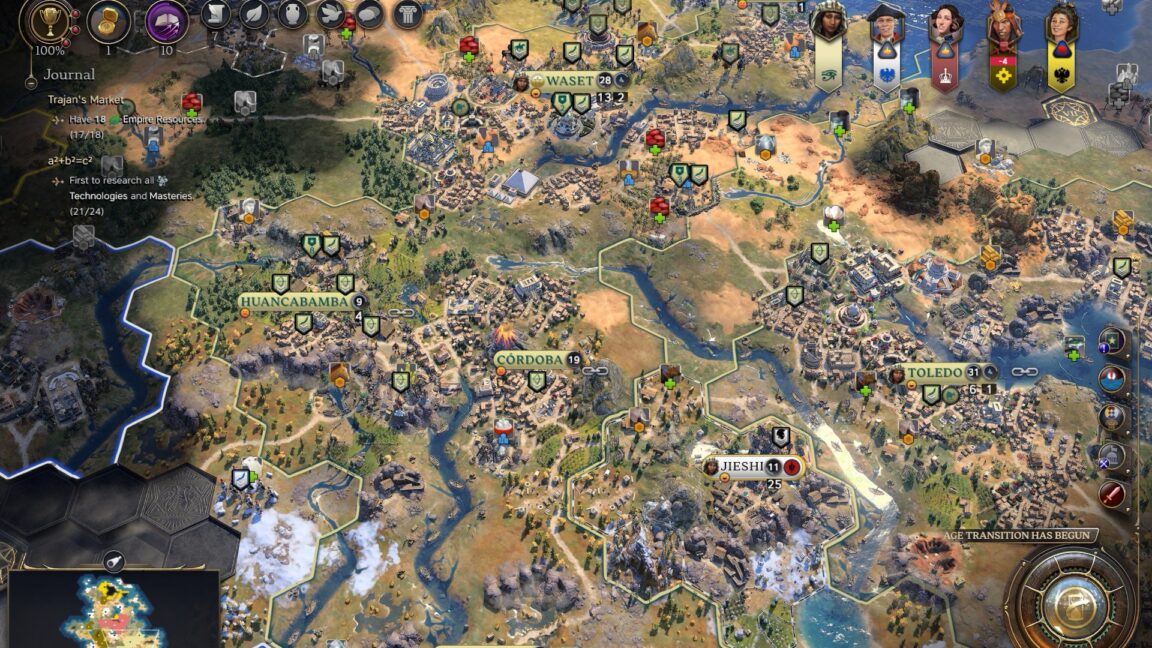
I played a full game as Egypt and tested out the syncretism system. Test of Time gives players who wanted a single-civ experience what they want without breaking the principles of the base game. In fact, there’s even a hint of pre-Civ 7 here, in that the civs definitely feel most powerful during their apex age. (In older Civ games, many civs peaked in relative power at a certain point in a long game.)
They added structure to a game that, for many players, is more of a sandbox than a linear series of challenges. Further, because they were the same every time you played, and there were only a few of them, they became tedious after multiple playthroughs.
The replacement here is triumphs, a large array of small objectives that you can complete within an age to gain bonuses.
Beach acknowledged that the players from the early, sandbox-first-design era of the franchise “are the ones that are having the bigger problem adapting to Civ 6 and Civ 7,” and noted that the team has seen that players who are new to the series have had fewer qualms about the direction it’s going.
“I think if you look at from Civ 4 to Civ 5 to Civ 6 to Civ 7, in each iteration as we’ve gone further in, we’ve sort of deepened the cultural representation of what a civ is, how many bonuses they have, how true to the period of history they are,” he told me. “We’re really trying to help the players tell the story and trying to give them historical hooks that they can latch onto in their heads to help them understand what’s going on in the game world.”
By contrast, “back, 20, 25 years ago, that wasn’t there, but players just invented the stories in their head,” he said.
To try to bring some player voices into the mix alongside the designers, Firaxis hosted a series of community workshops to test the new update. “Once the workshop began, that created a really cool dynamic where the devs and the players in the workshop were directly speaking with each other in Discord, jamming in the channels, responding to specific feedback threads,” said Schembari.
Beach said the success of the new workshop program made him realize how much the team had been missing that. “You see a lot of negativity online these days, and it’s hard to avoid that,” he said. “But I have had lots of periods during my career where I have worked with fans as closely as we did during a workshop, and I think we’ve just gotten away from that for too long.”
When asked how the team at Firaxis has weathered the intense player feedback over the past year, Beach went on to say, “To be brutally honest, there were a couple times during the, say, three, four months after launch, where I had to make a few morale checks. But overall, once you really start digging in, I think what’s really cool is we were able to give people exactly the experience they were expecting, but without breaking the structure of the game.”
Some people value the original experience over fixing design problems that have affected the series for decades. It’s easier to accept flaws that you’ve gotten accustomed to than to embrace completely new ones.
I do still wish Civ 7 were a little more sandbox-y, a bit more emergent. It’s not my favorite in the series, but I think it’s getting increasingly indefensible to call it a “bad game.”
Will Civ 7 be a civilization game that stands the test of time? I’m still not sure, to be frank. This update is a step in the right direction, though, and by giving players the ability to build a single civ that stands the test of time, it might finally meet more players’ definition of a good Civilization game.