
World
Israel and Hezbollah continue attacks after Israel-Lebanon talks in US
April 15, 2026 International Source: BBC World
Share this article



Israel strikes hit southern Lebanon and Hezbollah fires rockets at Israel, a day after rare direct negotiations.
Israel and Hezbollah continue attacks after Israel-Lebanon talks in US
Copyright current_year BBC. All rights reserved. The BBC is not responsible for the content of external sites. Read about our approach to external linking.
Copyright current_year BBC. All rights reserved. The BBC is not responsible for the content of external sites.
Read about our approach to external linking.
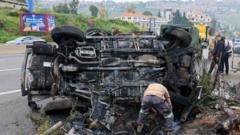
One Israeli strike hit a vehicle on a coastal highway in Jiyeh, south of Beirut
Rescuers work at the site of an Israeli air strike that targeted a vehicle in Jiyeh, south of Beirut, Lebanon (15 April 2026)
Fighting between Israeli forces and the Iran-backed Lebanese group Hezbollah has continued after Israel and Lebanon held direct talks in Washington aimed at easing the conflict.
On Wednesday, Israeli strikes hit two vehicles on the coastal highway south of Beirut, near the towns of Saadiyat and Jiyeh and outside Hezbollah's traditional strongholds.
Videos from one scene showed a burned-out van, with first responders working to extinguish the flames and recover human remains. There was no immediate comment from the Israeli military.
In northern Israel, a man was wounded in the town of Tamra after Hezbollah launched about 30 rockets across the border, according to medics and the military.
Hezbollah said it had launched rockets at 10 locations in northern Israel.
The Israeli military also said Israeli troops were continuing ground operations in southern Lebanon and that more than 200 Hezbollah infrastructure sites there, including rocket launchers, had been struck over the past 24 hours.
And it renewed calls for residents across a large part of southern Lebanon to evacuate amid the ongoing air and artillery bombardment.
Although Israel has avoided striking Beirut itself since its wave of attacks across the country a week ago, which Lebanese authorities say killed more than 350 people in only 10 minutes, it has continued to strike southern and eastern areas.
Israel has announced that it plans to create what it has described as a security buffer zone extending eight to 10km (five to six miles) inside Lebanese territory, saying the move is necessary to protect Israeli communities from Hezbollah attacks.
In the early hours of Wednesday, clashes were reported in several Lebanese border towns and villages, including Khiam and Bint Jbeil, with heavy gunfire and explosions heard throughout the night.
US delegation at the US-Israeli talks in Washington.
Israel and Lebanon hold first direct talks since 1993
The Israeli town on the frontline with Hezbollah
A dual image of a female Hezbollah supporter and an image of the site of an Israeli airstrike
Lebanon seeks peace, but Hezbollah needs to be convinced first
Israeli troops continue operations in southern Lebanon to create what Israel describes as a "buffer zone"
A photograph taken from northern Israel shows Israeli military armoured vehicles driving past destroyed buildings across the border in southern Lebanon (15 April 2026)
The fighting has continued despite a ceasefire between the US and Iran, which Israel has said does not apply to its campaign in Lebanon.
On Tuesday, a meeting in Washington brought Lebanese and Israeli representatives together for the first direct, high-level contact in three decades between the two countries, which remain formally at war.
US Secretary of State Marco Rubio, who mediated the discussions between Israeli ambassador Yechiel Leiter and Lebanese ambassador Nada Moawad, framed them as a pivotal moment.
"This is a historic opportunity," he said, flanked by US, Israeli and Lebanese flags, acknowledging the "decades of history" behind the conflict.
Lebanese President Joseph Aoun voiced cautious optimism, saying he hoped the negotiations would "mark the beginning of the end of the suffering of the Lebanese people."
Israeli officials, meanwhile, described the negotiations as part of a longer-term strategy against Hezbollah.
Leiter said the meeting with Moawad had led him to believe Israel and Lebanon were "on the same side of the equation", calling the negotiations the beginning of a "battle against Hezbollah".
Lebanese ambassador Nada Moawad (2nd R) said the talks in Washington were "constructive", while her Israeli counterpart Yechiel Leiter (R) said they "had a wonderful exchange"
US Secretary of State Marco Rubio (L), US ambassador to Lebanon Michel Issa (2nd L), Lebanese Ambassador to the US Nada Moawad (2nd R), and Israeli ambassador to the US Yechiel Leiter (R) pose for a photo before their meeting at the State Department in Washington (14 April 2026)
But no ceasefire was announced at the meeting, and the diplomatic move has exposed deep divisions within Lebanon.
Hezbollah strongly rejected the negotiations. One of its MPs, Hassan Fadlallah, warned on Wednesday that a rift in Lebanon could widen over the government's decision to negotiate with Israel, urging authorities to reconsider.
He said the group wanted a comprehensive ceasefire, not a return to the near-daily Israeli strikes and assassinations seen after the November 2024 ceasefire deal, which ended more than a year of conflict.
Meanwhile, the humanitarian crisis across Lebanon continues to deepen.
Lebanese authorities say that since fighting resumed on 2 March, after a Hezbollah attack on Israel, Israeli attacks have killed at least 2,124 people across Lebanon, including 254 women and 168 children, and displaced more than one million others.
Twelve Israeli soldiers and two civilians have been killed by Hezbollah over the same period, Israeli authorities say.
The BBC's Hugo Bachega (right) speaks to a paramedic amongst the ruins of an ambulance station in Lebanon
'They are striking everywhere' - Paramedics in Lebanon speak to BBC after Israeli strikes
The BBC's Hugo Bachega (right) speaks to a paramedic in Lebanon
Liat Zvi is pictured from the shoulders up, in a domestic setting with a table in the background. She is a dark-haired woman with gold-rimmed glasses.
Israelis war-weary but most oppose Iran ceasefire, poll suggests
Since the start of the US blockade on Monday, 15 vessels have crossed the Strait of Hormuz, nine of which have links to Iran, BBC Verify analysis of ship-tracking data suggests.
The survivors of the US attack on Iranian vessel Iris Dena, which claimed the lives of 104 people, were among those sent home.
The United Nations' secretary general said it was "highly probable" that the negotiations would restart.
A US statement said the two sides had agreed to launch direct negotiations, at a time and place to be determined.
The Italian PM said the pact, which happens every five years, would be suspended "in view of the current situation".
BBC foreign correspondent Nick Beake visits Metula, an Israeli town surrounded on three sides by Lebanon.
China, the biggest buyer of Iranian oil, says the US naval blockade undermines an "already fragile ceasefire".
The Lebanese government go into peace talks with limited influence over the group.