
Development
One Mars spacecraft, two senators, and a cloud of questions
May 19, 2026 Development Source: Ars Technica
Share this article



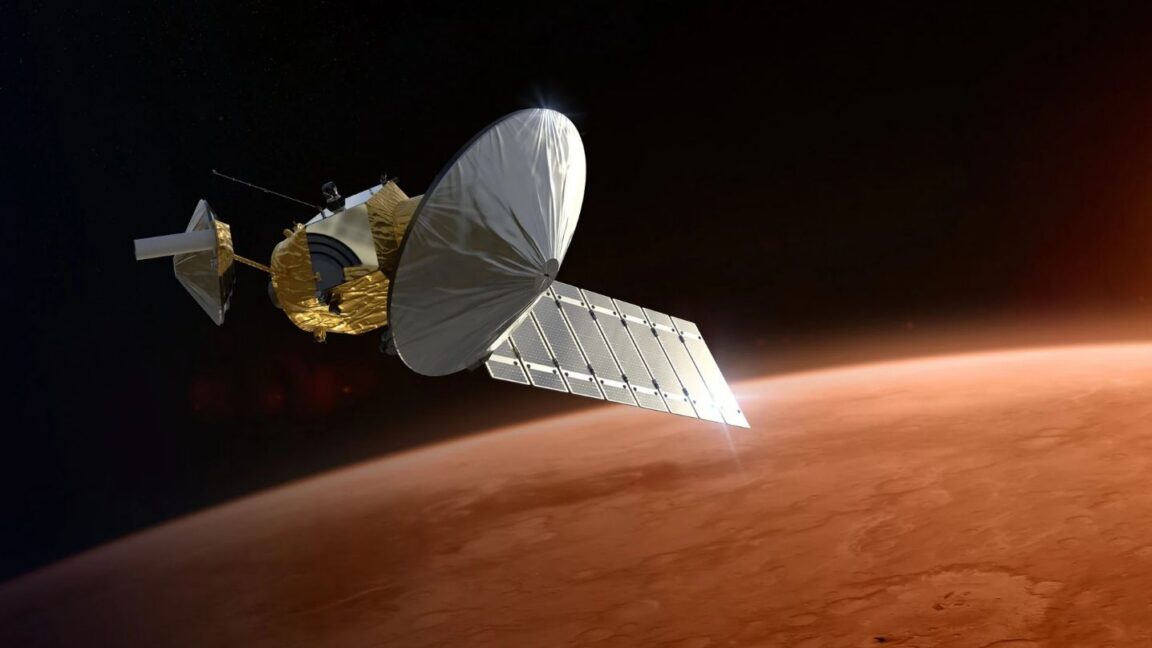
Similar language ended up in NASA’s procurement notice, which states that to be eligible to bid, a company needs to “demonstrate that the Offeror proposed a separately and independently launched Mars telecom orbiter to support an end-to-end Mars Sample Return mission.”
That seems like a curious requirement. Why must the bidder for a relatively straightforward orbiter around Mars have previously proposed an orbiter as part of an “end-to-end” mission to return samples from Mars? Was Congress seeking to be preferential for a particular company?
The One Big Beautiful Bill was signed into law on July 4, 2025. One month later, as part of its Q2 Investor Update, Rocket Lab included a slide about its plans to support human missions to Mars. In the corner of the slide, the company noted that $700 million had just been appropriated for a Mars orbiter (MTO).
“Rocket Lab was the only commercial provider to propose a MTO as part of an end-to-end Mars Sample Return mission to support human exploration and science missions to Mars,” the slide stated.
Ars’ Stephen Clark recently asked Rocket Lab chief executive Peter Beck if he knew why this delay had occurred. He said he did not. Beck was also asked whether NASA was moving quickly enough given the schedule constraints.
“I think there’s plenty of fire lit under them already,” Beck said. “They understand the importance of the mission. So I think we just need to get it out there, and they need to get it awarded, and everybody needs to get to work.”
One source indicated to Ars that this delay was due in part to a letter sent by US Sen. Roger Wicker, R-Miss, earlier in May to NASA. According to this source, Wicker’s letter was interpreted as favorable toward Rocket Lab’s position in the competition.
Despite multiple efforts, Ars has been unable to obtain a copy of this letter. A NASA spokesperson, noting that the agency is now in a “blackout” period due to the contract solicitation’s release, declined to confirm the existence of Wicker’s letter or to release it.
“We were a relatively loud voice on MSR, because we just saw a program and a capability that could be solved,” Beck said in his recent interview with Ars. “The cost estimates for MSR, and all the rest of it, was just nuts. I think anybody knows that I have a bit of a soft spot for planetary sciences. So with MSR, I just saw a whole bunch of Nobel Prizes sitting on the surface there, and it was just criminal not to bring them home. As part of that, we studied the whole architecture very, very, very closely, and it was clear to us that a Mars Telecommunication Orbiter would be an important part of that.”
Ultimately, the Trump White House and the US Congress, as part of the budget process, canceled the Mars Sample Return mission in January.
In March, the US Senate Committee on Commerce, Science, and Transportation unanimously passed a new NASA Authorization Act that called for a reinstatement of Mars Sample Return. According to this legislation, NASA shall “establish within the Science Mission Directorate a new Mars Sample Return program for the purpose of returning scientifically curated samples from Mars to Earth.” This mission should cost no more than $8 billion, according to the bill.
Although this legislation has not passed the full US Congress, we can draw some clues from it. Sen. Ted Cruz, R-Texas, chairs the committee that authored the bill, and he likely supports a revival of Mars Sample Return because it would bring new facilities and prestige to Johnson Space Center in Texas. Rocket Lab, if it were to obtain the contract to build a Mars orbiter, would have a leg up in the contracting process to develop the rest of the sample return mission. Testing for these vehicles, including a Mars Ascent Vehicle, could happen in Mississippi.