
Development
The US space enterprise is desperately waiting for Starship—will it finally deliver?
May 18, 2026 Development Source: Ars Technica
Share this article



The “Test Like You Fly” video also outlines the development of the third iteration of the Starship rocket, V3, highlighting both advances and setbacks encountered along the way. SpaceX is distilled to its core as the exceptional engineers who are designing and testing a radically new rocket talk about the very difficult problems they’re trying to solve.
“We are not breaking laws of physics; we are just trying to leverage them as effectively as we can,” explains Jacob McKenzie, the company’s vice president for the Raptor rocket engine that powers both the first and second stage of Starship.
McKenzie says SpaceX built 600 Raptor engines as part of its V2 Starship program, a remarkable number that underscores the investment the company is making to develop a rocket that has yet to reach orbit or deliver a single payload. (To put this into perspective, NASA is spending $3.5 billion to procure two dozen comparably powered, expendable rocket engines.)
By some estimates, SpaceX has now invested $15 billion in the Starship rocket program over the last decade, funding 11 test flights, a sprawling spaceport in South Texas, a massive new factory there to support a high production rate, and expanding facilities in Florida alongside the company’s existing infrastructure in the state.
That month, the then-general manager of the Starbase facility in South Texas, Kathy Lueders, said the company aimed to dramatically increase the vehicle’s launch cadence in 2025. “Elon would say, next year, he would love to have us have 25 missions a year,” she said during a community event. The company also planned to “capture” a Starship upper stage and conduct an orbital refueling test in that time frame.
In early February, the next V3 booster successfully passed pressure testing. After it was moved to the launch pad, SpaceX planned to ignite 10 engines up to full power. But just after ignition, due to an automatic abort from the ground systems, a hard shutdown was commanded. This ended up damaging half of the Raptors.
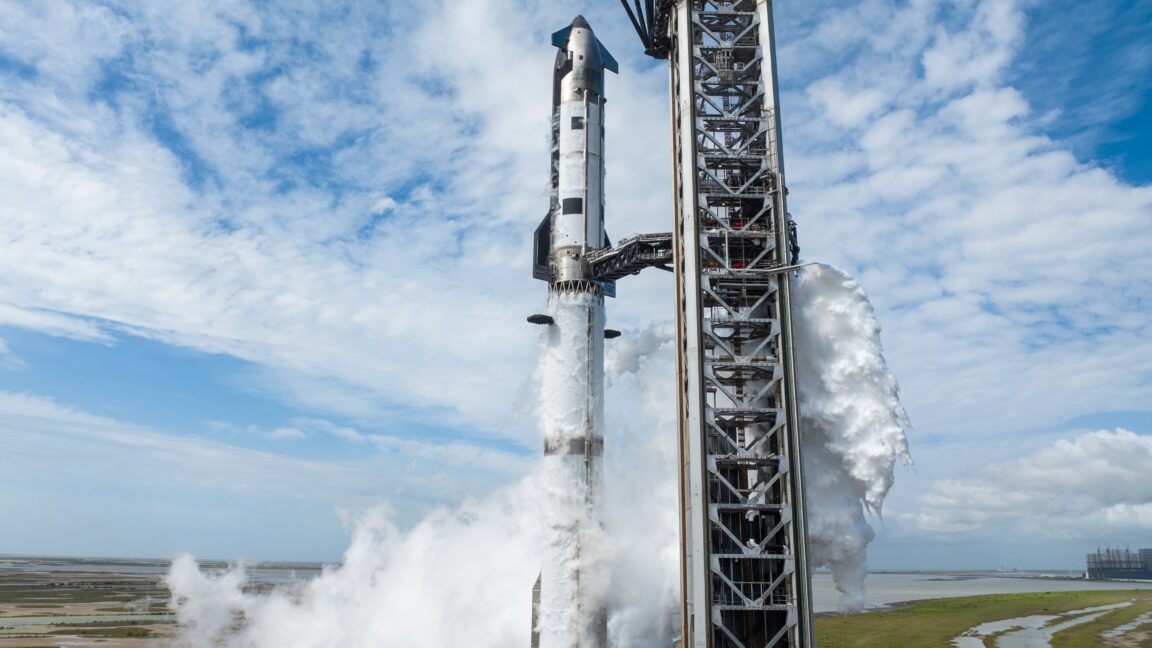
The number of grid fins has been reduced from four to three, and they have been lowered on the vehicle to protect them during hot staging—when the Starship upper stage ignites its engines while still attached to the booster stage. The ring hardware to support this hot staging is now integrated into the booster stage, so it will be reusable.
This is a bold bet because, after a decade and a half, the Falcon 9 has become the most successful launch vehicle in the world, setting records for reuse, longevity, price, and cadence. Because of its reusable first stage and payload fairing, SpaceX has pared back internal launch costs to about $15 million. This affords the company a huge advantage over Starlink competitors who, for a similar launch capability, must pay four to six times this amount. SpaceX charges a base price of $74 million for a Falcon 9 launch to external customers.
The promise of a commercial Starship is twofold. First, it will ease the current launch-capacity crunch by carrying several times the mass of a Falcon 9 payload in a single mission. And second, its price is potentially much sweeter. The Falcon 9 rocket brought launch costs per kilogram down into the low thousands of dollars. Starship could bring them into the low hundreds of dollars, nearly an order of magnitude.
But first, Starship V3 must fly successfully and then become orbital. After that, SpaceX will begin deploying its larger Starlink satellites and start working toward orbital refueling. NASA then has dibs on lots of flights in 2027 and 2028 when Starship is slated to fly as part of Artemis III, make a demonstration landing on the Moon, and then fly an actual lunar landing with humans. Including refueling launches, this accounts for dozens of missions, and the company has recently signaled to NASA that it will prioritize the government program.
So where does that leave customers beyond NASA and SpaceX’s internal Starlink payloads? Patton estimates that Starship may not become widely available for commercial purposes until 2028 or 2029.
SpaceX could beat that estimate, of course. Wednesday’s flight of V3 could knock it out of the park. SpaceX has been building the capacity to mass-produce Starships and fly them frequently. If everything goes well, the company could reach a sub-monthly launch cadence before the end of this year. But what if something goes wrong? Everything just slips further into the future.
So the stakes surrounding this Starship launch are really quite high. The US commercial space industry is depending on lower launch costs and higher capacity. NASA’s lunar ambitions, to a great degree, hinge on its success. And the stakes are highest of all for SpaceX.
Starlink direct-to-cell? Orbital data centers? SpaceX’s fantastic valuation after its IPO? An eventual city on Mars?
All of these rely entirely on Starship fulfilling its promise of rapid, low-cost, reusable launch. Starship must not just work; it must work far, far more efficiently than any rocket ever built, while simultaneously being the most colossal thing our species has ever launched into space.