
Development
Three's a party: US, China, and now Russia are on the prowl in GEO
May 16, 2026 Development Source: Ars Technica
Share this article



The Space Force has often compared the GSSAP satellites to a “neighborhood watch” in geosynchronous orbit. For example, one GSSAP satellite positioned itself near a pair of Chinese spacecraft performing a first-of-its-kind refueling demonstration in geosynchronous orbit last year.
China has launched multiple satellites capable of similar maneuvers. One of these satellites, named TJS-10, is currently flying relatively close to a nuclear-hardened US Space Force strategic communications satellite and a US missile warning platform, according to an update this week in the Integrity Flash newsletter published by ISR University.
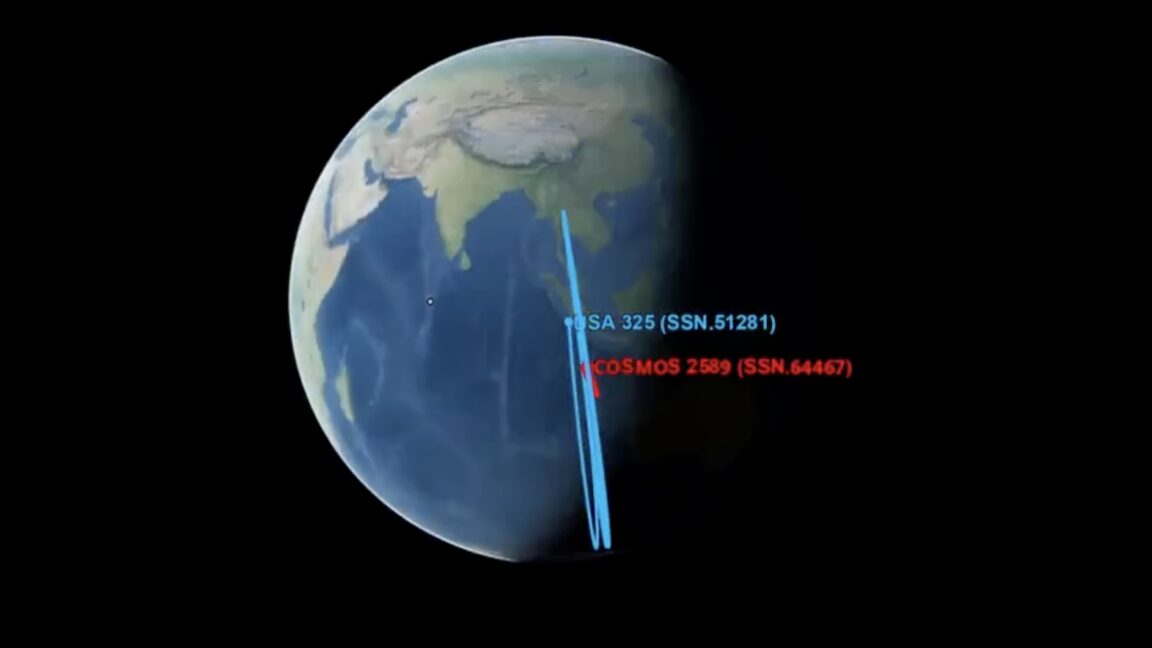
A new kind of Russian satellite is now in the mix. This satellite, officially known as Kosmos 2589, was launched in June 2025 into a highly elliptical orbit alongside a smaller spacecraft designated Kosmos 2590. The two satellites performed a series of high-altitude rendezvous and proximity operations with one another before Kosmos 2589 began moving toward a more circular geosynchronous orbit, where it arrived in April.
One of the US military’s GSSAP satellites was waiting for it. The US inspector spacecraft is now looping around Kosmos 2589, swinging near the newly arrived Russian satellite twice per day, coming as close as 8 miles (13 kilometers) on May 1, according to data from COMSPOC, a commercial space situational awareness company. The exact purpose of Kosmos 2589 remains unclear. Some Western officials suspect it is a higher-altitude version of Russia’s Nivelir anti-satellite system, which has been tested in low-Earth orbit and is now becoming operational.
“One of the dynamics of the current geosynchronous cat-and-mouse activity is your desired imaging target may try to run away from you, and as it goes away from you, may even turn around, and then get a good look at you,” said retired Lt. Gen. John Shaw, a former deputy commander of US Space Command.
It is not surprising that US commanders wanted to get a look at Kosmos 2589 as soon as it arrived in GEO, Shaw told Ars.
“One of the current tactics each side uses is to try to look at a potential target when it first arrives on orbit,” he said. “It’s sort of like an airplane just coming off the runway, because it’s still trying to orient and get checked out for operations. All of this is visible to amateur astronomers and sky watchers. What we need to do is evolve our own practice to the point where we don’t need that checkout period, and we can start maneuvering immediately. I expect others will do the same.”
Fuel limitations on the GSSAP satellites, made by Northrop Grumman, force US commanders to think twice about sending them off to look at every shiny new object that arrives in GEO.
“We want to be able to maneuver for advantage,” said Gen. Stephen Whiting, commander of US Space Command, in an event Tuesday hosted by the Mitchell Institute for Aerospace Studies. “And there’s a number of technologies that could enable that.
“The Marines have a great definition of maneuver warfare that it’s about shattering your enemy’s will and cohesion through rapid and disruptive acts, spatially, temporally, psychologically,” Whiting said. “I want to be able to do that. I want to be able to tell that young captain sitting at a space operation squadron, ‘Hey, you can fly that satellite like you stole it for advantage, not like our sweet grandmother who’s trying to go to church on Sunday morning … that’s where we find ourselves today because of this limiting factor of the fuel.”
The program that will follow GSSAP, known as RG-XX or Andromeda, will use cheaper, refuelable satellites to patrol geosynchronous orbit. The new satellites will help the Space Force gain “predictive battlespace awareness” enabling “offensive and defensive space operations,” Space Systems Command said in a press release.
The RG-XX satellites will help US forces study “adversary strategies, tactics, intentions, and capabilities, while also supporting anomaly resolution on blue force systems,” Space Systems Command said. “These efforts will also secure and maintain space superiority at scale in 2030 and beyond.”
The Space Force hasn’t said how many RG-XX satellites it will buy, but the program will use a “proliferated architecture,” a term that, at least in low-Earth orbit, can mean many dozens or hundreds of satellites. The Space Force has fewer than eight GSSAP satellites active today.
Earlier this year, Space Systems Command selected Anduril Industries, Astranis Space Technologies, BAE Systems, General Atomics, Intuitive Machines, L3Harris, Lockheed Martin, Millennium Space Systems, Northrop Grumman, Quantum Space, Redwire, Sierra Space, True Anomaly, and Turion Space as potential suppliers for the RG-XX/Andromeda program.