
Development
Rocket Report: Russia claims success with new ICBM; spaceplane déjà vu in Europe
May 15, 2026 Development Source: Ars Technica
Share this article



Skyroot named its initial line of vehicles “Vikram” in honor of the Indian physicist Vikram Sarabhai, who is considered the father of the Indian space program. As a testbed for its technology, Skyroot worked on a suborbital version of its rocket, Vikram-S, from 2020 to 2022 and launched the 6-meter rocket in November of that year. The larger Vikram-1 rocket now nearing its debut consists of three solid-fueled stages, with the capability to place up to a half-metric ton of payload into low-Earth orbit.
Italy is experimenting with air-launch. An Italian consortium has successfully completed a suborbital demonstration of an air-launched rocket system, European Spaceflight reports. The project, which used a Dornier Alpha Jet aircraft and a HAX25 sounding rocket developed by an Italian company named T4i, was initiated to support Italy’s push to develop a more responsive launch capability.
Another Italian contractor, GMV, provided avionics for the rocket. The program is named Aviolanco and is backed by the Italian government. A ground-launched sounding rocket completed the program’s first test flight in 2022, and Aviolanco progressed to the next phase with an air-launch demonstration from a Houston-based Alpha Jet over the Gulf of Mexico on April 22. The flight targeted an altitude of 80 to 100 kilometers, but a press release announcing the test’s completion did not indicate whether that target was met.
Prioritizing responsiveness... The test “successfully verified the entire system under real-world conditions,” officials said in a press release. Proponents of air-launch systems highlight their versatility. For example, an air-launched space mission could be rescheduled on short notice, with flexible trajectories to work around constraints such as changing weather conditions.
Air-launched rockets like Northrop Grumman’s Pegasus and Virgin Orbit’s LauncherOne have demonstrated that the concept works from a technical perspective, but neither proved to be commercially sustainable. As some space-faring nations look to develop more spaceports and sea-based launch platforms, though, an air-launch system could offer a strategic, if not commercial, advantage. (submitted by EllPeaTea)
German company joins French spaceplane initiative. Dassault Aviation and German satellite developer OHB have teamed up to propose that Dassault’s Vortex-S spaceplane become a European Space Agency program, Aviation Week & Space Technology reports. The two companies are proposing the reusable spacecraft as a means of transporting supplies to space stations and performing autonomous orbital free flyer missions. Dassault, best known for building French fighter jets and business aircraft, is the prime architect and integrator on the program. OHB would develop a service module for the spaceplane. Dassault and OHB said they are in discussions with other European space companies to expand the team.
This sounds cool, but... The French government announced 30 million euros ($35 million) of funding to support the spaceplane program last year. The first step is a sub-scale suborbital demonstrator, called Vortex-D, that Dassault says could fly as soon as 2028. That would be followed by an orbital free-flyer called Vortex-S, and the Vortex-C operational cargo transport vehicle with a total mass of about 8 to 9 metric tons.
Dassault has long-term plans for a human-rated spaceplane. Past and ongoing efforts to develop a European spaceplane have not made it to the launch pad. ESA’s Hermes spaceplane was canceled in 1992, and progress on a smaller low-Earth orbit (LEO) spaceplane named Space Rider has been slow. Meanwhile, ESA is working with The Exploration Company and Thales Alenia Space on developing cargo capsules, not spaceplanes, to service the International Space Station. ESA may have too many cooks in the kitchen to commit to another LEO transport vehicle. (submitted by EllPeaTea)
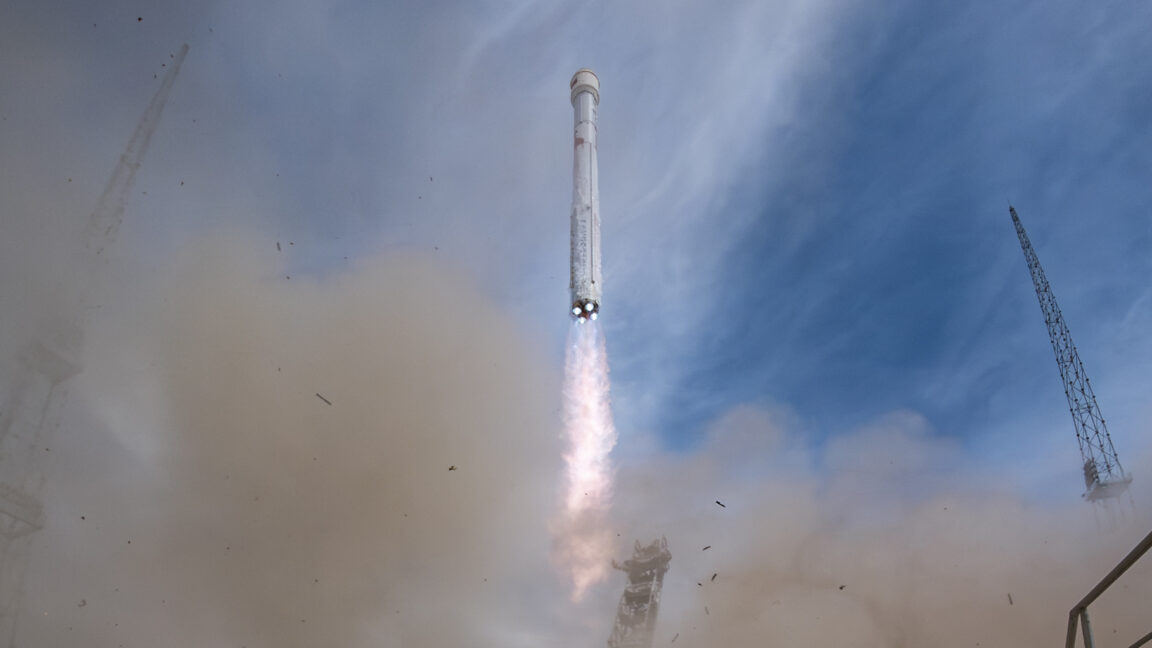
China’s Zhuque-2E rocket returns to flight. China’s commercial Zhuque-2E rocket successfully deployed a mock payload into orbit after lifting off Thursday from a commercial spaceport in the Gobi Desert, Space News reports. This was the first launch of the medium-lift Zhuque-2E rocket since a second stage failure on a mission last August.
Developed by LandSpace, the Zhuque-2E rocket is an evolution of the Zhuque-2 rocket, which became the first methane-fueled launch vehicle to reach orbit in 2023. The version used Thursday is taller and more powerful than previous iterations, with a height of 183 feet (55.9 meters), 745,000 pounds of thrust at liftoff, and a payload capacity of more than 6 metric tons (13,000 pounds) to low-Earth orbit.
Zhuque-3 on deck… LandSpace’s other rocket, the Zhuque-3, is scheduled to make its second flight in the next few months, according to Chinese state media. The Zhuque-3 launched for the first time in December, becoming the first Chinese orbital-class rocket to attempt booster recovery. While the launch phase was successful, the booster crashed during a downrange landing attempt. LandSpace is expected to try again to land the reusable booster on the next flight. (submitted by EllPeaTea)
China launches space station resupply mission. A freighter carrying nearly seven tons of supplies has made its way to China’s Tiangong space station, Space.com reports. The robotic Tianzhou 10 cargo ship lifted off atop a Long March 7 rocket from the Wenchang Space Launch Site on China’s Hainan Island on Sunday. Five hours later, Tianzhou 10 with Tiangong, the T-shaped, three-module space station that China finished assembling in low-Earth orbit in late 2022.
Crew rotation soon… Tianzhou 10 delivered about 6.9 tons (6.3 metric tons) of supplies to the Tiangong space station, including scientific experiments in fluid physics, propellant for the lab’s propulsion system, and a new spacewalking spacesuit. The cargo ship also carried provisions for the station’s three-person crew, which has been in orbit since October. A new Chinese crew is scheduled for launch in the next few weeks.
$275 million for rockets and data centers. A space unicorn started by Baiju Bhatt, the billionaire co-founder of Robinhood Markets Inc., raised $275 million, changed its name, and unveiled a plan to build data centers in orbit, Bloomberg reports. Bhatt’s startup, founded in 2024, was rebranded to Cowboy Space Corp. from Aetherflux, which initially focused on building satellites for beaming solar energy to Earth. Index Ventures led the funding, which valued Cowboy Space at $2 billion, the startup said Monday in a statement. Silicon Valley-based Cowboy Space will use the funding to develop its own rocket to put data centers into orbit.
Cowboy up… The company’s vision sounds familiar. Elon Musk’s SpaceX and Jeff Bezos’ Blue Origin have each announced plans to use their own rockets for launching orbital data centers. Cowboy’s approach differs from the former in that the new startup will design the upper stage of its rocket to itself become the satellite. The company says its new rocket is scheduled to debut in 2028. The path ahead for Cowboy Space is riddled with roadblocks. There are tall barriers to entry for anyone looking to compete with SpaceX and Blue Origin to put data center networks into orbit. Even those companies, bankrolled by two of the world’s richest entrepreneurs, are seeking outside funding to make their visions a reality.
Final steps… SpaceX’s launch team filled the rocket with more than 11 million pounds of methane and liquid oxygen propellants Monday in a final countdown rehearsal before the test flight’s scheduled liftoff Tuesday, May 19. After completing the rehearsal, ground crews removed the rocket from the launch pad to install hardware for the vehicle’s flight termination system. The test flight will mark the 12th launch of a full-scale Starship and Super Heavy booster and the first since last October.
Artemis III comes into focus. NASA announced Wednesday that it will fly the Artemis III mission in low-Earth orbit and that it continues to target 2027 for this stepping-stone flight that will help land humans on the Moon, Ars reports. The space agency chose the orbit close to Earth—as opposed to a higher orbit—because it would preserve the final remaining Interim Cryogenic Propulsion Stage for launching the Artemis IV landing mission later this decade. Instead, NASA will use a “spacer” to simulate the mass and overall dimensions of an upper stage but without propulsive capabilities.
Questions remain… Instead of landing on the Moon with Artemis III, the agency now plans to launch four astronauts in the Orion spacecraft, on top of the Space Launch System rocket. NASA Administrator Jared Isaacman announced the change three months ago. In Earth orbit, they will rendezvous with one or both of the vehicles under development to carry astronauts down to the lunar surface: SpaceX’s Starship and Blue Origin’s Blue Moon Mark 2.
NASA will assess each vehicle’s readiness through the rest of 2026 and perhaps into early 2027 before deciding on a final flight plan for Artemis III. What the astronauts will do after rendezvousing with Starship and/or Blue Moon is also unclear. “While some decisions are yet to be determined, astronauts could potentially enter at least one lander test article.” That will hinge on the maturity of each lander’s life support system.
May 15: Falcon 9 | CRS-34 | Cape Canaveral Space Force Station, Florida | 22:05 UTC
May 16: Falcon 9 | Starlink 17-37 | Vandenberg Space Force Base, California | 14:00 UTC
May 17: Long March 8 | Qianfan Polar Group TBD | Wenchang Space Launch Site, China | 14:40 UTC