
Development
The perfect commuter bike? Velotric's Discover 3 makes its case.
May 15, 2026 Development Source: Ars Technica
Share this article



Switching to the cadence sensor triggers a warning that it will drain the battery faster, which makes sense: You can gently spin the pedals in a gear meant for climbing hills while the electric motor does all the work. I quickly switched back to the torque sensor for pleasant spring-time riding, but I can see where the cadence sensor might make sense once the full heat of summer starts.
Of course, you could always just use the throttle. More on that below.
Another big upgrade comes in the drivetrain, provided by Shimano. After years spent diversifying its low-end components and moving electronics down from the high end to the middle of its range, Shimano has finally decided to rationalize everything. All the models in its upper range, both road and mountain bikes, will have dedicated electronic groupsets. The entire low end will be occupied by items from the Cues groupsets, which will all be completely interoperable.
Nearly every manufacturer focused on the US market has settled on a compromise that’s probably not technically legal: They enable switching to Class 3 in software but still provide a hardware throttle. The throttle simply cuts out at the lower max speed of Class 2. The assist it provides is also somewhat anemic; I could generally accelerate away from a full stop much faster by mashing the pedals a bit.
Velotric has provided a simple software solution. If the bike is set to Class 1 or Class 3, the throttle is disabled. While this may seem like a blindingly obvious way to do things, it’s rare enough that I initially thought I had been shipped a bike with a defective throttle.
Anything that makes it easier to change classes will obviously also make it easy for riders to switch into a class that may not be appropriate for the conditions. Of course, this sort of rider is more likely to set the bike to Class 3 and keep it there.
This isn’t the only nice bit of electronics that Velotric has added. The bike includes rear turn signals controlled by buttons that are easy to use without looking down, along with an alert when they’re active. I’ve found that leaving them on after a turn can be a real problem, as directionals are not part of my normal cycling routine. The only omission is front directionals, which would be helpful for turning left across oncoming traffic.
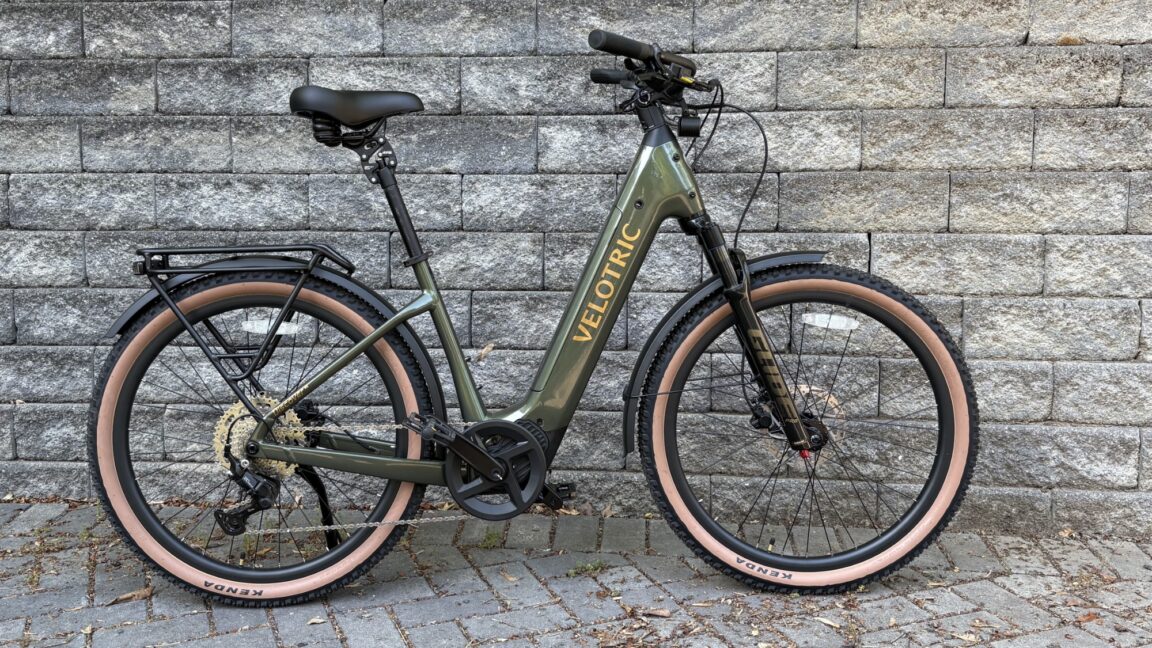
Velotric has also included adjustable front shocks and a shock-absorbing seatpost, coupled with a thick and cushy saddle. The Discover 3 also comes with some fairly beefy tires that also help cushion any bumps. The result is a very gentle ride, even across my local Worst Paved Road in Town™.
I’m not really the target audience for a commuter bike; if I had to commute, I’d rather do it on something that could also handle something like a bit of light trail riding. But it was hard not to be impressed with what Velotric has put together. The $2,000 price tag will obviously be a barrier for some people, but it isn’t a huge jump from models that are a significant step down in features and quality. And many commuter bikes that cost substantially more than the Discover 3 don’t add much to the riding experience, though they likely have higher-quality components.
Velotric itself has also been around long enough to iterate on several of its designs, lending some confidence that the company will be there to provide any service that’s needed in the future.
I see a couple of minor things that could be improved, but they are truly minor. So for the second time since I’ve started reviewing e-bikes, I’m giving one the official Ars seal of approval. If you’re in the market for a good commuter bike, the Discover 3 provides a fantastic balance of price and quality.