
Development
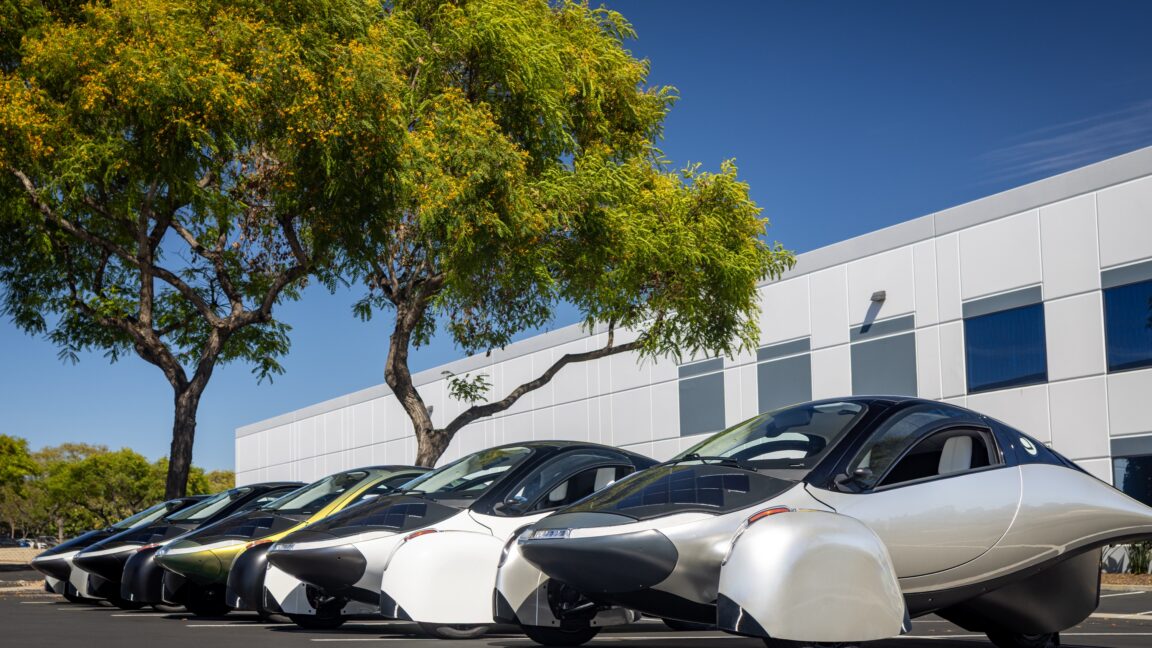
Vaporware or not? Aptera assembles its first five validation models.
May 14, 2026 Development Source: Ars Technica
Share this article



Among the many advantages the Chinese auto industry appears to have over foreign competitors is its ability to quickly turn a new idea into a car that customers can buy. At the other end of the spectrum, we have Aptera, which has been trying to bring a three-wheeled, ultra-efficient electric vehicle to market since 2006. Clearly, there have been more than a few stumbles along the way, but this week, the long-running saga got a new verse as the first validation models were assembled, bringing the EV one step closer to the market.
Aptera’s new low-volume assembly line is in Carlsbad, California, and workers there just assembled five EVs, which make their way through 14 stations. “Every vehicle we run through this line teaches us something,” said Chris Anthony, co-CEO of Aptera Motors. “With five vehicles now off the line, we have a growing foundation of data, a team that is getting sharper with every build, and a process that is proving itself in real time. That is what gives us confidence as we move toward our goal of customer deliveries.”
“What we are building here is not just vehicles but the system to build them well,” said Steve Fambro, co-CEO of Aptera Motors. “Each cycle through the line improves precision, efficiency, and repeatability. This is how we plan to meet our customers’ expectations when they finally get their hands on their own Aptera vehicle.”
The vehicle seats just two occupants and their luggage, but it takes up a surprising amount of room on the road—it’s actually an inch and a half wider than the gargantuan Hummer EV, if you can believe it, a vehicle so wide it scarcely fits in parking spaces or EV charging bays.
Visits to those charging bays are meant to be rare; the EV aims to deliver a range of 400 miles (644 km) from a 44 kWh battery pack—10 miles/kWh (6.2 kWh/100 km) is the claim for the $40,000 launch edition. (Should Aptera succeed, it plans a much cheaper version with just 250 miles/402 km of range.) Its drag coefficient of 0.13 is lower even than Volkswagen’s 1980 ARVW concept, and while I can’t find a published frontal area for the Aptera, its cross-section is clearly much less than that of a standard car shape.
And as you’ll note from the pictures, that aero body is clad in photovoltaic panels that provide up to 40 miles (64 km) of range a day, Aptera says.