
World
Iran activists tell BBC how threat of war intensifies trauma of repression
May 11, 2026 International Source: BBC World
Share this article



A dissident in Tehran says she feels helpless and under immense psychological pressure.
Iranian activist tells BBC how fear of war restarting intensifies trauma of repression
BBC speaks with civilians inside Iran struggling with impact of war
Copyright current_year BBC. All rights reserved. The BBC is not responsible for the content of external sites. Read about our approach to external linking.
Copyright current_year BBC. All rights reserved. The BBC is not responsible for the content of external sites.
Read about our approach to external linking.
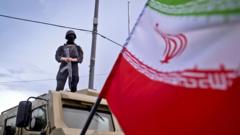
An armed Iranian police officer stands guard on an armored vehicle, monitoring the area during a state-run religious rally in downtown Tehran, Iran, on April 29, 2026. An Iranian flag is seen in the foreground.
People wearing black sit in front of a floral arrangement remembering people who have died
These days and nights she stays at home in Tehran. Waiting. For the sound of aircraft. Bombs. For news or no news of friends in detention. Shirin - not her real name - is constantly anxious. She is showing signs of post-traumatic stress disorder. Her left hand is no longer fully functional.
"Whenever I hear a disturbing sound, my body reacts involuntarily. The psychological pressure that entered my mind has numbed this part of my left hand. It doesn't work. I still have anxiety that the war might start again, and that is a terrifying thing."
On the streets the regime stages shows of strength, including parades by women driving jeeps mounted with heavy machine guns, others with automatic rifles.
Iranian security services were watching closely at a state-run religious rally in Tehran
The BBC uses trusted sources inside Iran to speak with those whose voices are silenced by the regime.
As a political activist living under severe repression Shirin suffers a feeling of helplessness.
"Things [have] happened that we could do nothing about — for example, the execution of those arrested during the January uprising. The executions happened and the detainees were hanged… we have now lost the streets."
Heavily armed women were among those taking part in a pro-government march last month
A young woman in a headscarf and sunglasses is seen standing up through the sunroof of a car, holding a large gun, as part of a pro-regime demonstration.
She listens for the sound of cars pulling up outside. The knock on the door. The phone call summoning her to interrogation. When they've come for you once already, the fear never goes away.
The first time she was on the phone to her mother when the car pulled up beside her on the street. It was back in 2024 during the long fallout from the "Woman, Life, Freedom" protest movement after the death in custody of 22-year-old Mahsa Amini, arrested by the Morality Police for allegedly not wearing her hijab properly.
A man and a young woman got out and stood in front of Shirin.
"I said 'yes'. I told my mother I would call her back later and hung up."
They had been in the middle of talking about finding food for their evening meal.
As a political activist Shirin understood what was happening. The couple confronting her were secret police.
"I asked: 'What do you want?" They said, 'You are under arrest.'"
Moments later she was inside the car and the young woman challenged her for not wearing a headscarf. There was a scuffle.
"She said, 'Put on your headscarf.' She tried to force the headscarf on me. I said: 'You shouldn't touch my headscarf.' I pulled her hand down."
The "Woman, Life, Freedom" protest movement started in 2022 after the death in custody of Mahsa Amini
Iranian protesters set their scarves on fire while marching down a street on October 1, 2022 in Tehran, Iran.
Shirin was interrogated but eventually released after signing a statement agreeing to public silence for two months on pain of solitary confinement. Breaking that pledge would mean going straight to jail. If Shirin were to be arrested today it's highly unlikely she would be offered a choice.
According to Human Rights Watch (HRW), "detainees, many of whom never should have been detained in the first place, are facing human rights violations, serious injury, and death."
Activists estimate that more than 50,000 people have been arrested since the most recent anti-regime protests in January. Many of those are being held incommunicado. The repression has intensified since the war began in February. There are repeated and credible allegations of torture.
A report issued by HRW last month quoted the words of a senior Iranian police commander, Ahmadreza Radan, who warned: "We will not deem anyone who takes to the streets at the will of the enemies as a protester or anything else, but as the enemy [itself] and will [thus] treat them in the same manner that we would treat the enemy."
Anger over economic conditions sparked anti-government protests in Iran in January
Fires are lit as protesters rally on January 8, 2026 in Tehran, Iran.
Shirin has lost her job because of her anti-regime stance. Some work colleagues blamed her and other activists for the Israeli American attack on Iran. None of this has dampened her opposition to the regime, but her feelings about the war have changed.
"I was very happy when the regime's military personnel were killed. But when civilians were killed, I fell apart — especially when I saw they had hit a half-finished, newly built building by the side of the street, and 25 people died in it. A one-year-old child lost his mother. That affected me deeply."
The combination of state repression and the US Israeli bombing campaign has deepened Iran's already profound mental health crisis.
The Iranian Red Crescent reports tens of thousands of calls to its helplines since the start of the conflict. With attacks on 18 medical facilities reported by the World Health Organization, an already under-resourced system is struggling to deal with a wave of psychological problems.
This psychiatric hospital in Tehran was damaged by strikes in late March
A fire engine and firefighter are seen at the damaged Dil Aram-e Sina Psychiatric Hospital following the US and Israeli attack in Tehran, Iran on April 04, 2026
A medic at one Tehran hospital who spoke with the BBC described the anguish of people suffering with conflict related trauma.
"As soon as you ask 'how are you feeling?', the patient starts crying. And we have one psychologist who only comes one day a week because they haven't signed a contract with him. Only one day a week for a population [in the area] of 26,000 people? I never thought everything would slip out of our hands like this."
Shirin worries about a suspended prison sentence which the secret police could invoke at any time. "They might enforce it," she says.
Like many activists the BBC has heard from in recent weeks, Shirin expects repression to intensify if the war ends with the regime still in place.
"It is clear that the pressure and suppression against personal freedoms will intensify… But these hardships can be endured so that Iran remains standing. I told my mother: 'It's okay, I'll even accept prison, but let Iran remain'."
A woman with her child stands behind police tape next to rubble and debris on a street and looks at the aftermath of an Israeli and the U.S. strike on a police station, 2 March 2026.
'Endless fears': Even if fighting stops, the damage to Iran's children will endure
Undated picture of Narges Mohammadi provided by her family, showing smiling with uncovered hair
Concern for jailed Iranian Nobel laureate as brother fears she is dying
An image of Mojtaba Khamenei in the middle of a road where yellow and green taxis and motorcycles are parked, with a man wearing sunglasses, black trousers and a grey T-shirt holding a phone to his right ear.
Iranian authorities granted human rights activist Narges Mohammadi bail amid growing concern over her poor health in prison.
One restaurant owner said there is "no substitute for Iranian saffron" because of its quality.
Iran is reported to want lifting of the US naval blockade, recognition of Iranian sovereignty over the Strait of Hormuz and compensation for war damage.