
Development
DHS can’t create vast DNA database to track ICE critics, lawsuit says
May 8, 2026 Development Source: Ars Technica
Share this article



“None of these conditions existed when the government collected Plaintiffs’ DNA,” protesters alleged.
Under Illinois law, the basis for collecting DNA is even stricter, protesters noted. Only people “arrested for first degree murder, home invasion, or sexual assault” can be required to submit DNA samples, and only after a judge or jury reaches an “independent finding of probable cause.”
But DHS and the FBI have expanded their authority under the DNA Act, systematically working to collect more DNA samples for a software program called the Combined DNA Index System (CODIS).
That database was originally approved to make it easier for local, state, and federal cops to coordinate investigations into serious crimes. But Congress amended the law in 2006 to “permit the collection of DNA from any person arrested for any crime, regardless of the seriousness of the crime,” protesters lamented.
As the number of people in the database grew, DNA technology has advanced, protesters said, giving cops access to more kinds of biological identifiers. However, the DNA Act was not updated as technology improved, which meant federal officers increasingly got access to more sensitive information than Congress intended, protesters alleged.
Most distressingly to protesters, there is no way to request the DNA samples’ destruction and the process to get DNA profiles expunged from the database comes with extra costs and could take as long as five years. In the meantime, federal agents can access their DNA profiles.
And there’s seemingly no way to prevent improper access, since privacy impact assessments that might serve as agencies’ only internal check to reveal civil injustices have been “dismantled,” protesters alleged. In 2026, zero assessments have been reported, down from eight in 2025 and “a peak of 24 filings in 2024,” their lawsuit reported.
Protesters asked the court to declare that the DNA Act, as applied in their circumstances, is unconstitutional. They’ve also asked the court to order their DNA samples to be destroyed, arguing that “the Constitution does not permit the government to convert participation in a protest into a basis for indefinite access to a person’s most private biological information.”
If left unchecked, the federal government “could create a genetic database of innumerable, lawful protesters by improperly arresting, briefly holding,” then collecting their DNA before releasing them, protesters warned.
In January, Border Czar Tom Homan said that “he was ‘pushing for’ a database of individuals arrested at protests, pledging to ‘make them famous,’” protesters said. Around the same time, DHS sent out a memo ordering agents to “capture all images, license plates, identifications, and general information on hotels, agitators, protesters, etc., so we can capture it all in one consolidated form,” the lawsuit noted.
“The government’s significant investment in surveillance and its stated intent to use the technology against protesters is intended to deter people from objecting to the government’s actions,” their complaint said. “And it has worked.”
In the rush to follow Trump’s orders to swarm streets nationwide with ICE agents, DHS cut more than 240 hours of courses, shaving off weeks of training that would’ve taught agents how to control crowds or police cities. Agents also missed training on protesters’ rights, with “courses on constitutional law, lawful arrests, and the limits of officers’ authority” either eliminated or “substantially reduced.” A former ICE assistant chief counsel testified to Congress that “ICE is teaching cadets to violate the Constitution,” the complaint noted.
During Operation Midway Blitz, DHS branded protesters like the ones suing as “domestic terrorists” and “violent anarchists who seek to tear down America,” the lawsuit said. Meanwhile, Vice President JD Vance and other officials reminded agents that they had “absolute immunity” in these clashes.
The same tone was struck in an Instagram ad recruiting agents, where DHS used a photo showing agents in tactical gear pinning down a protester who was never charged with a crime. Encouraging applicants to “join ICE,” the post seemed to use “aggressive physical enforcement against civilians” as a recruiting tool, misleadingly branding the peaceful protester as violent and proclaiming in the caption that “we will NOT allow violent activists to lay hands on our law enforcement.”
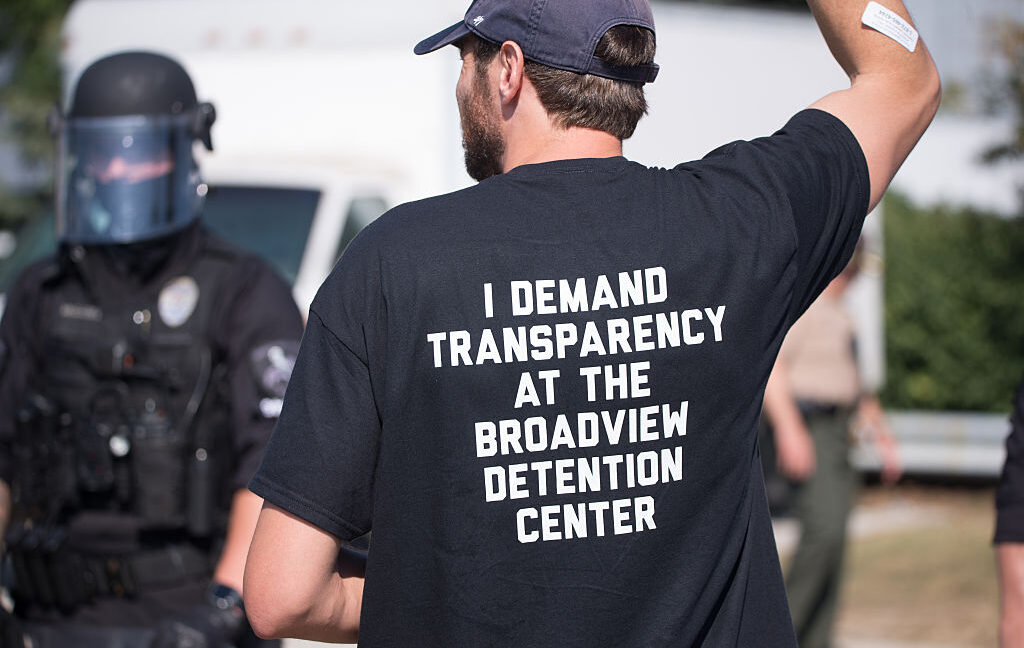
But no violent activists were charged at Broadview. Dana Briggs, a 71-year-old Air Force veteran who is suing DHS, was one of the only Broadview protesters arrested whom DHS came remotely close to charging.
As he explained, he was standing outside of the Broadview facility wearing a “Vets against Trump” T-shirt when ICE agents in tactical gear suddenly yelled, “Clear out the way!” Seeing no vehicles coming through, Briggs asked, “Why?”
Raising his phone to record the exchange, Briggs was soon shoved by an agent and fell down. As agents attempted to then “forcibly detain him,” Briggs tried to hand his phone off to another protester and swatted away an officer’s hand when the officer tried to block the hand-off.
“Briggs did not intend to hit anyone; it was a reflexive reaction to being swarmed by multiple federal agents with weapons,” the complaint said. However, Briggs was arrested anyway and held in a federal prison over the weekend, without access to medication for a heart condition.
The government tried to claim that Briggs assaulted or forcibly resisted the agents, but “the government reviewed additional body-worn camera footage of the encounter and then decided to drop the charges.”
The judge was seemingly so appalled that the court took the unusual step of releasing the video. Hearing Briggs’ case, the judge emphasized that the government “sought to strike hard blows” and “swung and missed—multiple times.” The weakness of the government’s case, another court hearing the case suggested, “calls into question their ability to accurately assess the facts.”
Briggs, who had attended protests for decades, had never been arrested prior to the Broadview clash. Now, his speech has been chilled, as he’s unlikely to attend a protest where DHS agents might be present.
Thirty-year-old Grace Cooper was also in the designated “free speech zone” when she was arrested in a clash that she described as “the most terrifying 90 seconds of her life.”
It was her first time at a Broadview protest, and Cooper didn’t know what to expect. On that day, Border Patrol commander Greg Bovino allegedly arbitrarily ruled that the designated area was suddenly a “free arrest zone,” then ordered protesters to move quickly from the area or else face arrest.
Although Cooper immediately turned to comply, an agent grabbed her from behind and “slammed her to the ground.” After her arrest, no agents could tell her what her crime was, and she even reported overhearing agents debating what her crime might possibly be.
Of the protesters suing, Cooper was the only one to refuse the DNA sample. Such refusal is a crime, the complaint noted, and agents did not allow her to decline. After hours, agents released her without charging her, dropping her off at “a nearby gas station” and refusing to give her any information about whether her case remained ongoing.
Like the others, Cooper’s “most immediate fear” after her arrest was “what the government will do with her DNA.”
“She worries the government will use her DNA to place her on a ‘domestic terrorist watchlist’ and track her movements—at airports, during traffic stops, and in ways she cannot anticipate or contest,” the complaint said.
Carey R. Dunne, a founder of the Free + Fair Litigation Group, which is representing Briggs in the lawsuit, told The New York Times that the protesters’ litigation addresses “a constellation of constitutional violations that needed to be challenged.”
The unchecked DNA collection “puts you and your family in a surveillance state database of people who’ve criticized this administration,” Dunne alleged, while suggesting that on an “authoritarian scale of one to 10, this is a 10.”
Briggs told the NYT that the lawsuit could clarify the DNA Act and potentially restore privacy for countless Americans who may be increasingly affected by the allegedly unconstitutional DNA collection.
“If we don’t have a right to our own selves, everything is going to break down,” Briggs said.