
World
Rosenberg: Russia's Victory Day parade with no tanks a sign Ukraine war not going to plan
May 7, 2026 International Source: BBC World
Share this article



For the first time in nearly two decades, there will be no military hardware, just soldiers during Saturday's parade in Moscow.
Rosenberg: Russia's Victory Day parade with no tanks a sign Ukraine war not going to plan
Copyright current_year BBC. All rights reserved. The BBC is not responsible for the content of external sites. Read about our approach to external linking.
Copyright current_year BBC. All rights reserved. The BBC is not responsible for the content of external sites.
Read about our approach to external linking.
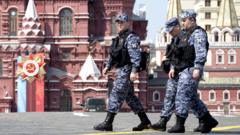
Russian National Guard officers walk across Red Square decorated for the Victory Day military parade in Moscow, Russia, on May 6, 2026.
For the first time in nearly two decades, there will be no military hardware at the Red Square Victory Day parade
A Victory Day sign is seen in the middle of Red Square in Moscow
One word dominates Red Square right now: "Victory".
The word Pobeda stares down from giant red banners. It flashes across video screens. Close by people are taking selfies beside an art installation that spells out the word.
stares down from giant red banners. It flashes across video screens. Close by people are taking selfies beside an art installation that spells out the word.
On the square, which is blocked off by metal barriers, soldiers are rehearsing for the annual Victory Day parade that marks the defeat of Nazi Germany.
Russia's national idea, constructed under Vladimir Putin, centres around the Soviet Union's victory in World War Two. The ninth of May has become Russia's most important national holiday.
But this year the 9 May parade is being scaled back. For the first time in nearly two decades there will be no military hardware on Red Square: no tanks, no ballistic missiles. Just soldiers.
The way in which the Kremlin will be remembering the past says much about present: it's a sign that Russia's war on Ukraine is not going to plan.
"Our tanks are busy right now," Russian MP Yevgeny Popov tells me. "They are fighting. We need them more on the battlefield than on Red Square."
"But with the war [on Ukraine] in its fifth year," I suggest, "not only has Russia not secured victory, but under pressure from Ukraine you're scaling back the parade. Some would say that's embarrassing."
"What other choice do we have?" Popov replies. "Nato countries, Ukraine and Great Britain's weapons, your king and your prime minister, are threatening us."
Yevgeny Popov, a Russian MP, says tanks are needed on the battlefield rather than on Red Square
Yevgeny Popov, a Russian MP, speaks to the BBC
In February 2022 the full-scale Russian invasion of Ukraine was President Putin's choice.
And more than four years on, the Kremlin chooses to continue the war while accusing the West of fuelling the conflict.
On Tuesday two people were killed and more than 30 wounded in a long-range Ukrainian missile and drone strike on the Russian city of Cheboksary. The previous night a drone penetrated Moscow's air defences and struck a luxury high-rise apartment four miles (6km) from the Kremlin. There were no casualties, but extensive damage to an upper floor.
The threat of Ukrainian drones over Red Square has been used to justify the paring back of this year's parade. President Putin's spokesman Dmitry Peskov has spoken of the "terrorist threat" from Ukraine. Russia's defence ministry has threatened to launch a "retaliatory, massive missile strike" on the centre of Kyiv if Moscow is attacked on 9 May.
Red Square is filled with installations and signs that read 'Victory!' in Russian
A sign near Red Square reads 'Pobeda!' meaning 'Victory!' in Russian, in large red letters.
In a side-street off Red Square I gauge public reaction. Do Russians care about an absence of tanks at this year's Victory Day parade?
"There is a safety issue," concedes Sergei. "But parading our military hardware shows our strength on the world stage. Perhaps we should be displaying something."
"I understand it would be foolish to showcase [hardware] in case something happens during the parade," says Yulia. "On the other hand, this means that we are afraid of something. And that's not great, either."
"The parade, of course, is a symbol," believes Vladimir. "But if circumstances don't allow it to take place in full, we'll have to wait a year for that."
A scaled-back parade, too, is a symbol: of a country that has failed to secure victory in Ukraine after more than four years of war. In January the conflict passed a milestone: Russia's war on Ukraine has gone on longer than the Soviet Union's fight against Hitler's Germany, which is known here as the Great Patriotic War (1941-1945).
Are there consequences for Vladimir Putin?
Recent polling – including by state-run agencies - suggests his domestic approval rating is falling.
Towards the end of last year, the Kremlin leader was on TV in military fatigues several times, oozing confidence, as he discussed the Ukraine war with his generals. We've seen far less of "Commander-in-Chief" Putin this year.
From my conversations with Russians, it feels like there is growing fatigue here with the war on Ukraine, increasing concern about the cost of living, and immense irritation with recent state-imposed restrictions on the internet.
Russian authorities have warned that on Victory Day in Moscow there will be restrictions on mobile internet: in the interests of security, they insist.
Officials claim that digital shutdowns, which have hit many Russian towns and cities in recent months, are designed to prevent Ukrainian drone attacks and acts of sabotage. But they are deeply unpopular across the country.
The authorities don't appear particularly bothered by that.
"It's not your business, with all respect, what we are doing with our internet," MP Yevgeny Popov tells me. "It would be better to be with no internet than to be killed by a Ukrainian missile or drone."
In the village of Rublyovo, two soldiers who have been fighting in Ukraine join a memorial for villagers killed during the Great Patriotic War
Russian fighters in a Victory ceremony in Rublyovo
In the village of Rublyovo near Moscow schoolchildren have gathered around the local World War Two memorial. They're laying red carnations in memory of villagers killed in the Great Patriotic War. The Red Square parade may have been scaled back, but there are ceremonies across Russia in memory of the 27 million Soviet citizens killed in the war.
Standing by the memorial are two masked men in military fatigues with medals pinned to their chests. They've been fighting in what the Kremlin still calls the "special military operation", Russia's war on Ukraine.
I get talking to one of the fighters. He likens the Ukraine war to the Great Patriotic War. I point out a key difference: in 1941 Russia was invaded by Nazi Germany; in 2022 Russia invaded Ukraine.
"Russia is a country of victors," he declares. "It always was and always will be."
Yet more than four years into this war, victory continues to elude his country.
A person is silhouetted against a glowing orange sky as they look at their smartphone, with the silhouette of the Kremlin in the background during sunset in the Red Square in Moscow on 31 March.
Steve Rosenberg: Kremlin's tightening grip on internet fuels Russian discontent
Russian service personnel march during a Victory Day parade on Moscow's Red Square. Photo: 9 May 2025
Russia scales back Moscow Victory Day parade, blaming threat from Ukraine
A Ukrainian serviceman practices with an assault rifle, on the right is a different image showing Jeremy Bowen in a blue press vest
Bowen: Why Ukraine remains defiant and does not feel close to defeat
Ukraine is considering a law that would effectively ban foreigners from accessing surrogacy in the country.
The road crossing is the latest sign of the deepening relationship between Pyongyang and Moscow.
After Ukraine's President Zelensky said territory had been captured using just robots and drones, what is the future of unmanned warfare?
Protests have taken place at the prestigious arts fair over the inclusion of Russia for the first time since the full-scale invasion of Ukraine.
Ukraine's president says Russia has "spurned the ceasefire" and Kyiv is deciding on further action to take.
People in the Ukrainian city of Oleshky say they have been cut off from fresh supplies of food or medicine for months.
Kyiv said it would begin a truce on 6 May and then "act symmetrically" after Moscow declared a pause for its Victory Day parade.
Hope and Aid Direct has sent more than 100 aid trucks to Ukraine since the conflict began in 2022.