
Development
NASA’s new Moon plan is taking shape, but some big questions remain
November 21, 2026 Development Source: Ars Technica
Share this article



Then, the astronauts will return to Orion and undock from Blue Moon to set up for a rendezvous and docking with SpaceX’s Starship in a slightly lower orbit, keeping it below most of SpaceX’s Starlink constellation. Orion will stay attached to Starship for just two hours, and the astronauts won’t enter the SpaceX vehicle.
NASA changed the plan for the Artemis III mission earlier this year, rerouting the flight plan from a lunar mission to a low-Earth orbit mission. This means the Artemis program’s first crewed lunar landing will be on Artemis IV, targeted to launch before the end of 2028.
So, why is Artemis III seemingly testing so much more with Blue Origin than with Starship? Creech told Ars a big reason is to maintain SpaceX’s focus on orbital refueling. Blue Origin no longer requires in-space refueling for Artemis landing missions. Also, SpaceX has extensive experience with life support systems with its Dragon crew spacecraft. Blue Origin has comparatively little.
“The bigger challenges for [SpaceX] were the prop transfer and getting to the uncrewed landing demo,” Creech said. “The thing that we’re going to learn more with Starship is, when we dock with Orion, they will have control of the attitude, control of the stack. That integrated stack control will be on the Starship side. So, with that huge of a vehicle, I think we’re going to learn more on that.
“With Blue, we’re going to have Orion control the stack for this mission,” Creech said. “When we get to a later mission, the Blue lander with fully loaded prop will have to control the stack. But with Blue, trying to mitigate risk, we’re going to have Orion do that.”
Artemis III will be Blue Origin’s first time flying a crew cabin for orbital spaceflight. Blue Origin has experience with suborbital space tourism, but those flights were brief and didn’t require the level of advanced life support necessary for longer durations. Blue Origin and NASA will emphasize those test objectives on Artemis III.
“I think SpaceX’s part was really, we need to focus on the docking,” Creech said. “If we added a crew cabin, that would slow us down on the other things and not add to what we’re already doing.”
“One of the things we added into the program in the last year is, we really felt like we needed a test of the three-engine configuration,” Creech said. The hotfire test of the three-engine Blue Moon propulsion unit will occur inside a vacuum chamber at NASA’s In-Space Propulsion Facility in Ohio.
What’s still not clear, however, is whether SpaceX will have to refuel Starship at an altitude somewhere above low-Earth orbit. A graphic presented by Jeremy Parsons, NASA’s Artemis program manager, last month illustrated this possibility with a “final tanking orbit” before Starship docks with Orion in high-Earth orbit.
“We’re still working that out,” Creech said. “We’re making progress, but where we actually rendezvous with Orion is still in trade, so that’s why you saw a little bit of fuzziness there.”
Starship’s elevator, for example, is not part of SpaceX’s uncrewed landing demonstration. Engineers will use a test lab at Marshall Space Flight Center in Alabama to check the elevator’s performance in a simulated lunar environment.
NASA did not initially require SpaceX or Blue Origin to prove their landers could take off from the Moon before a crew mission. Government officials later added the lunar takeoff requirement for each company’s uncrewed landing demos.
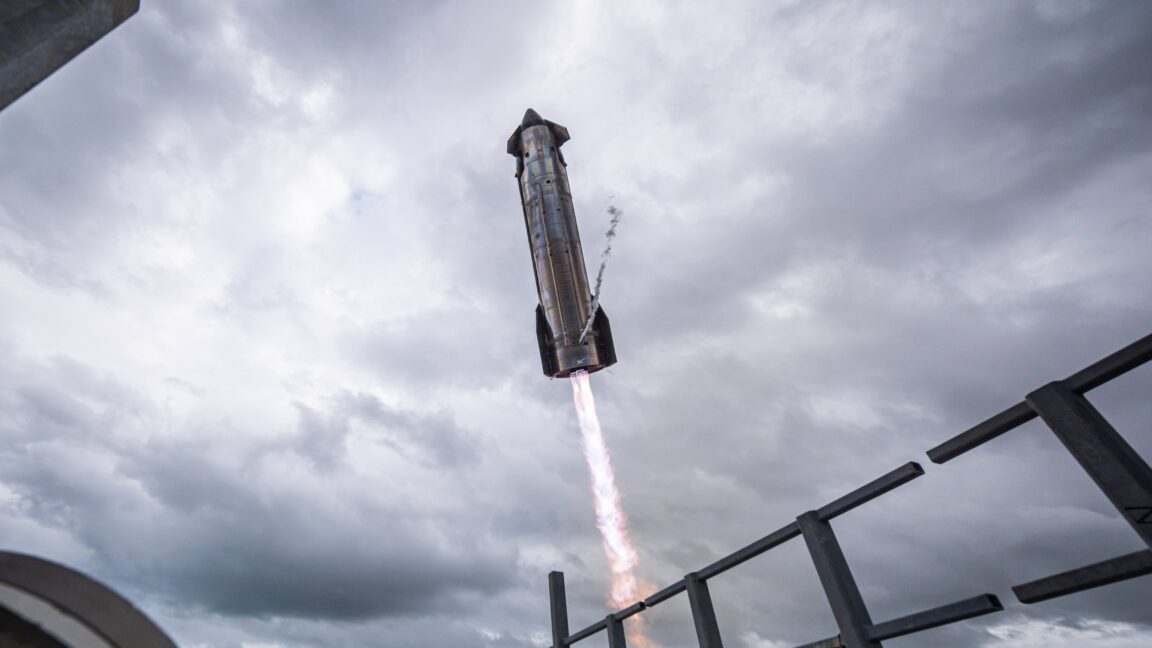
For Starship, orbital refueling remains the key to the Moon. SpaceX’s propellant transfer demonstration will involve two Starships, one launched from Florida and another from Texas, docking together in low-Earth orbit and transferring a “meaningful” amount of propellant from one ship to the other, Creech said.
“The first quarter of next year, we will see a long-awaited propellant transfer test from SpaceX, where they launch two Starships in pretty close proximity, actually dock, and transfer, we’re calling it a meaningful amount, of propellant,” Creech told Ars. “That is going to be a big learning point if they pull that off, because their architecture depends on propellant aggregation and multiple propellant flights.”
The propellant transfer test will mark the first time one spacecraft has offloaded a significant quantity of cryogenic propellants—in this case, methane and liquid oxygen—onto another vehicle in space. It is the culmination of decades of government and commercial research on cryogenic orbital refueling. The results will tell engineers how much of the propellant will be lost from boil-off during the transfer.