
Development
Watching as a giant star swallowed its neighbor and exploded
November 21, 2026 Development Source: Ars Technica
Share this article



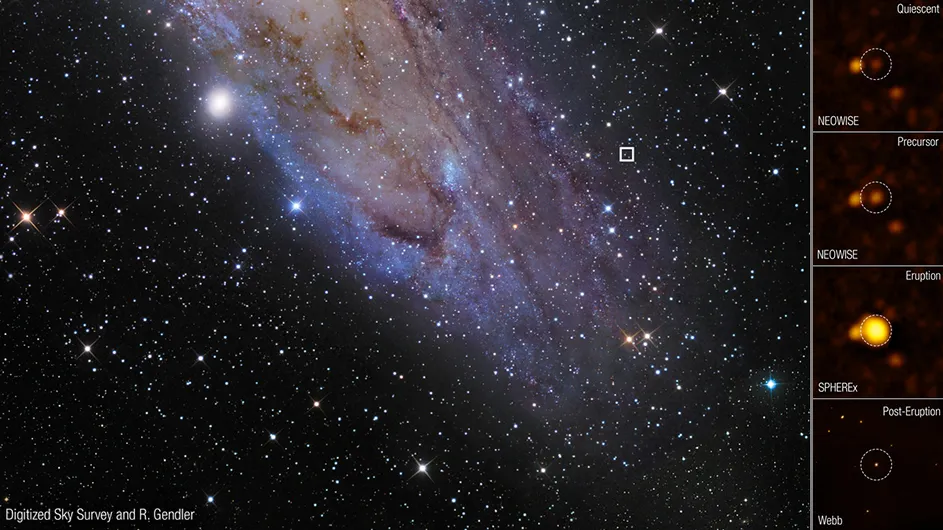
In April 2025, Karambelkar’s team published a paper suggesting that this system, named AT 2025abao, was undergoing an engulfment in progress. Back then, though, they couldn’t rule out a competing explanation: a single star with instabilities deep within its core. So, they kept watching.
The researchers reconstructed the history of the system using observations from about a dozen telescopes and surveys, going back to photographic sky plates from 1989. Until 2018, the star barely changed. Modeling those quiet years revealed a giant late in its life, about 350 times wider than the Sun. Its companion was impossible to see, however. “The giant star outshines the smaller star by a factor of about 18,000,” Karambelkar says.
To get around it, the team estimated the mass of the smaller companion based on the amount of dust the system had shed before the engulfment. The estimates suggested a star of roughly 0.7 solar masses.
Between 2018 and early 2025, the giant brightened two- to three-fold in visible light, swelling while its temperature stayed nearly constant. Karambelkar compares the process to a spacecraft reentering Earth’s atmosphere. The companion, skimming through the giant’s outer layers, was gradually seeing its orbit shrink, and the friction was heating up the envelope. The energy released by that drag matched the extra light the team observed.
Then, the star’s visible light dropped by half while its infrared glow kept rising. NASA’s SPHEREx space telescope happened to catch it in July 2025, revealing that the giant had swollen to some 860 times the Sun’s width and wrapped itself in fresh dust.
In October 2025, the star brightened roughly 100-fold in just 25 days, shining like 1.5 million Suns at its peak. “At one point, the rate at which the orbit was decaying became very, very fast,” Karambelkar says, going on to compare the release of the gravitational energy to an explosion. “The companion just fell very quickly, very deep inside the envelope of the star, and it crashed into the core. That violent crash set off a bomb inside the star, and that explosion caused it to brighten very quickly and eject some of the material.”
The eruption had all the hallmarks of a luminous red nova, a type of outburst known to come from merging stars—but an event the researchers weren’t expecting. “Honestly, our minds were blown,” Karambelkar says. He argues that this was the evidence that this explosion was a consequence of the inspiraling of a binary companion. What made AT 2025abao special, though, was the giant itself.
All previously known luminous red novae came from younger stars with dense, tightly bound outer layers, which inevitably drive both stars toward a merger. This one was an old giant with a loose, churning envelope—the setup that can also leave behind a surviving tight binary. To find out if the companion actually survived, the team looked at how AT 2025abao’s energy was spent.
The efficiency the team calculated fits values inferred from known post-engulfment binaries. But the formula assumes the energy is mostly spent expelling lots of the envelope. Here, most of it went into flinging a small amount of gas at high speeds. It turned out the formula works as a rule of thumb but misses some of the physics.
In AT 2025abao, gas shed during the slow spiral piled up in the plane of the binary’s orbit, so the explosion’s ejecta could expand freely toward the poles even though it was blocked around the equator. That, Karambelkar argues, explains the hourglass-shaped nebulae seen around dying stars. “It had been an idea for a very long time that those hourglass shapes are shaped by binary interactions,” he says. “It seems like what we’re seeing here confirms that hypothesis.”
The team admits it can’t yet be sure the stars merged, because dust formed from the ejected material hides whatever is left inside. “We want to continue monitoring the system for several years, possibly even decades, to watch the dust clear out and whatever is remaining inside emerge,” Karambelkar says. “That will conclusively tell us whether this merged or the binary system survived.” In the meantime, the team hopes to find many more such events involving stars of different masses and types.
Telescopes we have today can detect them only as far as Andromeda, but the Vera Rubin Observatory and the Nancy Grace Roman Space Telescope should spot them in about 100 Milky Way-like galaxies within some 50 million light-years. “We can have an influx of several of these events per year,” Karambelkar says.
Nature, 2026. DOI: 10.1038/s41586-026-11221-z