
Development
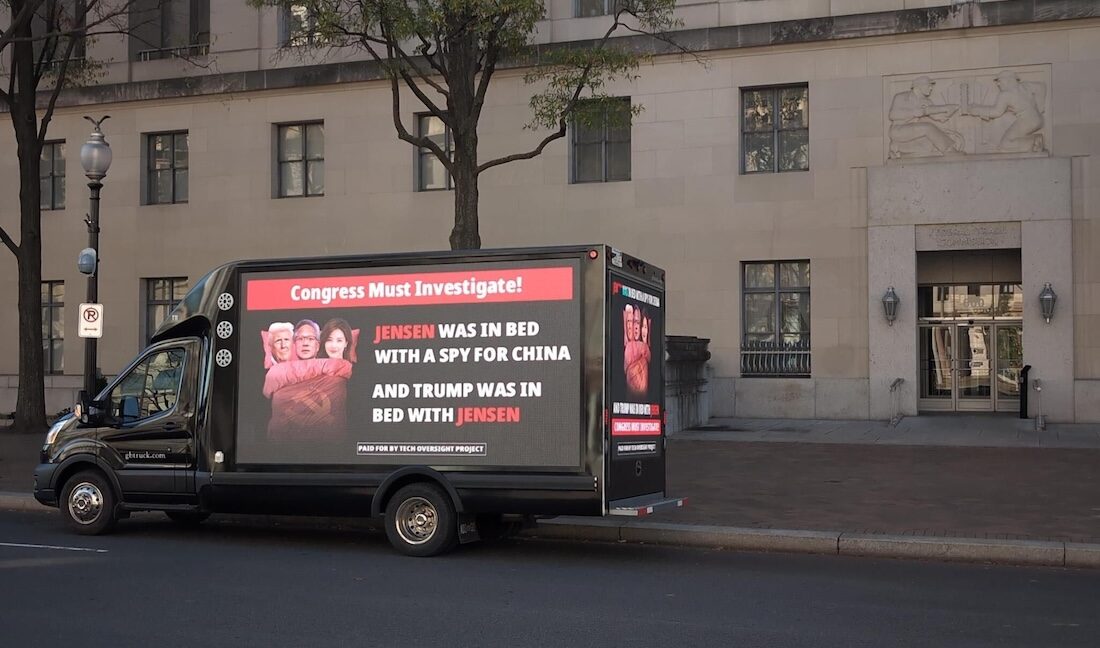
“Trump was in bed with Jensen”: Critics balk at Huang’s wish to return to Nvidia
November 18, 2026 Development Source: Ars Technica
Share this article



Instead of distancing himself from the Nvidia CEO, Trump invited Huang to sit at the head table during a state dinner with China’s president Xi Jinping, and last month, Trump awarded Huang the National Medal of Science, the nation’s highest scientific honor, for his AI achievements.
“Not only has he continued to do nothing, he’s invited that very CEO into the White House and on state visits to China with him,” Sacha Haworth, TOP’s founder and CEO, told Ars. “And the question we all have to ask is ‘why on Earth would he do that?’”
What Trump and Nvidia knew—and when—have become central questions for some Republicans, as well as top Democrats who plan to investigate the scandal when they assume control of key committees in Congress next year. Andrew Yoon, head of research for a nonprofit called CivAI, which warns the public of dangers from AI, told Ars that Huang doesn’t need to be compromised by China to have endangered the US. Prioritizing boosting profits over national security alone is “pretty concerning.”
“I think the most notable thing here is that Jensen Huang has been at the absolute forefront of lobbying to be able to sell chips to China,” Yoon said. “He has leveraged his very deep relationships with government, especially President Trump, in order to be able to sell as many Nvidia chips to China as he can get away with. If he could be selling Blackwell chips to China, I’m sure he would be.”
Yoon noted that evidence suggests some Chinese AI models have been trained on Blackwell chips. Even with China’s push to prioritize domestic chipmakers like Huawei, Nvidia chips remain “indispensable” to China’s frontier AI goals, Yoon said. And national security experts fear that access to high-end chips will help China advance its military AI or gain economic ground.
“The public is outraged by Nvidia’s CEO for compromising our national security, but we didn’t get here because of Jensen Huang’s missteps alone,” Haworth said. If “Nvidia was knowingly doing business with companies tied to illegal chip sales and smuggling with China,” then “the Trump administration was asleep at the wheel,” she said.
“White House AI Czar David Sacks and Commerce Secretary Howard Lutnick were protecting their own fortunes rather than looking out for Americans,” Haworth said.
If the US fails to hold them accountable for alleged conflicts of interest, “it would send a signal that powerful men once again cannot be held to account and that powerful men are protecting powerful men,” Haworth said.
Detailing Sacks’ alleged conflicts, the group cited New York Times reporting that the former AI Czar had long supported Huang’s stance that allowing Nvidia to sell more chips in China would help the US stay ahead in the AI race. After Sacks became Trump’s key AI advisor, Huang quickly forged a “tight bond” with him, and “both stood to benefit” from their push to sell chips to China, TOP reported.
Also notably, while advising the White House, Sacks opposed policies such as the Trump administration’s recent move to cut off China’s remote access to US-made chips through now-restricted Southeast Asian data centers. Citing Sacks’ alignment with Huang, TOP reported that after just one meeting with the two men, Trump decided to allow Nvidia to sell AI chips to China that the Biden administration had previously blocked.
Huang valued his alliance with Sacks, TOP noted, citing reporting that showed Huang declaring last year that Nvidia was “lucky” to have Sacks advising Trump. But TOP is concerned that the alliance was built on mutual financial interest and that Sacks took a part-time role in the Trump administration to avoid divestments or disclosure requirements that might have revealed the extent of his possible conflicts of interest.
TOP flagged two areas it believes warrant Congressional investigation. While advising Trump to embrace AI deregulation, Sacks and his firm, Craft Ventures, continued investing substantially in AI. Sacks also stood to benefit from pushing Trump to integrate AI into warfare and national security tools, TOP’s report said. Craft Ventures has invested in Palantir, “a Peter Thiel-founded government contractor seen as a ‘rising star’ in the US Defense Tech World and holding hundreds of millions in US government defense contracts,” TOP said.
However, when Trump was reportedly first told of the spying allegations this spring, Cantor Fitzgerald again continued to boost Nvidia. Most prominently, the company helped “finance the expansion of one of Nvidia’s newest business partners, IREN,” facilitating a five-year, $3.4 billion deal between Nvidia and the Australia-based cloud computing provider.
Among those now criticizing Lutnick for weak enforcement of export controls that appeared designed to protect Huang’s bottom line is Treasury Secretary Scott Bessent. But even with scrutiny coming from within the Trump administration, not everyone is convinced that Lutnick did anything wrong. Yoon suggested that, given Lutnick’s long career, there may be normal explanations for potential financial conflicts.
“Maybe a separate question is ‘should people with a long storied history in business and industry be working in government at this level?’” Yoon said.
Haworth said the next 48 hours will be critical in determining whether Huang succeeds in returning to Nvidia.
“I think it’s going to be incumbent on the incoming Democratic leadership to insist that whether or not he returns, investigations will follow,” Haworth said.
But Yoon thinks Nvidia is unlikely to bring Huang back any time soon, despite current evidence suggesting that “Nvidia’s actions here have been perfectly legal” and that “influencing a political system for your financial interests is very much legal in the United States.”
It seems “untenable for Nvidia to continue doing what they’re doing,” Yoon said. Zooming out even more, he suggested the scandal showed that the entire AI industry can no longer afford to operate under a profit motive alone, so long as governments continue positioning the technology as a strategic asset.
If US investigations expose corruption, bribery, treason, or other crimes, Nvidia risks losing some of its dominant stake in the GPU market. On Tuesday, the Information reported that some Nvidia customers had already lost trust and were looking to Google and AMD for more stability.
Nvidia has also been accused of intervening in a Commerce investigation, which Yoon said could also be “pretty consequential” if any evidence bears that out.
“I think it’s pretty unlikely that Huang makes it back to Nvidia any time soon,” Yoon said. “Maybe he goes on a redemption tour and comes back in five years or something, but I’m not really seeing a path forward for him right now.”