
Development
James Webb telescope finds ice older than the star it orbits
November 14, 2026 Development Source: Ars Technica
Share this article



According to theoretical models, ultraviolet radiation from the star can destroy small grains of pure ice faster than collisions can produce them. On the other hand, grains of dirty ice, mixed with other molecules, should survive longer.
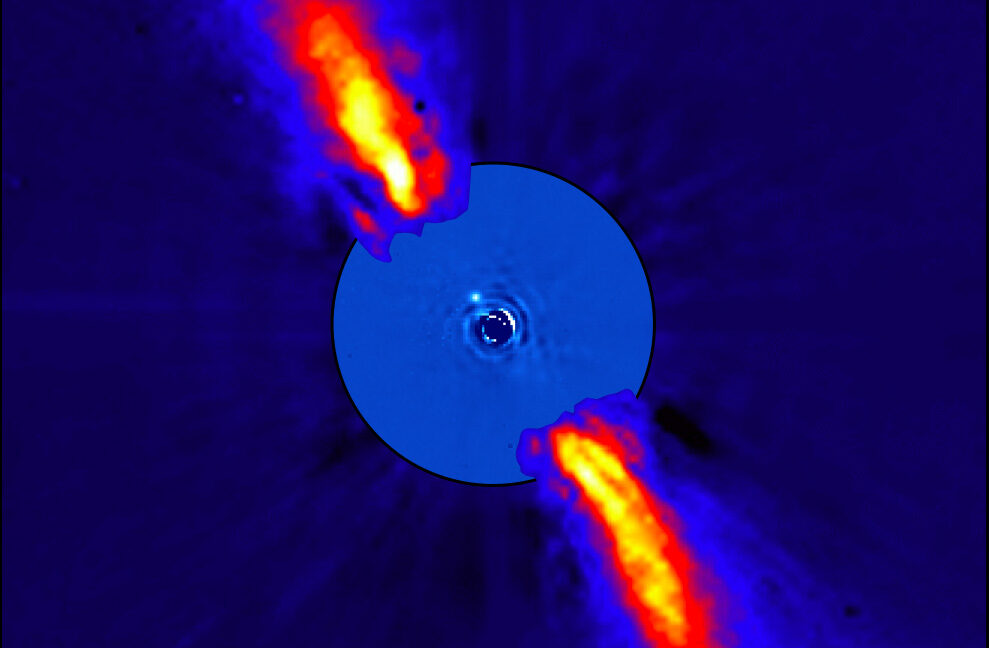
Betti and her colleagues observed Beta Pictoris on December 7, 2023, using Webb’s Near Infrared Spectrograph (NIRSpec). They operated it in a mode that records a full spectrum, from 0.6 to 5.2 micrometers, for every point in the image. After subtracting the overwhelming glare of the star, the team measured how much starlight the disk’s dust reflects at each wavelength to look for the fingerprints of ices.
Water ice absorbs light strongly near 3 micrometers, while carbon dioxide ice absorbs either at 4.27 micrometers or 4.39 micrometers when it contains the heavier carbon-13 isotope. The team first mapped the water ice features across the disk and found they were strikingly uniform. They then extracted detailed spectra from two spots on opposite sides of the star, each roughly 100 astronomical units out.
Both spectra showed water and carbon dioxide ices, the latter in both its common form and the rarer carbon-13 version. But the shape of those features turned out to tell us more than the fact they were there.
The structure of the water ice also pointed in this direction. When water freezes at moderate temperatures, its molecules settle into an orderly crystal lattice, and crystalline ice produces a sharp peak in the spectrum just above 3 micrometers. That peak was absent at Beta Pictoris. The ice is almost entirely amorphous, a disordered, glass-like solid that forms when water molecules freeze so fast and so cold that they stick wherever they land. The team estimates that less than 7 percent of the water ice in the system is crystalline, which is somewhat surprising.
Models predicted that ice in debris disks should mostly be crystalline. For amorphous ice to stay in that form, it has to remain colder than about 100 Kelvin, or minus 173° Celsius. Otherwise, something has to keep breaking up its crystal structure, such as high-energy ultraviolet light, cosmic rays, or particles streaming from the star. Either way, the researchers concluded the ice most likely formed in the interstellar medium, long before the planets of Beta Pictoris began to take shape.
The remaining question was how the icy grains got spread so evenly across the disk.
The team argues that this even ice distribution requires frequent collisions among planetesimals. Each collision would release fresh icy dust, including ice that had been buried and protected deep inside the colliding bodies, replenishing what the starlight destroys. We already have evidence that such collisions do happen. Earlier infrared images revealed a curved, lopsided streak of dust in the southwestern arm of the disk, thought to be debris from a violent collision a little less than halfway out from the star.
Betti’s team’s findings support the idea that the disk’s carbon monoxide gas comes from colliding icy bodies and offer an explanation of how ice can survive in an environment constantly exposed to ultraviolet light. What the team could not do is determine exactly how much crystalline ice is present or rule out other molecules hiding in the mixture.
But if a young planetary system 64 light-years away may have started with much the same icy ingredients as ours, then primordial, interstellar ice might be a common ingredient of planetary systems in general. This means the raw materials for water-rich, potentially habitable worlds might be common, too.
Science, 2026. DOI: 10.1126/science.adw7770