
Development
Specialized’s Tarmac SL9 S-Level is built to wreck your Zone 2 ride
November 13, 2026 Development Source: Ars Technica
Share this article



I rode the S-Level all around the Chicago suburbs as well as in central Illinois. Unlike the Diverge 4 Pro, I wasn’t able to test its climbing ability in the Rocky Mountains. All we’ve got in most of Illinois are short, punchy climbs … and a lot of long flats. I rode The S-Level on everything from freshly laid asphalt to freshly laid chipseal, including a couple of 60-mile-plus rides on the country roads downstate.
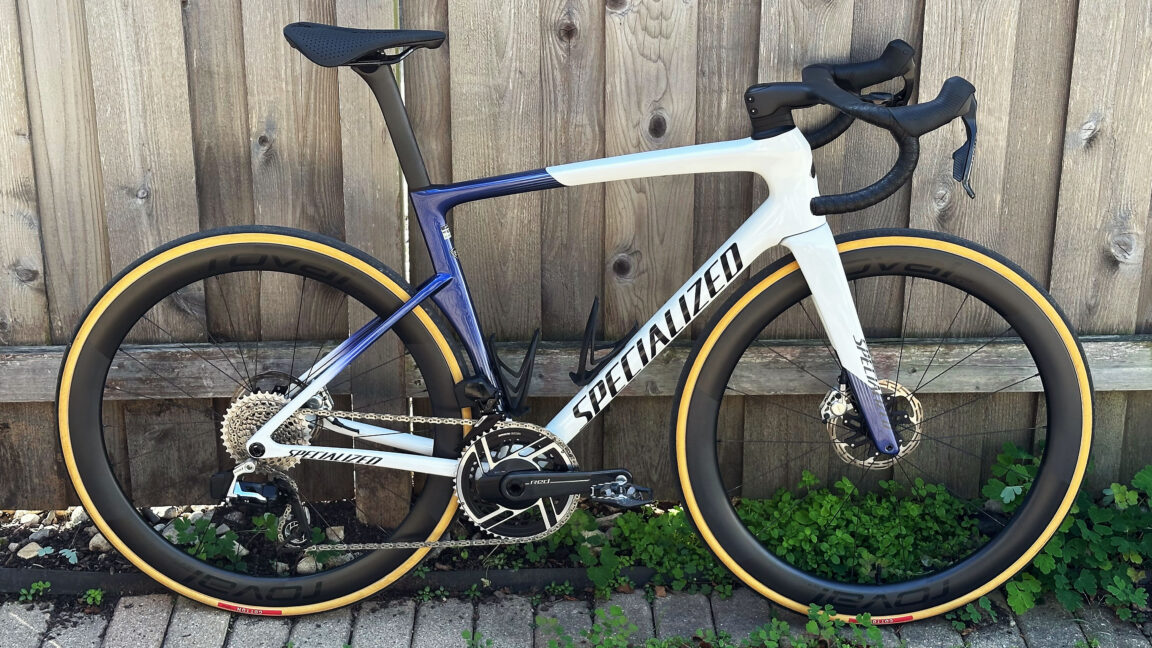
Visually, the S-Level is striking. The blue-on-white with gray striping is one of Specialized’s better-looking colorways. And it looks aerodynamic. Indeed, Specialized says the Tarmac SL9 is the most aerodynamic road bike it has ever made. Notable changes from the previous-generation Tarmac SL8 to SL9 involved tweaking the head tube, rerouting the rear hydraulic brake hose to accommodate the narrower head tube, and moving to a dropped-down tube for improved aerodynamics. But the most visually striking change is the Win Fin. As the seat tube rises from the bottom bracket, it deviates from the vertical to follow the curve of the wheel as it approaches the seat stays. When riding with just a single water bottle on the downtube—common in pro races where a full bottle is just a team car away—Specialized claims Win Fin saves riders half a watt.
On every surface shy of brand-new chipseal, the Tarmac felt comfortable and balanced, with the bike absorbing some of the punishment meted out by uneven pavement. Fresh chipseal is another matter entirely, as it feels more like gravel, which felt jarring on the SL9 S-Level. What was particularly impressive about the SL9 is how great it feels on long rides. Some manufacturers are skilled at building aero bikes that feel great on hours-long rides, and the Tarmac is just as good as the Trek Madone SLR 9 AXS Gen 8 I reviewed in this regard.
When you’re ready to drop the hammer, the S-Level is your willing accomplice. It’s twitchy in all of the good ways, with instantaneous response to the rider’s effort. The SRAM Red AXS groupset makes shifting buttery smooth (and the bonus buttons on the brake hoods allow the rider to change screens on the bike computer without releasing the brake hoods), and the drivetrain (50t/37t chainrings and a 10t-36t cassette) offers gear ratios for every type of terrain.
The first few seconds of a climb on the Tarmac SL9 S-Level feel like they come for free. Whether I stayed seated or cranked out watts in an upright position, there was no lag or flex as the bike snapped forward. Descents were amazing, and cornering on the S-Level is sublime—I felt balanced and in control at all times.
The 3D-printed Power Pro Mirror is a fine saddle, but there’s a reason I ride with a Specialized S-Works Power with Mirror on my Trek—it’s more comfortable and offers noticeably more padding around the cutout. And if I owned the S-Level, I’d move to 32 mm tires as soon as I wore out the 30s for better compliance.
Specialized brags that the Tarmac SL9 S-Works is the fastest bike ever made, and it claims the S-Level is the second-fastest bike ever made. I can’t speak to that claim, but the SL9 S-Level checks all of the boxes for an aerodynamic road bike. It’s lightweight, it’s fast, it’s responsive, and it’s great on rollers and punchy climbs. And it’s nice to get a SRAM Red groupset without springing for the absolute top-of-the-line model. $10,500 is a hefty sum for a road bike, but I’d be a lot more willing to forego the weight savings from the lighter components (frame, wheels, seatpost, bottom bracket, and bearings) of the S-Works—and spend $3,500 less. The real selling point, though, is how often it made me want to go harder just for the fun of it. That little imp has a point: Zone 2 can wait until tomorrow.