
Development
Democrats oppose plan to stack FCC with Republicans, plan probes of Chairman Carr
November 11, 2026 Development Source: Ars Technica
Share this article



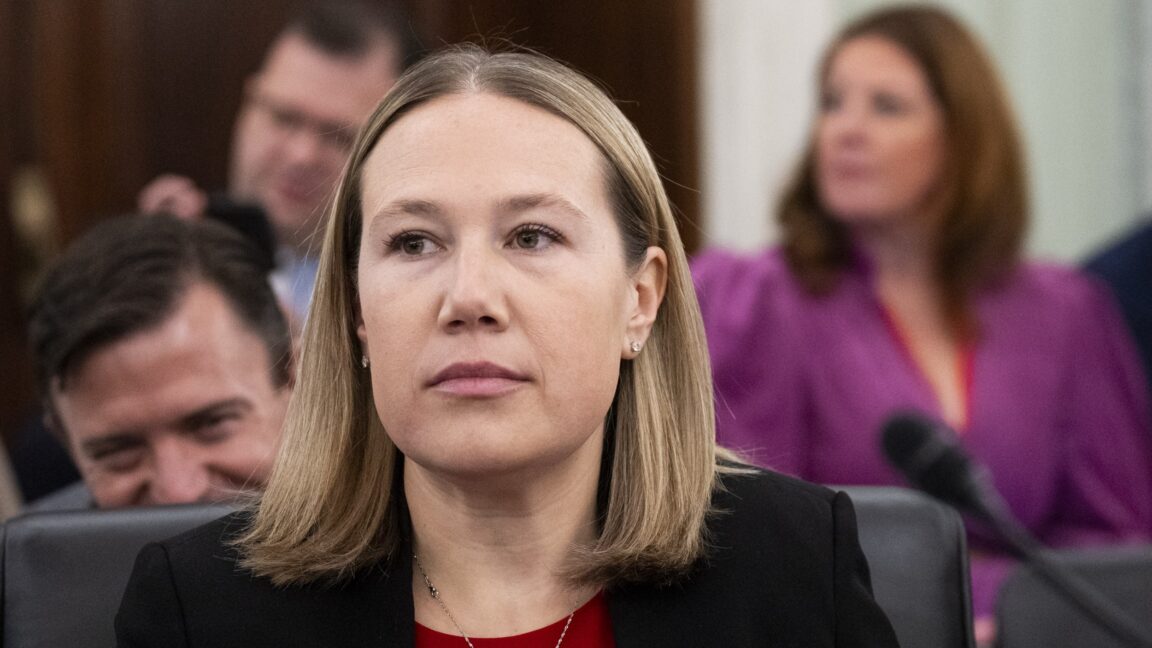
Markey accused Thumann Severs of evading questions about Carr threatening and taking actions against broadcasters on behalf of Trump. “Anyone seeking a seat on the Federal Communications Commission must be willing to stand up to such threats and to defend the First Amendment, and you’re not willing to do so here in your confirmation hearing,” Markey said.
Democrats similarly criticized Thumann Severs for not giving a clear answer on whether the FCC has authority to eliminate E-Rate, a $2 billion-a-year program that was created by Congress to connect students and library visitors to the Internet. Carr has proposed eliminating or scaling back the program. Thumann Severs said she helped Carr work on the E-Rate Notice of Proposed Rulemaking, which seeks public comment about the program and the FCC’s authority to change or eliminate it.
“I can’t prejudge the open proceeding [on E-Rate] at the FCC right now,” she said today.
Sen. Tammy Duckworth (D-Ill.) criticized Thumann Severs’ answers. “If you’re confirmed, you’re going to be one of the votes that decides whether the FCC stays an independent regulator, or becomes an arm of the White House press office. We deserve to know where you stand, and I am not comfortable with your answers today,” Duckworth said.
Duckworth told Thumann Severs that the FCC cannot eliminate E-Rate without Congressional approval. “We never directed the FCC to eliminate the program and frankly, at a time when the price of gas, groceries, and utilities is skyrocketing, the last thing the FCC should be doing is making it harder for schools to stay connected,” Duckworth said.
The Senate Commerce, Science & Transportation Committee held today’s hearing for Thumann Severs and three other nominees for federal positions. Senators have until Thursday to submit additional questions for the record, and nominees will have until November 16 to respond.
Thumann Severs needs approval from the committee and then the full Senate to be confirmed to the FCC. Committee Chairman Ted Cruz (R-Texas) is trying to get her approved before Republicans have to give up their Senate majority.
Thumann Severs would give Republicans an unusual 3-1 advantage on the FCC, which usually operates with a 3-2 split. Democrats criticized Republicans for not pairing her nomination with a Democratic one. The commission has only one Democrat, Anna Gomez, and she would have to leave at the end of 2027 if she is not given another term.
“For many decades, the Senate has paired commission nominees: A Republican and a Democrat moving together,” Sen. John Hickenlooper (D-Colo.) said. “Congress established the FCC as an independent, bipartisan agency… a bipartisan FCC is essential to avoid things like large-scale media consolidation, and I think also more fundamentally to protect a free and diverse press.”
Markey asked Thumann Severs if it was appropriate for Carr to use the FCC’s regulatory authority to pressure broadcasters into taking a comedian off the air. Markey was referring to an incident last year in which Carr threatened to revoke ABC broadcast TV licenses over remarks made by Kimmel, who was then suspended by ABC owner Disney.
“We can do this the easy way or the hard way,” Carr said at the time, adding that Disney must “take action” on Kimmel “or there’s going to be additional work for the FCC ahead.”
When asked about Carr’s comments today, Thumann Severs said, “Those were his words. They were not my words, and I have not advised him or worked with the chairman on these particular issues. I can say that if I were to be confirmed as commissioner, I would make all of my decisions [based on] the facts and the law and the record.”
Senate Democrats tried to get Thumann Severs to discuss Carr’s decision to order an early review of ABC station licenses. “Do you think the FCC should revoke broadcasters’ licenses because the president does not like their coverage?” Duckworth asked.
Thumann Severs answered that the FCC “has a responsibility to fully investigate any complaint… and to evaluate that complaint on the merits. I don’t think a decision should be made purely based on someone’s discontent with the content being aired.”
Although the ABC license review is widely seen as retaliation against the network for its news coverage and other programming, Carr’s proceeding is ostensibly based on an allegation that Disney’s diversity, equity, and inclusion (DEI) practices are discriminatory.
“Based on publicly available material, which is all I have seen on that particular matter, the licenses were called for early renewal as part of an investigation into potential rule violations,” Thumann Severs said today.
Cruz mentioned the Carr FCC’s review of ABC licenses and noted that “ABC argues [the review] is actually in retaliation for the network’s programming.” Cruz also alleged that in Democratic administrations, “the FCC has previously used its public interest standard as a weapon against conservatives.”
“If you are confirmed, will you commit to basing licensing decisions on the law and the record and to not using the FCC’s authority to pressure or punish a broadcaster for protected speech?” Cruz asked the nominee. She answered, “Yes.”
Cruz then asked Thumann Severs if she supports the JAWBONE Act, a bill that Cruz introduced with Sen. Ron Wyden (D-Ore.) to enable lawsuits against federal officials who try to coerce broadcasters or tech platforms into restricting speech.
Thumann Severs answered that she supports the bill. “I think it’s incredibly important that federal officials not use their position… to coerce against protected speech,” she said.
Cruz seemed satisfied with her answers. While Democrats recognized that Republicans have the votes to advance the nomination, they spent much of the hearing criticizing Thumann Severs’ answers and the Republican plan to confirm her without a paired Democratic nominee.
“We should not be confirming a Republican nominee without also renominating and confirming Anna Gomez, the Democrat, and filling the other vacant Democratic seat,” Markey said. “There is a potential next year where there will be three Republicans and no Democrats on the Federal Communications Commission… that is wrong, and that is why I do not believe we should proceed with this nomination at this time.”