
Development
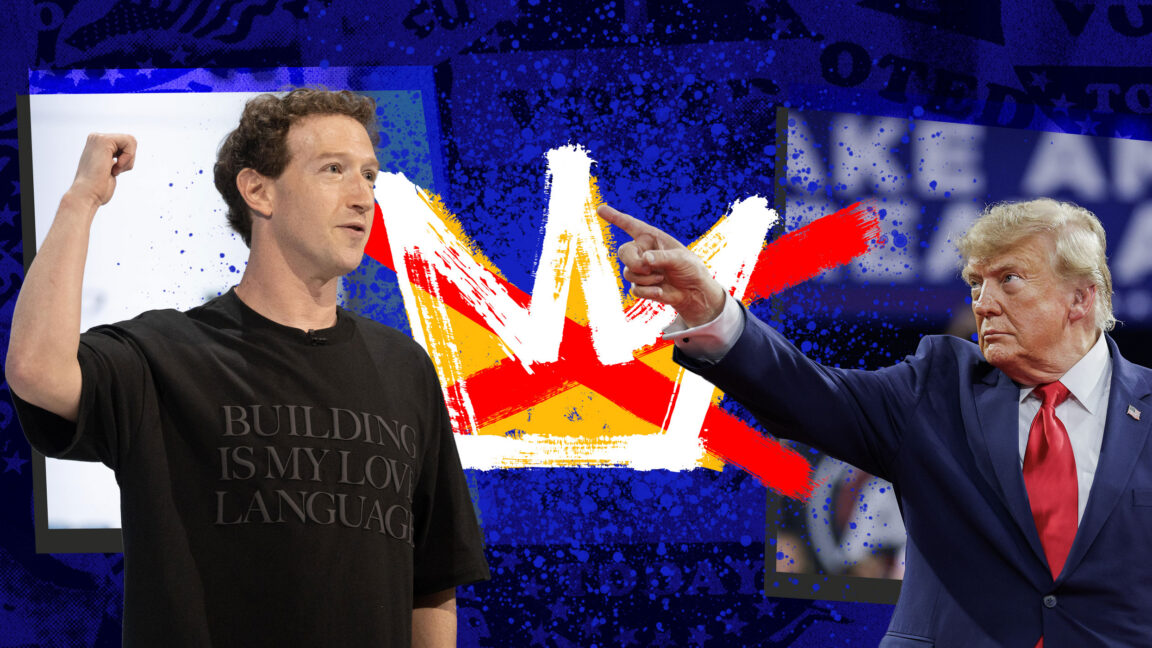
Trump wanted to give No Kings no air. Then, Meta suspended its Instagram.
November 3, 2026 Development Source: Ars Technica
Share this article



“Meta acknowledged that it made a mistake, but an apology without action does nothing to ensure that this kind of censorship won’t happen again,” No Kings said, calling Meta’s laissez-faire attitude “unacceptable.”
Ars has found no evidence that the Trump administration asked Meta to restrict the No Kings account or that anyone at Meta intentionally targeted the account for political reasons. Meta told No Kings that it planned to post a public reply to the coalition’s demands, but the company did not respond to Ars’ request for comment, and Stone has yet to post an update on X. His account did, however, apologize for another accidental enforcement action impacting a Republican-controlled account the day before the No Kings meeting. “We automatically removed the @MOSenateGOP Facebook account because our systems mistakenly assessed the account was impersonating another one,” Stone said.
“This was never simply about a technical glitch or one Instagram account,” No Kings’ press release said. “It’s about whether millions of Americans can rely on these platforms to organize, communicate, and access critical voting information without disruption.”
Formed in 2025 after Donald Trump returned to office for a second term, the No Kings Coalition is best known for organizing some of the largest coordinated protests in recent US history. Using social media channels to coordinate nationwide demonstrations against Trump policies viewed as anti-democratic, organizers estimated that more than 5 million people participated in its first protests in June 2025 and say attendance has only increased since. No Kings estimates 7 million people attended the second protests in October 2025, and more than 8 million showed up for the third demonstration last March.
Hundreds of civil rights organizations, including Black Voters Matter and the American Civil Liberties Union, make up the No Kings Coalition. Initially, there was no centralized Instagram account where the groups could coordinate their social media messaging. But as the November 3 election approached, the coalition got more organized, hoping that an official No Kings account with a large following would help it identify and amplify content ahead of the fourth event.
That’s when No Kings decided to use Claude as a “keyword and hashtag search tool to track conversations across social media platforms,” the group’s social media team told Ars.
According to Stone, the Claude tool was “reading profiles, posts, and hashtags,” which “sharply” increased the account’s activity in “intense bursts” that “resembled automated bot traffic rather than an ordinary human browsing our systems.”
Ars could not determine what specific Claude-powered tool the coalition was using, how it accessed Instagram, or whether it was an Anthropic service or a third-party integration built using Claude. Ars asked both Anthropic and Meta whether there was anything unusual about the way No Kings was using Claude, but neither company responded.
Ezra Levin, co-founder of Indivisible, a progressive nonprofit in the No Kings Coalition, told Ars that the volume of posting increases because organizers understand a basic principle of advertising: “You’ve got to reach people seven different times in seven different ways, and it’s the seventh time that they hear, and they’re like, ‘Oh right, there is an early vote action going on. I should get out there.’”
The high volume shouldn’t matter, though, Levin said, emphasizing that “it seems pretty absurd that a social media company that doesn’t go down during the Super Bowl or during the World Series or during the Oscars shuts our account down during an early vote push.”
“We’re not using any boutique tools that nobody has developed before,” Levin said. “These are all nonprofits. We’re putting things together with popsicle sticks and glue. We’re not developing our own sophisticated apparatus. So there is nothing that I’m aware of that is unique about how we were using the social media platform that day.”
Levin pointed to a series of episodes dating back to at least 2016 that raised questions about Meta’s role in protecting democratic processes. That year, Facebook acknowledged that it sold election-related ads to a shadowy Russian company. More recently, Meta faced questions from Congress in 2021 after turning off election-related safeguards and failing to detect “Stop the Steal” groups from gaming its algorithm to spread disinformation. After Trump’s 2024 election and shortly before his inauguration, Meta announced that it would end its US third-party fact-checking program. Zuckerberg also said Meta would work with Trump to push back against what he characterized as censorship by foreign governments. Critics warned that the move amounted to Meta declaring that “the truth doesn’t matter.”
To Levin, Meta’s playbook for handling controversies like the No Kings Instagram suspension is to lawyer up, offer technical explanations, and issue “empty apologies.”
Levin also pointed to Meta’s decision to donate $1 million to Trump’s inaugural fund and later $5 million for Trump’s ballroom project, which Levin said were blatant efforts to curry favor with the president.
Given what Levin sees as Zuckerberg’s alignment with Trump, he said it’s difficult for No Kings to accept that a technical glitch, rather than deliberate action by someone at Meta, was behind the suspension. Levin acknowledged that some posts that appear to be suppressed on Meta platforms may simply fail to get traction. But given Meta’s history with election content and its failure to make changes to protect pro-democracy content, he said, it’s difficult for outsiders to not be skeptical.
For example, Levin said Meta never acknowledged that at least one No Kings creator’s account was also suspended on the day the No Kings account was disabled. Other No Kings creators have reported that some Instagram posts seemingly receive no views.
“This is why the history does matter,” Levin said. “The context matters here because if I believed Meta to be a corporation that was operating above-board and was stridently pro-democracy and always erred in the defense of people organizing, I would say, ‘Look, it’s Meta. You know Meta, they wouldn’t do that. Probably there’s something else going on.’ But you would have to not have your head screwed on straight to believe that based on the publicly available information.”
Although four hours may not seem like a long time, any disruption that makes it harder for No Kings to reach people has a significant impact, Levin said.
“We are forced to use these platforms that are privately owned in order to reach these folks,” Levin said. “And in using the platforms, we are vulnerable to this kind of pressure, and that directly undermines our ability to reach these people.”
If the same thing happened “in the middle of election day, where pro-democracy accounts are suppressed or shut down,” that could be “cataclysmic,” Levin said.
David Greene, senior counsel for the digital rights group the Electronic Frontier Foundation (EFF), told Ars that the timing of the No Kings Instagram suspension is “suspicious” and that Meta’s technical excuse is “a really incomplete answer.”
As No Kings continues to demand that Meta release any communications with Trump, Meta also faces increased pressure from lawmakers and state officials to make changes to support accounts like No Kings during election day.
Last week, a coalition of 14 state attorneys general sent a letter to Meta demanding a more transparent explanation of the suspension. By October 29, they asked Meta to “detail its plans to ensure that legitimate election activity on Meta platforms is not disrupted.”
“This is particularly concerning given the proliferation of AI agents marketed to consumers, including by Meta, as compatible with social media accounts,” the attorneys general wrote.
Ars could not confirm whether the coalition’s deadline was met, but the attorneys general weren’t alone in expressing concern that Meta may be “unable to differentiate between legitimate political activity and bot activity that harms users” in the age of AI.
Democratic Maryland Senator Chris Van Hollen sent a similar request, The New Republic reported, specifically asking why it took so long for Meta to help admins regain access. In Congress, Robert Garcia and Jamie Raskin, members of the House Oversight Committee and House Judiciary Committee, also probed Meta for answers. Levin noted that these lawmakers could become future chairs of those committees if the elections swing No Kings’ way.
In Levin’s ideal world, “the next Congress” would “take a very different approach” to regulating the tech industry. He believes that could have significant consequences ahead of the next presidential election. Rather than seeing tech CEOs aligned with the executive branch, there could finally be a more “healthy” public debate, where “different presidential candidates” may adopt “different positions of their orientation towards Silicon Valley,” Levin said.
The EFF believes the Trump administration should disclose all its communications with Meta, but so far neither side is clarifying whether Trump may be influencing how Meta handles election-related content, Greene said.
Greene said it’s difficult to determine whether Meta was engaged in “jawboning,” with the Trump administration pressuring the platform to silence dissidents. However, “the explanation they’ve given is so inadequate that it’s hard to discount the [idea] that there was political influence,” he said.
And he agreed that a four-hour admin lockout was too long.
“Because as we know, when you’re organizing a protest, even if you shorten this to a three-minute delay from a three-hour delay, that could be consequential,” Greene said. “And so, the idea is to avoid these things in the first place.”
Kate Ruane, director of the Center for Democracy and Technology’s Free Expression Project, told Ars that Meta must explain not only why its automated systems flagged accounts like the No Kings Instagram account but also why the “mistake prevention systems” it designed to avoid such situations “were not triggered in this circumstance.”
Ruane noted that the CDT supports the JAWBONE Act, which “would require the government to be transparent with the public about communications from the government to online speech intermediaries related to the constitutionally protected speech they distribute.” If the next Congress passes that law, Meta could face greater scrutiny if questions about the No Kings suspension remain unanswered. Levin suggested that “a pro-democracy Congress” would send subpoenas, hold hearings, and use legislative processes to hold Meta accountable.
“Large-scale political speech events are frequently organized using Meta’s services,” Ruane said. “It is critical for users engaged in those activities to understand exactly what happened and how they and Meta can avoid it in the future.”