
Development
Scorpions go terminator mode and reinforce their weapons with metal
May 1, 2026 Development Source: Ars Technica
Share this article



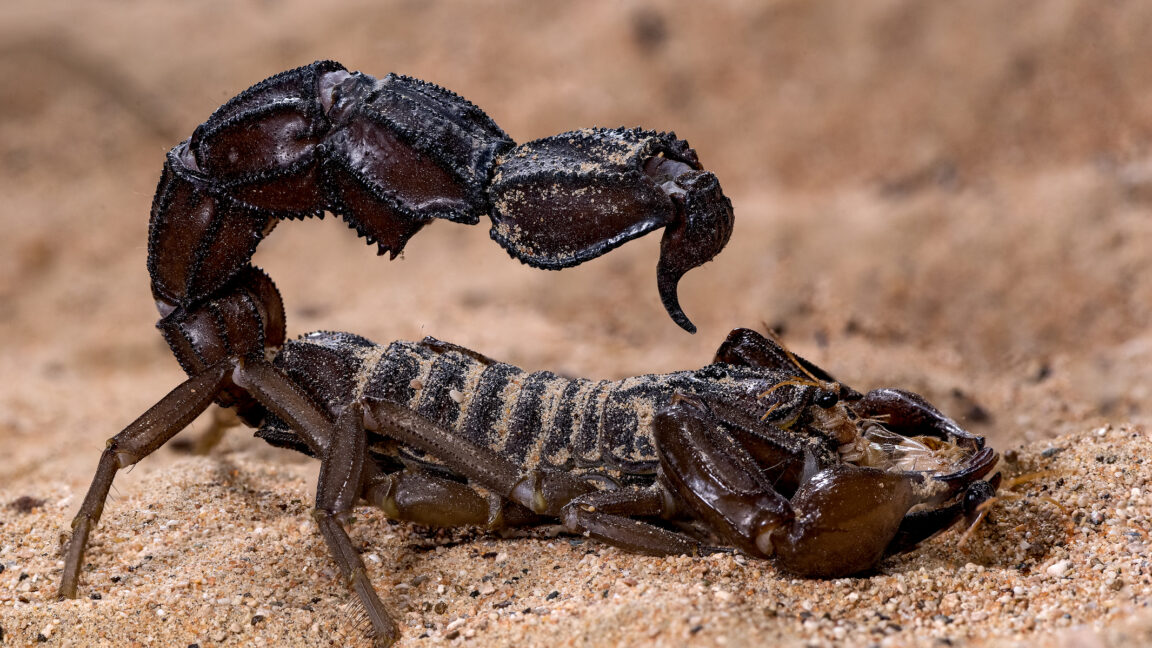
The purpose of manganese in the region below the aculeus, the team speculates, is probably to improve the flexibility and absorption of vibrations. Having both metals arranged in this way turns the stinger into a biological spear capable of punching through tough hides or exoskeletons of prey. “It makes sense because a scorpion’s sting is quite aggressive and produces quite a lot of force, so the stinger has to take it without snapping,” Campbell said.
The team noticed a similarly clever metal arrangement in the pincers. Zinc and iron enrichment was present only in the granular rows of the chela, specifically in the jagged, tooth-like bumps called denticles on the movable outer segment. The layout resembled a samurai sword, where the hardest material is concentrated mainly along the cutting edge. “When these denticles, these teeth pop up, we see the enrichment and then, in the entire area around them, all the rest of the claw, there is no metal whatsoever,” Campbell said.
But when Campbell and his colleagues took a deeper dive into species-to-species variations in the scorpions’ weaponry design, they encountered yet another layer of complexity. “One of the things that made me want to do this investigation is that scorpions are all very different,” Campbell said. “They have different sizes and shapes of their pincers and their stingers, and there are significant differences in their behavior.”
The team wanted to learn whether these differences are reflected in scorpions’ patterns of metal enrichment in their weaponry. It turned out they are.
Going into the study, the team hypothesized that pincers built for generating high crushing force would contain the highest levels of metal to provide maximum hardness, while enrichment in the weaker, slender pincers would be lower. While this held true for zinc, the correlation was the exact opposite for iron.
“The reason we suspect this is the case is that, rather than providing hardness to the claw, the iron enrichment has more to do with abrasion resistance,” Campbell said. When a scorpion with large beefy pincers hunts, it can usually just crush its victim outright. Scorpions with long, slender claws need to hold onto a wrestling, fighting prey for longer to give the venom from their stings time to start working. As for zinc, the enrichment in the chelae was greater in species with reduced crushing power, most likely to compensate for their morphological weakness.
Another finding of the study was the inverse correlation between zinc uptake in the stinger and the claws. If a scorpion species has highly zinc-enriched pincers, its stinger is relatively zinc-poor, and vice versa. “It’s not that they just choose to reinforce one weapon over the other,” Campbell said. “I think this is an evolutionary drive toward reinforcing the weapon that is used the most.”
Still, there are some weapon design problems that evolution failed to solve and questions we have not yet answered. “One of the really interesting things that you see in scorpions in the wild is that their stingers can actually snap,” Campbell said.
The point at which the stingers usually snap, the researchers say, is at the zone where zinc enrichment at the tip abruptly stops and transitions into manganese. “It’s quite an interesting weakness for them to have in that region, and I don’t have a real theory or answer to why it is so,” Campbell said.
One idea the team floats is that zinc and manganese are limited resources, so scorpions can only reinforce the most critical parts of the stingers instead of spreading the metals across their entire exoskeleton.
Going deeper into the reasons behind what appears to be a design flaw in an otherwise neatly built stinger is one thing Campbell wants to focus on in the future. But the team thinks there’s more to learn.
“We were using museum specimens, and we only picked one from each species,” Campbell said.
The downside of this approach is that the study did not capture variations in metal-enrichment patterns between different individuals of the same species. These variations, Campbell acknowledged, may be significant in scorpions, which in general have strong sexual dimorphism—females are typically much bigger than males.
Another angle the study did not cover is whether metal enrichment changes across the scorpions’ lives. Scorpions undergo several molts, shedding their exoskeletons to grow and transition into a new stage, or instar. “There was a study that showed in the first instar, when the scorpion is born, there is no metal enrichment,” Campbell said. “The metal starts to come to the stingers by the second instar.”
The challenge in answering questions like these, Campbell thinks, is that scorpions are notoriously difficult to study. They are nocturnal, they often live in deserts, and they burrow underground.
“We don’t 100 percent know what their behavior is,” Campbell said. “It would be good to make true correlations between what we observe in the wild, how they interact with their environment, and what we find in their exoskeletons in the lab. That would be a huge, huge study to try.”
The team’s study on metal enrichment in scorpions’ weapons is published in the Journal of The Royal Society Interface: https://doi.org/10.1098/rsif.2025.0523