
Development
China's top-secret spaceplane can't hide in low-Earth orbit
October 28, 2026 Development Source: Ars Technica
Share this article



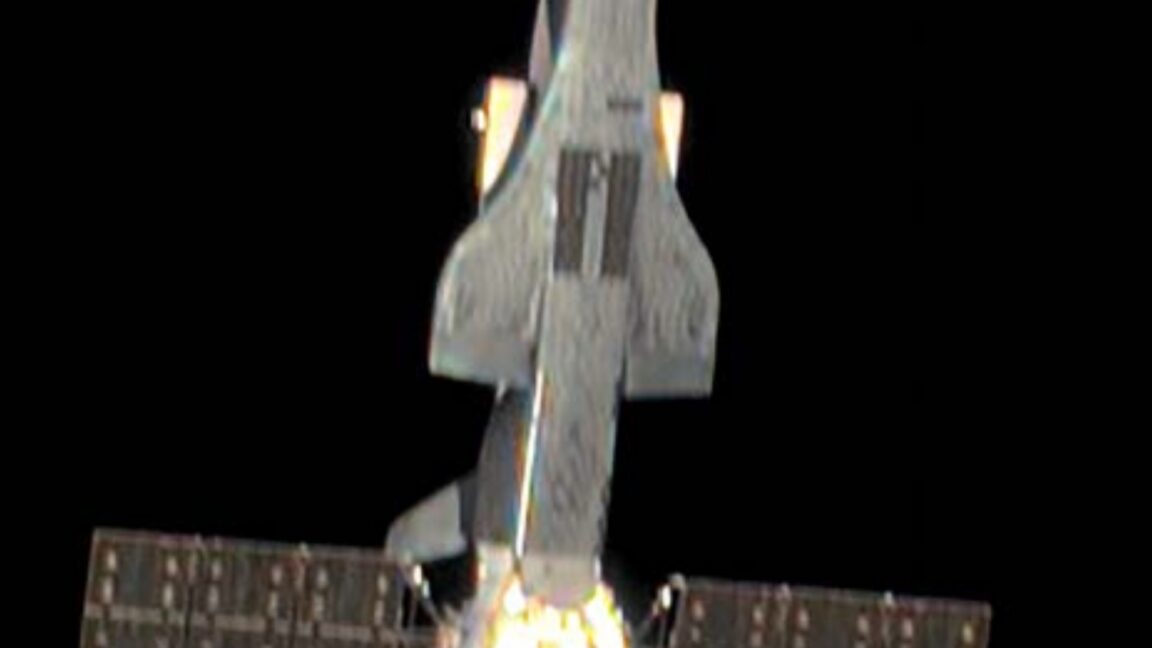
Like the X-37B, China’s spaceplane lifts off inside the payload shroud of a conventional rocket, then operates as a satellite once in orbit. The spaceplane flies like a miniature unpiloted version of NASA’s Space Shuttle and reenters the atmosphere for an autonomous land runway landing at the end of each mission. Ground teams then refurbish it for another flight.
The “enhanced maneuverability” of spaceplanes make them “more suitable for certain missions than traditional satellites,” the DIA said in its report. So far, the Chinese spaceplane has only flown in low-Earth orbit (LEO) at an altitude of a few hundred miles. One of the Space Force’s X-37B flights soared to an altitude of more than 24,000 miles before using aerobraking to set up for reentry and landing.
Spaceplanes like China’s and the X-37B can also deploy small satellites from their cargo bay. Most recently, China demonstrated an ability to catch an object in orbit, perhaps using a robotic arm. The vehicle now in space released a sub-satellite in June and recaptured it in July, then did the same thing again in August and September, according to an analysis of open source orbital tracking data by Jonathan McDowell, an astrophysicist who catalogs spaceflight activity.
The capability exhibited by Maxar and other commercial companies in the NEI field is distinct from the recent actions of some military spacecraft, such as Russia’s Kosmos 2612, which deliberately maneuvered to approach a US-registered radar imaging satellite earlier this month. Commercial NEI observations come from chance encounters, often at extremely high speed.
The DIA’s assessment of space threats includes an update on China’s pursuit of anti-satellite technology, or “counterspace” weapons. The intelligence agency reported the Chinese military likely considers directed-energy weapons (DEWs) “ideal counterspace systems” because they can be used to permanently or temporarily disable a satellite. One potential use for lasers in space would be to dazzle a sensor on an adversary’s satellite.
“China has multiple ground-based laser weapons with varying power levels to disrupt, degrade, or damage satellites in LEO,” the DIA said. “By the late 2020s, China may field space-based directed energy systems and higher-powered ground-based directed energy systems capable of threatening satellites in higher orbits.”
The DIA noted China’s testing of ground-based anti-satellite missiles and the country’s historic demonstration last year of satellite refueling in geosynchronous orbit, a regime some 22,000 miles (36,000 kilometers) over the equator, something no other country has achieved above LEO. China has also tested a robotic arm that could snag a spacecraft out of orbit, and now operates a growing fleet of satellites called TJS that routinely approach foreign spacecraft.
The US Space Force also has a constellation of inspector satellites in geosynchronous orbit and recently procured more that could be refueled, overcoming maneuverability limitations. Air Force Secretary Troy Meink revealed last month that the Pentagon has fielded weapons in space, making the United States the first nation to acknowledge possession of orbital weapons.
Russia is pursuing its own orbital combat program, which includes an ambition to deploy a nuclear weapon in space, according to US intelligence officials.
A more conventional Russian weapons system, known as Nivelir, is designed to fire projectiles from one satellite to smash into another. The Russian military simulated an attack using the Nivelir system in 2020. In April, Russia launched a fleet of small satellites into an orbit close to a commercial radar remote sensing satellite owned by ICEYE that provides reconnaissance imagery to Ukraine. One of the Russian satellites moved within “tens of meters” of the ICEYE satellite earlier this month before backing away, US officials said.