
Development
Rocket Report: Falcon Heavy is back; Russia's Soyuz-5 finally debuts
May 1, 2026 Development Source: Ars Technica
Share this article



If they’re ever built… SBIs are widely seen as the most challenging and expensive element for Golden Dome, but they may not be the panacea administration officials argued for when President Donald Trump signed the executive order for Golden Dome in January 2025. Gen. Michael Guetlein, director of the Golden Dome program, suggested SBIs for boost-phase missile intercepts, which Trump’s executive order originally called for, may not be built. “We are so focused on affordability. If we cannot do it affordably, we will not go into production,” Guetlein said in a hearing before the House Armed Services Strategic Forces subcommittee earlier this month. “We are looking at the threats from a multi-domain perspective to make sure I have redundant capabilities and I don’t have single points of failure,” he added. “So, if boost-phase intercept from space is not affordable and scalable, we will not produce it, because we have other options to get after it.”
Cloaked launch schedule… Since the reported drone incursions, the Russian government put a tighter lid on information about its launches from Plesetsk. Authorities typically publish airspace warning notices called NOTAMs advising pilots to steer clear of a rocket’s flight path and downrange drop zones where spent booster rockets fall back to Earth. These NOTAMs usually cover a few minutes to a few hours for a primary launch date, and perhaps a backup date in the event of a delay. The notices accompanying the most recent launches from Plesetsk covered much longer time periods, with daily windows of up to 10 hours over up to 14 consecutive days. This makes it more difficult to pin down when a launch will occur ahead of time.
FAA tells launch companies it’s time to pay up. The Federal Aviation Administration is ready to begin collecting user fees for the first time for commercial launches and reentries, which could generate millions of dollars annually, Space News reports. The legal foundation for the user fees was signed into law last year by President Donald Trump as part of the “One Big Beautiful Bill Act,” which called for the FAA to phase in user fees over eight years, beginning in 2026. The money will go into a trust fund to help pay for the operating costs of the FAA’s commercial space office. The FAA will assess the user fee as the lesser of two amounts. For 2026, that fee is 25 cents per pound of payload, capped at $30,000 per launch or reentry. The FAA will retroactively charge launch and reentry operators for fees accrued since the beginning of this year.
SpaceX will pay most… The company most impacted by the user fees will be SpaceX, which owns and operates the vast majority of US launch and reentry vehicles. Based on the assessment of 25 cents per pound of payload, SpaceX initially would pay a fee of between $9,000 and $10,000 for each of its Falcon 9 launches carrying Starlink Internet satellites. The fee rate will increase over the next eight years, with the maximum fee reaching a cap of $200,000 in 2033. The funding will be used by the FAA to improve integration of launches and reentries into the national airspace system.
Atlas V launches again for Amazon. United Launch Alliance completed its second Atlas V rocket launch of the month Monday, marking the company’s fastest turnaround between two Atlas V missions from the same launch pad at Cape Canaveral, Florida, Spaceflight Now reports. It beats the previous record by nearly three days. Onboard the Atlas V rocket was a batch of 29 Amazon Leo satellites. This was ULA’s sixth flight delivering production versions of Amazon’s broadband Internet satellites to orbit and its seventh overall, including the two demo satellites launched on the Protoflight mission in October 2023.
The end is near… This was the 108th launch of an Atlas V to date. ULA is hitting a stride with the Atlas V rocket as the company’s new Vulcan launch vehicle remains grounded due to a booster anomaly on its most recent flight in February. But the Atlas V program is winding down, with hardware for just eight more Atlas Vs in ULA’s inventory, including two more for the Amazon Leo constellation. ULA is on contract to launch 38 Vulcan rockets to deploy satellites for the Amazon Leo network, but those missions are on hold pending the investigation into Vulcan’s solid rocket motor problem. (submitted by EllPeaTea)
Ariane launches for Amazon, from the Amazon. Less than three days after the Atlas V launch from Florida, another cluster of 32 Amazon Leo satellites rode a European Ariane 6 rocket into orbit from the Guiana Space Center in South America, European Spaceflight reports. The rocket launched in its Ariane 64 configuration that features four solid-fuel boosters. The first of the 32 satellites was separated from the rocket’s upper stage just under an hour-and-a-half after liftoff. All 32 satellites were deployed over 12 separation events lasting roughly 25 minutes in total.
Hitting a cadence… Arianespace has been contracted by Amazon to carry out a total of 18 missions supporting the deployment of its satellite constellation, which is intended to compete with SpaceX’s Starlink global broadband network. Arianespace has indicated that it plans to launch up to eight Ariane 6 flights in 2026, a significant portion of which will be dedicated to working through its backlog for Amazon. (submitted by EllPeaTea)
Miles to go… The upper stage is currently not reusable, so each new build will equate to one launch. Blue Origin has a long way to go before achieving 100 New Glenn flights, and doing it within three years sounds overly optimistic. The company has a lot on its plate with development of a human-rated Moon lander for NASA, a standardized spacecraft bus and space tug called Blue Ring, and other lesser known projects. The New Glenn rocket’s current upper stage, with two BE-3U engines, failed on the most recent launch earlier this month. But Blue Origin has talented engineers and deep pockets thanks to its owner Jeff Bezos, so it’s worth taking the goals seriously. Money solves many, if not all, ills.
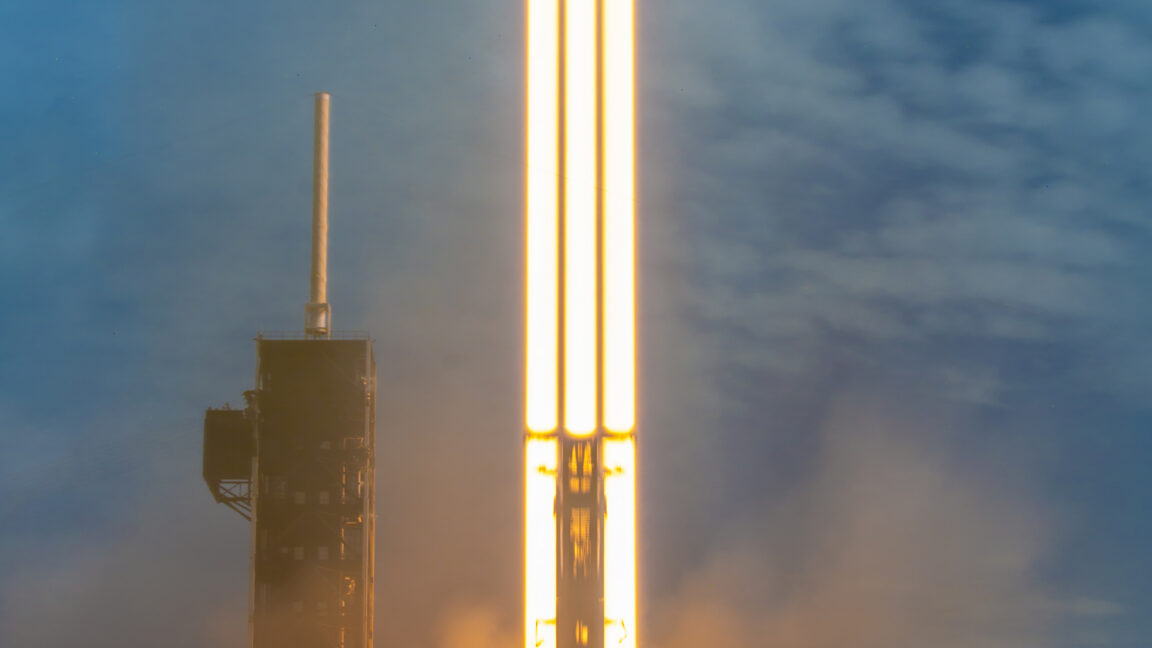
Welcome back, Falcon Heavy. A triple-core SpaceX Falcon Heavy, the company’s most powerful operational rocket, blasted off from Florida Wednesday, boosting a ViaSat Internet satellite into space, the company’s third in a globe-spanning fleet of high-speed broadband relay stations, CBS News reports. Along with putting the ViaSat-3 satellite into its planned preliminary orbit, the rocket’s two side boosters, heralded by competing sonic booms, executed on-target touchdowns on separate pads at the Cape Canaveral Space Force Station after boosting the vehicle out of the dense lower atmosphere. It was the 12th flight of a Falcon Heavy rocket since the booster’s maiden launch in 2018 and the first since October 2024 when SpaceX sent NASA’s Europa probe on the way to Jupiter.
A healthy backlog… Despite the long gap between flights, SpaceX has quite a few Falcon Heavy missions planned over the next few years. The next one is set to launch NASA’s Nancy Grace Roman Space Telescope from Florida in September. Another Falcon Heavy will launch a commercial lunar lander for Astrobotic, perhaps toward the end of this year. SpaceX has at least a dozen more Falcon Heavy flights on contract through the end of the decade. (submitted by EllPeaTea)
Artemis III core stage arrives at KSC. The largest piece of hardware for NASA’s Artemis III mission arrived at Kennedy Space Center, Florida, on Monday after a trip by barge from its factory in New Orleans, Florida Today reports. Ground teams at Kennedy offloaded the core stage—still lacking its engine section—from the barge Tuesday and transferred it inside the Vehicle Assembly Building. There, technicians will install the core stage’s four RS-25 main engines and prepare the rocket for stacking.
Next year, maybe… NASA hopes to launch Artemis III next year on a mission to Earth orbit. The astronauts on Artemis III will perform rendezvous and docking tests in orbit between NASA’s Orion crew capsule and one or both human-rated lunar landers developed by SpaceX and Blue Origin. The agency’s administrator, Jared Isaacman, told lawmakers on Monday that SpaceX and Blue Origin say they could have their spacecraft ready for the Artemis III mission in Earth orbit in late 2027, somewhat later than NASA’s previous schedule of mid-2027. If Artemis III flies next year, NASA hopes to follow it with a human lunar landing attempt in 2028. (submitted by EllPeaTea)
May 1: Falcon 9 | Starlink 10-38 | Cape Canaveral Space Force Station, Florida | 17:35 UTC
May 3: Falcon 9 | CAS500-2 rideshare | Vandenberg Space Force Base, California | 06:59 UTC
May 6: Falcon 9 | Starlink 17-29 | Vandenberg Space Force Base, California | 02:00 UTC