
Development
Russia cloaks launch schedule after spaceport falls in Ukraine's sights
May 1, 2026 Development Source: Ars Technica
Share this article



Three months earlier, in December, local Russian news outlets reported another attempted drone attack at Plesetsk. This one reportedly occurred around the time of the launch of a Soyuz-2.1a rocket on December 25 with a radar observation satellite designed to provide Russia’s government with all-weather reconnaissance imagery.
Special military operation is Russia’s official euphemism for the country’s invasion of Ukraine. A Russian diplomat in 2022 suggested that civilian satellites, such as Starlink, used by Ukraine could become “legitimate targets” for Russian retaliation. Perhaps, then, it is no surprise that Ukraine has its sights set on the Plesetsk Cosmodrome.
Since the reported drone incursions, the Russian government put a tighter lid on information about its launches from Plesetsk. Authorities typically publish airspace warning notices called NOTAMs advising pilots to steer clear of a rocket’s flight path and downrange drop zones where spent booster rockets fall back to Earth. These NOTAMs usually cover a few minutes to a few hours for a primary launch date, and perhaps a backup date in the event of a delay. US and Chinese authorities release similar notices for their space launches.
“Some of the warnings contain a mix of coordinates for impact zones of both rockets,” Hendrickx wrote on SeeSat-L, a long-running online forum of satellite and launch tracking enthusiasts. “This may have been done deliberately in an attempt to cover up the dual launch scenario. As has been the case for other launches from Plesetsk this year, the launch periods and daily launch windows in the navigation warnings are unusually long and most likely don’t entirely correspond to the actual launch windows.”
The overlapping warning notices “created the impression that they were for a single launch,” Hendrickx told Ars.
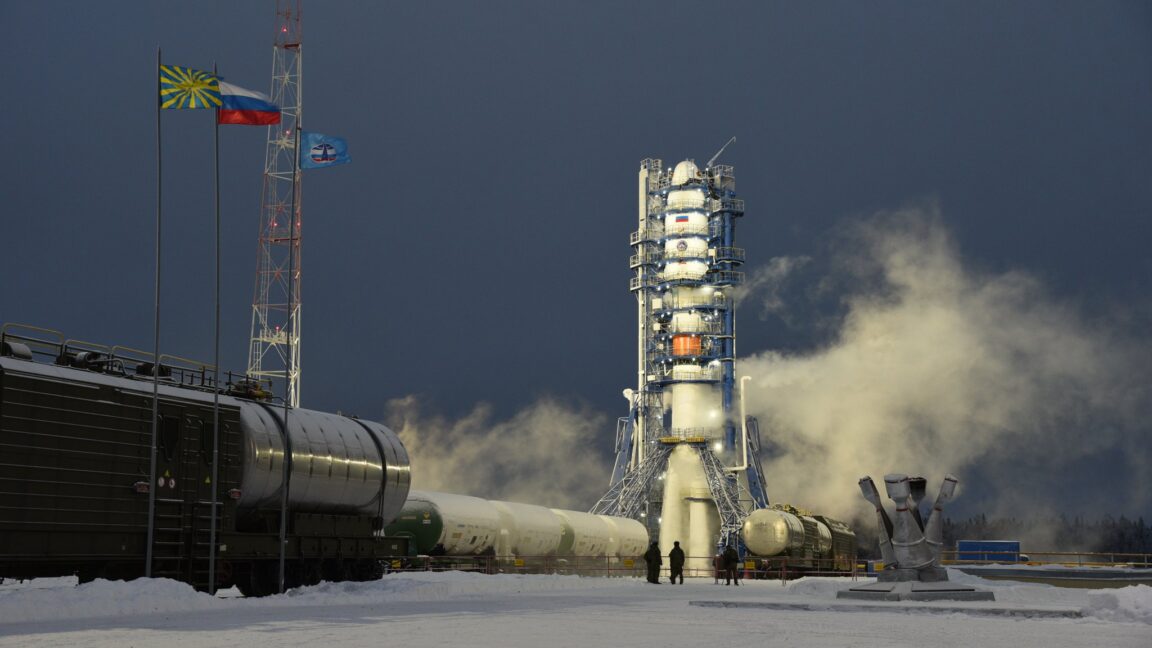
The first of these two cloaked launches departed from Plesetsk on April 16, when a Soyuz-2.1b rocket placed eight classified Russian military satellites into orbit for an unknown purpose. A week later, on April 23, a smaller Angara-1.2 rocket launched from the cosmodrome with a quartet of suspected military spy satellites. Russian government officials announced the launches and posted photos of them after confirming their success.
Plesetsk’s first few months of 2026 have been the busiest period for space launches at the cosmodrome since 2022. Dozens more launches will be required to fully deploy the Rassvet constellation, which Russian officials say will number 900 satellites by 2035. Russia’s Nivelir anti-satellite missions also launch from Plesetsk, the primary launch base for Russia’s military space program.
Seasoned observers of Russia’s space program might question if the drone attacks are a ruse to add another layer of secrecy over Russia’s launch activity at Plesetsk. But Russian officials continue to announce launches after they occur, and, in any event, US and other foreign intelligence agencies keep a close watch on Plesetsk. And Ukraine’s ability to strike fortified locations inside Russia is well-known.
“Bakanov didn’t literally use the words ‘Ukrainian drone attack’ (too shocking for Putin?), but that’s clearly what he was referring to,” Hendrickx told Ars. “I see no reason why the Russians would lie about these drone attacks, the more so because Putin himself was briefed about at least one of them.”