
Development
Stratospheric airship flew from US to Japan to test sky cell tower concept
October 19, 2026 Development Source: Ars Technica
Share this article



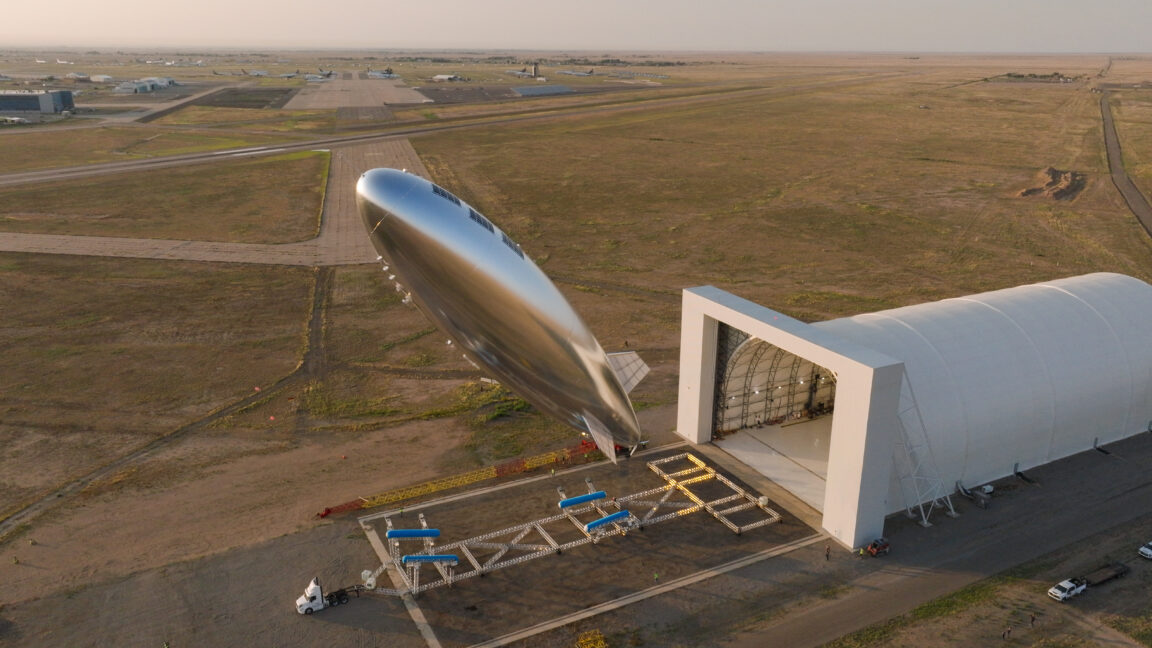
The lighter-than-air platform has also benefited from advances in material sciences that “were either not discovered or not understood back in the late 1990s,” Frandsen said. He highlighted the example of the discovery of graphene in 2004, which “greatly helped us optimize strength relative to weight on our hull, the energy density of our batteries, and performance relative to the area and weight of our solar panels.”
The design could eventually scale up to a high altitude platform system (HAPS) capable of lifting payloads as heavy as 551 pounds (250 kilograms). That would be between 25 and 50 times more payload capacity than competing stratospheric platforms such as high-flying drones, according to Helena, a US nonprofit organization with a for-profit investment arm that has invested in Sceye.
Sceye’s current platform has already done multiple flight demonstrations with payloads exceeding 220 pounds (100 kilograms) and can provide up to 1 kilowatt of onboard power capability for any devices that it may be carrying.
A heavier payload and higher power capacity opens the door to bigger mission possibilities, such as someday using a single Sceye platform hovering in the stratosphere to provide mobile broadband coverage equivalent to 500 ground-based cell towers. That may prove useful for both enhancing commercial telecommunications services and providing emergency coverage during disaster scenarios.
The capability was first used during a previous 12-day flight from New Mexico to Brazil. But the monthlong mission to Japan and back—dubbed Service Test 1 (ST1)—was the longest test flight and deployment yet for Sceye’s platform.
“There were times when our actual plan trajectory and flight path was disrupted by a change in the weather,” Truong told Ars. “So what it would do was actually just park itself at a safe, quiet place in the weather and just station-keep a while until it moved on.”
The Sceye-supported connectivity passed testing in all three scenarios, although Truong acknowledged initially being unsure about whether the indoor test would succeed. Sceye’s team had decided not to run Sceye’s communications antenna at full power to minimize potential interference and to play it safe with local regulators.
For a separate edge computing experiment, a server aboard Sceye’s platform let SoftBank demonstrate an average roundtrip data-processing response time of 68 milliseconds. That supposedly represents a 40 percent reduction in latency compared to standard Internet-based cloud processing times.
“You need those three layers to work together to make sure that nobody’s left behind, but also to make sure that you can get to the real-time services that are the promised land of 6G,” said Frandsen.
This could also provide additional resiliency for global communications at a time when the Internet’s undersea backbone of fiber-optic cables linking continents and islands faces greater threats from deliberate sabotage—not to mention accidental cable cuts from weighted fishing boat nets and ship anchors.
“You’ve seen stories where there’s a dispute and a boat for some reason forgets to raise their anchor and they suddenly take out that ocean cable,” Truong said. “Now you don’t have to worry about that because everything’s wireless… that leads to resiliency from an operational perspective.”