
Development
The Surface Laptop Ultra delivers on most of Microsoft's promises
October 16, 2026 Development Source: Ars Technica
Share this article



With a starting price of $2,599, this is not a budget alternative to Apple silicon. This is bleeding-edge hardware, and you’re going to be paying a premium for it. Depending on your selected processor and memory options, MSRP can reach as high as $5,899. Prospective buyers should note that the lower-specced 24GB unified memory model ships with Windows 11 Home, while the rest of the fleet arrives with Windows 11 Pro. I received the 64GB model for testing, and I think that would probably be the sweet spot for a lot of users to align cost and performance.
I really have to wonder if 24GB is enough to go around when we know that Windows 11 is memory-hungry on its own. When you have to assign a significant portion of that 24GB of unified memory to VRAM for gaming, does performance suffer? An audience question inside the Surface Laptop Ultra review information session asked about the usefulness of the base model, and didn’t get much back other than a vague “useful for smaller models locally” answer. Microsoft may have a more definitive answer to that question a few months from now when software and drivers catch up with hardware.
So has the Microsoft and Nvidia team-up created the ultimate all-in-one laptop? Or is this the industry once again putting the hardware hype cart before the finished-software horse?
The graphics bench tests sing when given access to 40GB+ of usable RAM. These results certainly back up Microsoft’s claims that the Surface Laptop Ultra can handle modern AAA gaming. It just takes some different paths to performance than we might be used to.
The AI benchmark was a bit of a miss. I don’t have the ability to run an NPU-accelerated benchmark in Geekbench AI, because the software presumably doesn’t currently have a compatible NPU backend for this unique architecture. Curiously, Windows does list a generic NPU under Display Adapters in Device Manager, but Geekbench AI only offered the ONNX CPU testing path. It’s unclear whether the generic NPU listed by Windows is a virtual device, some sort of driver exposure, or something else entirely.
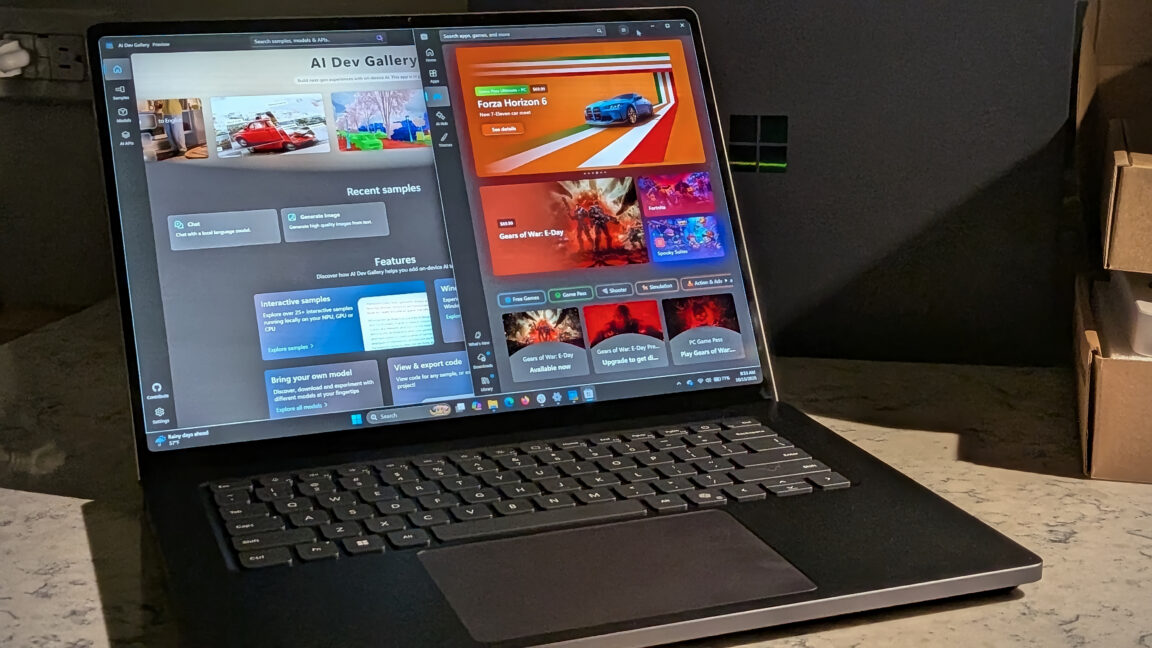
The problem isn’t the laptop’s hardware, but everything currently sitting on top of it. Microsoft’s own AI Dev Gallery still feels half-baked, with a limited selection of small models mostly tied to the CPU. Phi Silica, the flagship LLM, is still gated behind developer registration. The Copilot+ features are still to come at a later date, which might be this year or next. None of these are fatal flaws on their own; this thing is still prelaunch at the time of writing after all. But taken as a whole, you start to see a pattern. PCs are being rushed to market with the new RTX Spark chipset so that manufacturers at least have something new to offer for the 2026 holiday season, with software left to play catch-up later on some non-specific date.
So who is the Surface Laptop Ultra really for? If you’re a CUDA developer who favors portability and needs to test local AI models on the fly, and you happen to have an extra $2,599–$5,899 in your back pocket, this is genuinely exciting hardware. For everyone else? I’d advise patience. Take a pause to see how the software matures before jumping ship from your MacBook Pro.
Has Microsoft and Nvidia’s partnership delivered the ultimate all-in-one PC? Not yet, but they have delivered the first ARM laptop I’ve used that makes the question worth asking—now the horse just needs to show up.