
Development
Trump commercial railing against his enemies kept airing after court blocked it
October 14, 2026 Development Source: Ars Technica
Share this article



In the previous Trump administration filing opposing the motion for a temporary restraining order, one of the government’s arguments was that a court order was unnecessary because the ads would not run past October 11. It said:
DHS issued a purchase order to obtain media services from a vendor in support of U.S. Customs and Border Protection (CBP) for placing national media buys. The vendor has currently purchased media buys under the terms of the purchase order through tomorrow, October 11, 2026. DHS has directed the vendor not to make any additional media buys past October 11, and DHS has no plans to make any additional media buys under the purchase order or otherwise use appropriated funds on any similar contracts for the creation or distribution of the media that is the subject of this lawsuit. Accordingly, the alleged offending conduct will end tomorrow, and Plaintiffs therefore will suffer no harm, let alone irreparable harm, absent an injunction.
The Washington Post reported yesterday that the ads kept running after the restraining order took effect. Nonprofit advocacy group Common Cause and other groups that sued the government submitted a filing later in the day notifying the court of the government’s noncompliance.
The Trump ads continued airing on programs including 60 Minutes, ABC World News Tonight, and America’s Funniest Home Videos. They ran nearly 400 times after the restraining order took effect, including 32 times on Monday, according to AdImpact data cited in the plaintiffs’ court filing.
“Plaintiffs do not presently seek contempt sanctions,” the groups said. “But given that the ads have continued to run on October 12—the day after Defendants insisted the ad-buy was no longer effective—Plaintiffs request a status conference to determine Defendants’ compliance.”
Rochon found that the plaintiffs are likely to succeed in their claim that the Trump administration violated the 2026 Consolidated Appropriations Act requirement that no funding may be used “for publicity or propaganda purposes within the United States not heretofore authorized by Congress.”
“Defendants do not contest that the at-issue advertisements are purely partisan and unconnected to DHS’s official functions,” Rochon wrote. “Thus, the Court finds that Moving Plaintiffs are likely to succeed in showing that the advertisements are impermissible ‘publicity or propaganda’ under Section 718 [of the Consolidated Appropriations Act].”
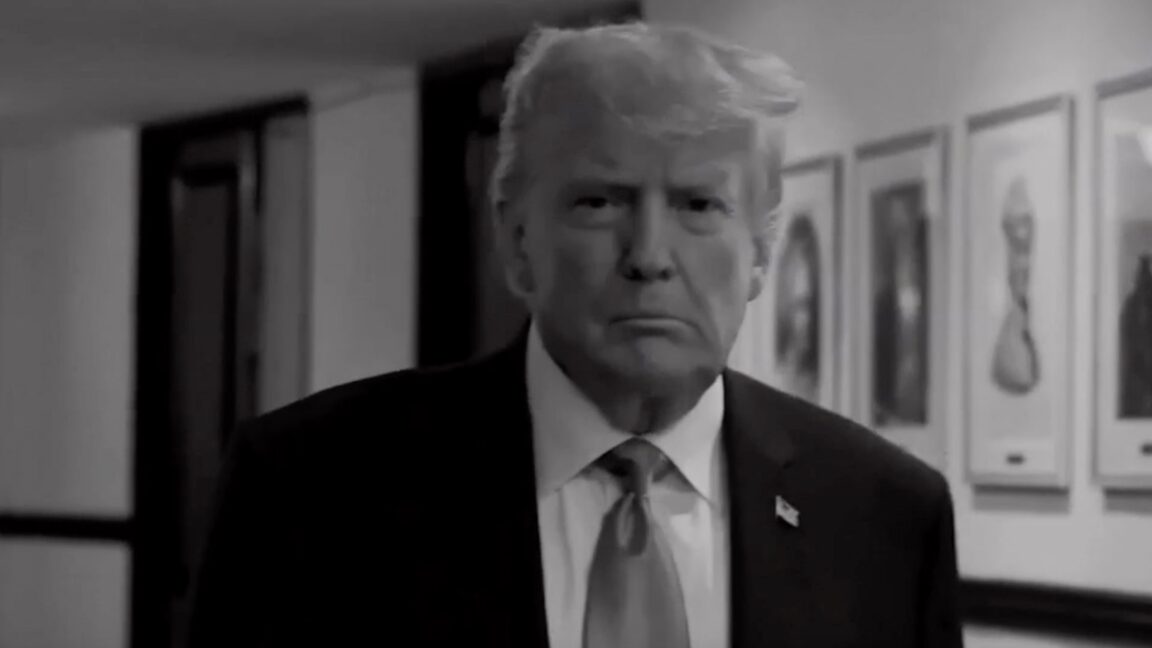
One of the ads “is almost identical to one used during President Trump’s 2024 campaign, other than the fact that its funding disclaimer now identifies the United States government rather than his presidential campaign,” Rochon wrote. “It depicts President Trump walking down a hallway while delivering a series of statements about his political adversaries. Among other things, he promises to ‘demolish the deep state,’ ‘drive out the globalists,’ ‘cast out the communists, Marxists and fascists,’ ‘throw off the sick political class that hates our country,’ and ‘rout the fake news media.’ This advertisement provides no information about DHS’s official functions.”
As of October 8, the ad “had aired approximately 9,679 times, generating an estimated 972 million impressions at an estimated cost exceeding $9.09 million,” Rochon wrote. Another $6.3 million was estimated to have been spent on four other government-funded ads challenged in the lawsuit. That’s about $15.4 million as of October 8, and more was spent over the next few days.
Rochon found “a clear and substantial likelihood” that the Trump administration violated the Administrative Procedure Act “because Congress did not appropriate funds for DHS to spend on disseminating the challenged advertisements.” Rochon said a restraining order was necessary despite the DHS claim that it had “no plans” to continue running the ads.
“Defendants also have not provided reasonable assurances that OMB will not reapportion funds from another source to continue running similar advertisements,” she wrote.
The temporary restraining order is in place for only two weeks, but it can be converted into a preliminary injunction that would keep the ads off the air while litigation continues. Trump, the White House, OMB, and DHS face a similar lawsuit filed by the Democratic National Committee in the federal court in the District of Columbia. A hearing on a motion for a temporary restraining order in that case is scheduled for Thursday.