
Development
Neutrino physicist wins 2026 Nobel Physics Prize
October 6, 2026 Development Source: Ars Technica
Share this article



“Halzen had the audacious idea that you could turn an enormous volume of naturally occurring Antarctic ice into a telescope for neutrinos,” said American Institute of Physics CEO Michael Moloney. “He then led the decades-long effort that turned that idea into IceCube, which now provides an extraordinary window on the universe and some of its most distant and energetic phenomena. This prize highlights one of the great recurring stories of physics: When we find a fundamentally new way to observe nature, we often discover entirely new questions that we didn’t previously know how to ask.”
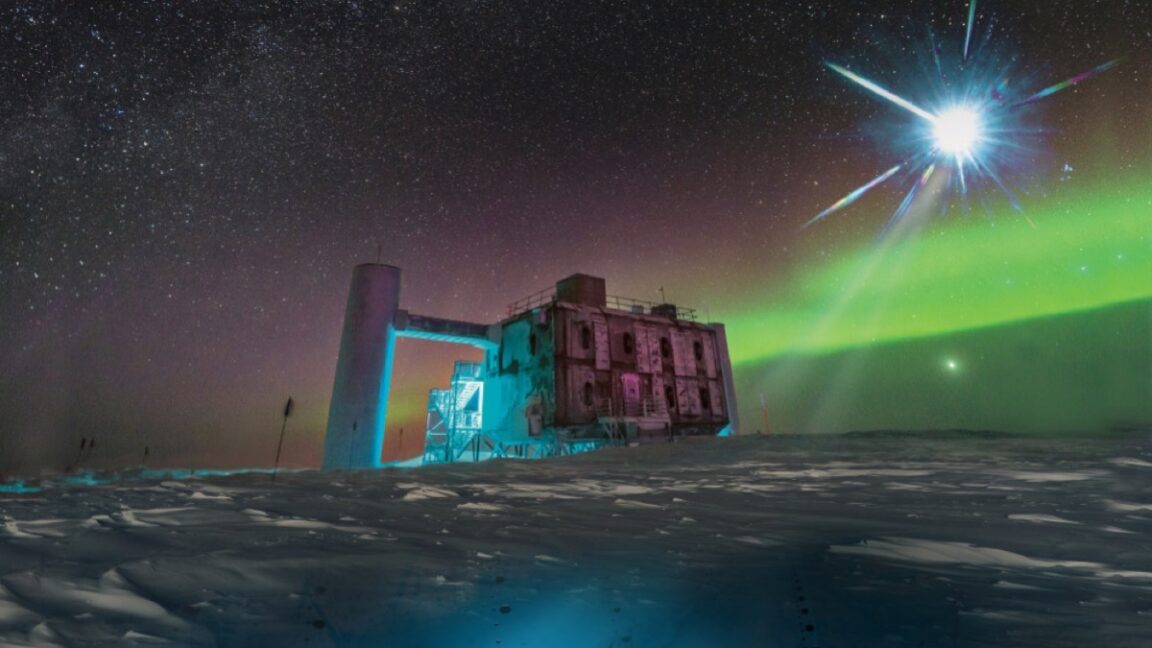
That didn’t make it an easy feat to embed the instruments deep in the ice. After conferring with glaciologists, Halzen and his team opted to create kilometer-deep holes using a hot water “drill” to melt the ice, then lowered a long cable with strings of light sensors into the hole.
The first neutrino observatory at the site was called AMANDA. The initial results were disappointing since the upper part of the ice had so many bubbles that the light diffused and blurred any relevant information about neutrino trajectories. But the ice was very pure below 1400 meters. However, AMANDA didn’t cover sufficient volume to reliably detect neutrinos, so IceCube eventually took its place.
“Our attitude was ‘let’s study the ice, let’s design a hot water drill, let’s see if it works,’” Halzen told the American Physical Society last year when he won the APS Medal for Exceptional Achievement in Research. “The ice had to be clear, the drilling methods we developed at Madison had to work, and we had to be able to reject backgrounds. We started small, and to our own amazement, we overcame all these hurdles. And suddenly, we had the tools to build a kilometer cube detector. In the almost 40 years of this AMANDA/IceCube adventure, nobody ever told us that this was uninteresting. It was really a question of the technology.”
Credit: ©Johan Jarnestad/The Royal Swedish Academy of Science Credit: ©Johan Jarnestad/The Royal Swedish Academy of Science