
Development
The dawn of the age of the exoskeleton
October 3, 2026 Development Source: Ars Technica
Share this article



One of the earliest known concepts was patented in 1890 by Nicholas Yagn, a self-taught Russian inventor, who designed a wearable apparatus for exercising. And in 1919, the American Leslie C. Kelley received a patent for a steam-powered device to support walking, one of the first powered exoskeleton concepts.
By the end of the 1960s, multiple actuated robotic exoskeletons incorporating electronic control systems had been developed. Since then, exoskeleton research and development has advanced rapidly, leading to the emergence of numerous devices with commercial and clinical applications.
Exoskeletons generate forces to make the wearer stronger, move faster, or fatigue slower.
Some devices also improve movement accuracy and dexterity or support overall posture. Some are designed to elevate human capabilities beyond what is typically possible. Others help patients with reduced physical capacity.
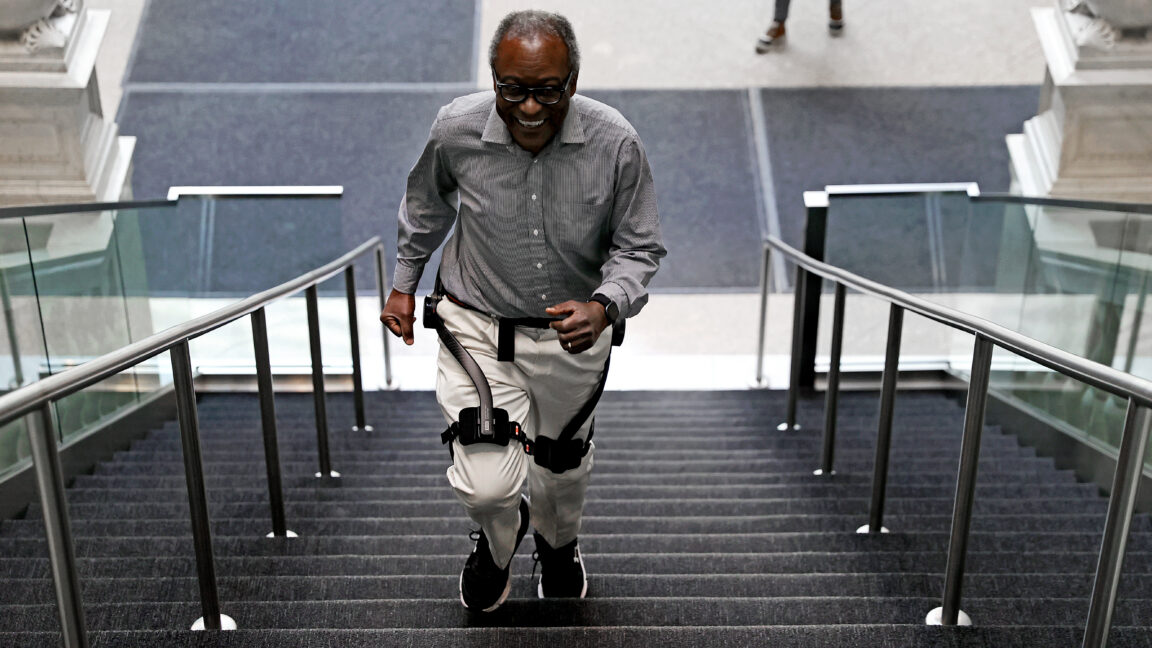
Modern, active robotic exoskeletons typically consist of a lightweight mechanical frame with ergonomic attachments to the human body. These are usually affixed at the trunk, waist and to upper or lower limbs.
For example, the Hypershell device seen in Ukraine attaches to the user’s waist and thighs, to assist with hip flexion and extension and strengthen lower-body movement. The SuitX device used by IKEA attaches to the torso and upper limbs, to support the back and shoulders.
Control units are normally pre-programmed for specific tasks, though modern exoskeletons are increasingly becoming more adaptive. Some are equipped with algorithms that learn from users’ actual working behaviors to better support their actions.
However, assistance exoskeletons provide generally falls into three categories.
Power augmentation increases the force capabilities of the user. This is commonly seen in assistive exoskeletons, like those being used by IKEA and in Ukraine.
Assist-as-needed or resist-as-needed settings provide support to the body only when necessary. This setting is often used in rehabilitation devices, to help users train their bodies to recover lost capabilities.
Finally there’s full robotic control, where the exoskeleton assumes complete control over part of the body. This tends to be for users who have lost certain motor functions. For example, a lower-body exoskeleton might use full robotic control to allow someone with spinal cord injury to walk.
These ways of working can be combined and adapted according to the specific task, environment, and needs of the user.
For now, most exoskeletons rely on feedback from sensors to define how they exoskeletons behave; they’re wholly mechanical. But in the future exoskeletons could be operated with signals from the wearer’s muscles or brain. Research is exploring this, but it remains a challenge. Harnessing these signals might require an invasive interface and extensive user-specific calibration and adaptation.
Power is another current challenge. Batteries have to be integrated into exoskeletons and regularly recharged. This introduces weight and size constraints that affect practicality. The energy density of batteries is steadily improving, however.
New materials are also pushing the boundaries of what’s possible. Exoskeletons are being developed that are made from soft textile or rubber-like materials that can be integrated into clothing, footwear, or protective equipment.
Research into walking exoskeletons during the 1960s and 1970s contributed to the development of the first humanoid bipedal robots. This has come full circle. Interest in humanoid robotics is now accelerating the development of actuators and batteries. These will advance the wearable robotic technologies of tomorrow.
Ildar Farkhatdinov, Senior Lecturer in Healthcare Engineering (Robotics and Mechatronics), King’s College London. This article is republished from The Conversation under a Creative Commons license. Read the original article.