
Development
Rocket Report: SpaceX completes launch triple-header; Rocket Lab nets big contract
October 2, 2026 Development Source: Ars Technica
Share this article



Portuguese company acquires what’s left of Orbex. A Portuguese space technology business has snapped up the assets of Orbex, the Scottish rocket maker that collapsed earlier this year, the Scotsman reports. The buyer, Omnidea, plans to establish its UK operations at Orbex’s former manufacturing facility in Scotland, having agreed to a deal to acquire the assets and intellectual property (IP) of the defunct rocket developer. An initial team of ex-Orbex employees will join the business, with Omnidea planning to recruit further as the operation develops.
No Prime resurrection … Omnidea, once a partner of Orbex, says it plans to use its new Scotland base as a center for “structures development and fabrication” and as a “hub for flight and ground system electronics.” Omnidea is a supplier of propulsion, fluid control, avionics, and thermal management components in the European space industry, but the company is also exploring other markets. It looks like Orbex’s Prime rocket, which never ventured near a launch pad, is still dead.
It’s rare, but astronauts have been off the planet for their child’s birth before. Most recently, NASA astronaut Randy Bresnik, set to command the Artemis III mission next year, was flying aboard the Space Shuttle Atlantis in 2009 when his wife gave birth to their daughter in Houston. This launch was delayed several weeks to fix a leaky valve on Dragon’s propulsion system, work that involved cutting out the suspect valve and welding in a new one, an unusual but apparently successful repair method.
SpaceX rideshare launch deploys 130 payloads. An artificial intelligence prototype from Google, a methane-tracker, pharmaceutical manufacturing labs, and more hitched a ride onboard a SpaceX Falcon 9 rocket from Vandenberg Space Force Base, California, on Thursday afternoon, Spaceflight Now reports. The rideshare mission, known as Transporter-18, carried 130 payloads into a polar Sun-synchronous orbit. It was SpaceX’s second launch of the day, following the successful flight of NASA’s SpaceX Crew-13 mission from Florida a few hours earlier.
Bread and butter … Much of the growing ecosystem of commercial satellite startups sees SpaceX’s rideshare launches as key enablers to their businesses, offering relatively inexpensive access to space on a predictable schedule. These kinds of launches, at least on Falcon 9, will likely go away in a couple of years as SpaceX transitions to the much larger Starship rocket. But for now, a bevy of satellite companies continue relying on Falcon 9 launches. The customers on Transporter-18 ranged from tech powerhouses like Google to scrappy startups like Starfish Space, alongside top remote sensing companies such as Planet Labs and ICEYE.
Debuting Starlink V3 … What’s more, SpaceX packed 26 of the company’s newest generation of Starlink broadband satellites into the rocket’s cargo bay. One by one, the flat-packed satellites—too large to fit inside SpaceX’s workhorse Falcon 9 rocket—were released from Starship’s payload deployer using a system of pulleys and cables to eject the satellites overboard like a Pez dispenser spits out candy. SpaceX cut a planned 10-hour test flight to three hours after one of the ship’s Raptor engines failed during ascent, but the vehicle was still able to make a pinpoint splashdown at one of its backup return sites north of Hawaii.
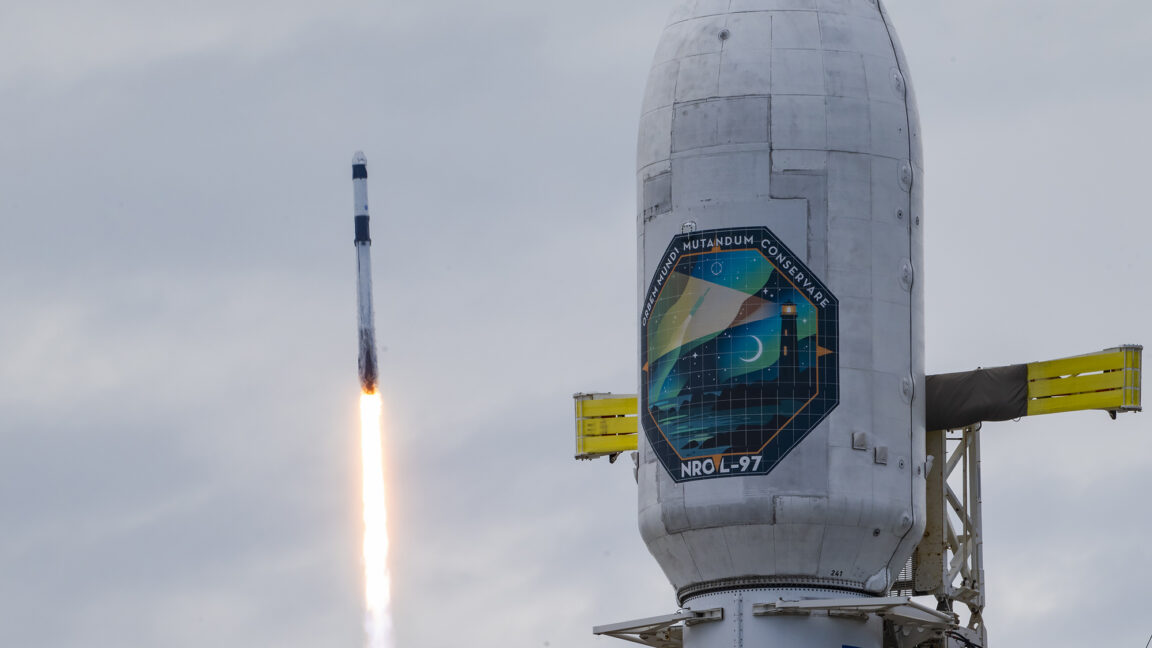
And four landings … This was the first time a Falcon Heavy rocket has launched a payload for the NRO, the US government’s spy satellite agency. Little is publicly known about the payload except that it launched into a highly inclined orbit, flying northeast from Florida’s Space Coast. To add an extra flourish to the launch triple-header, SpaceX returned both Falcon 9 boosters to their launch sites in Florida and California and landed both side boosters from Falcon Heavy back at Cape Canaveral Space Force Station. That makes three launches and four landings (plus a Dragon docking at the ISS) in one day.
Blue Origin foresees growing launch cadence. As Blue Origin continues to recover from a New Glenn pad explosion in May, the company is seeking permission to significantly increase the vehicle’s launch rate, Space News reports. This is a big surprise, but a draft environmental assessment released this week puts some numbers to Blue Origin’s plans. The company is seeking permission from the FAA to increase the rate of New Glenn launches from Cape Canaveral Space Force Station’s Launch Complex 36 from 12 to 50 per year.
Reuse built in … The proposal would include 50 launches of the rocket and 50 landings of the rocket’s first stage on a drone ship in the Atlantic Ocean. It would also allow up to 100 static-fire tests, one for each stage of the rocket for each launch. The proposal also covers recovery of the rocket’s payload fairing, which Blue Origin has not attempted on any of the three launches of New Glenn to date.
October 5: Falcon 9 | SDA Tranche 1 Transport Layer A | Vandenberg Space Force Base, California | 08:17 UTC
October 7: KSLV-2 | NEONSAT 2-6 | Naro Space Center, South Korea | 03:23 UTC
October 9: Long March 12 | Unknown Payload | Wenchang Space Launch Site, China | 19:25 UTC