Development
NASA squeezed Treasury, vibe coded, and broke the mold in bid to save Swift
October 1, 2026 Development Source: Ars Technica
Share this article



NASA and Katalyst officials are reviewing lessons learned from the mission to better prepare for the next time they need to rapidly call up a satellite rescue mission. First and foremost: Don’t wait until the last minute, said Shawn Domagal-Goldman, director of NASA’s astrophysics division, in a meeting last week of the National Academies’ Committee on Astronomy and Astrophysics.
“The way that the timeline worked out, we didn’t have the ability to open up the doors fully to proposed solutions. We went with the teams we had on [contract] already. That is not a regret of the team we ended up with. It’s just I think I prefer the more open solutions.”
NASA commissioned 30-day studies from three teams—Katalyst, Starfish Space, and a joint proposal from Cambrian Works and Astroscale—in August 2025 to show how they planned to rescue Swift from destruction. The teams eligible for the studies were limited to partners NASA already had on contract for technology development. Under federal acquisition rules, it would have taken months or longer to start a brand new procurement and bring on a new provider.
The studies led to NASA’s selection in September 2025 of Katalyst to try to rescue Swift. Officials knew the odds were stacked against them.
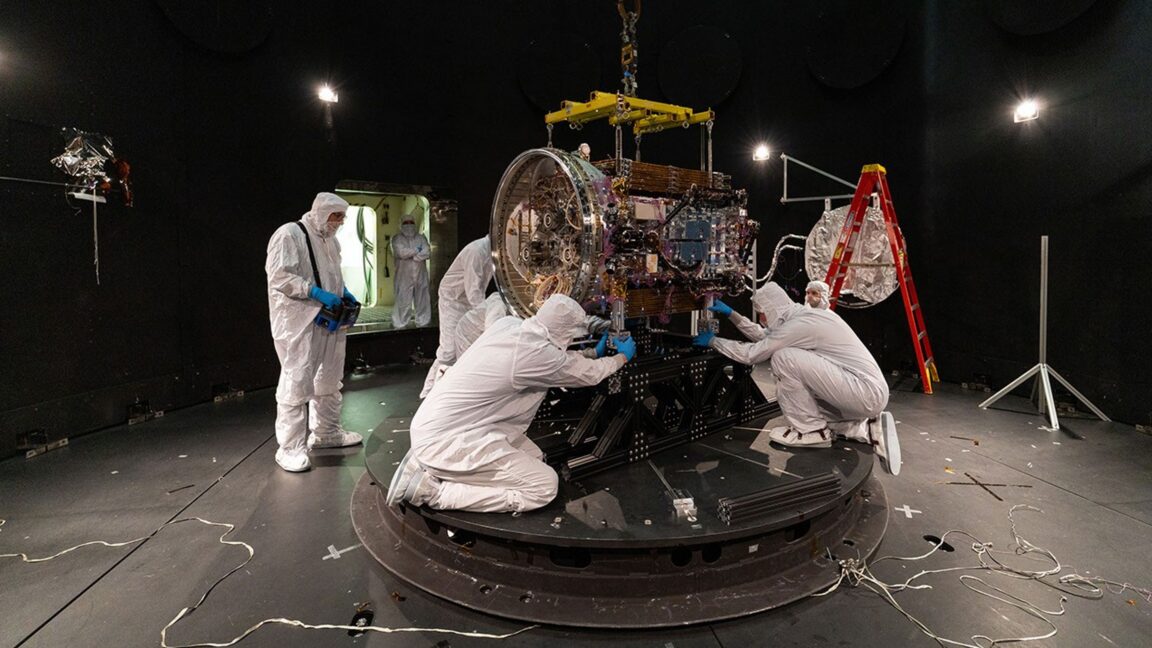
Katalyst quickly put out orders to suppliers for all the parts required to assemble the Link spacecraft. In some cases, Katalyst found its suppliers couldn’t deliver in time, so it decided to build parts itself. Engineers also had to decide what to test on the spacecraft before handing it over to the launch provider, Northrop Grumman.
NASA’s strategy was to tell Katalyst what to do, but not how to do it.
“On paper, it was five requirements,” said Kieran Wilson, principal investigator for the Link mission at Katalyst. “In practice, it boiled down to do no harm and boost Swift. It was not specified how that was going to happen. That allowed us, in turn, to put engineering judgment ahead of exhaustive process, which allowed us to move much more quickly.”
But more time isn’t always available. Satellite reentries are difficult to forecast, and changes in solar activity can change the density of air molecules in low Earth orbit, resulting in more or less drag on satellites flying there.
“I think next time we’d like to get ahead of it in advance of an unexpected change in the de-orbit date,” Domagal-Goldman said.
The engineers responsible for operating the Swift spacecraft also came up big in the run-up to the rescue mission. The reboost attempt would be moot if the atmosphere dragged the Swift observatory toward reentry before Katalyst could launch Link in pursuit.
Jamie Kennea, who led Swift operations until earlier this year, said his team at Penn State University devised a way to reorient the observatory to give it a more streamlined aerodynamic profile, minimizing drag and extending its time in orbit. This gave Katalyst a few more months of schedule margin at the expense of suspending Swift’s scientific observations.
“That sounds simple on paper,” Kennea said. “In reality, getting there was extremely hard. We had to use every single tool at our disposal to achieve that goal. That would include rewriting and rewriting software. The use of agentic AI, even vibe coding, helped us out in a lot of cases where we couldn’t figure out how to do things. GPU compute was used extensively to achieve this. What we ended up achieving was essentially extending the lifespan of Swift by several months.”
Wilson said the Link mission came in “within about 5 percent of our predictions” at the time of Katalyst’s bid. “We were within $1.5 of our $30 million mission target, which includes launch, labor, contractors, what have you.”
This shows that a satellite rescue or reboost mission doesn’t have to take hundreds of millions of dollars and years to get to the launch pad, as several government-led demonstrations have done, Wilson said. One example was OSAM-1, a NASA mission that would have attempted to grab onto an aging Landsat Earth-imaging satellite and refuel it.
With the refueling test, NASA’s OSAM-1 demo mission had more scope than Katalyst’s Swift rescue mission, but the agency spent $1.5 billion on the project before canceling it in 2024. At the time of cancellation, NASA officials noted advancements in the commercial industry as one reason for pulling the plug on OSAM-1 and breaking the mold in how they view satellite servicing.
“The industry is at the point where it’s ready to take off,” Van Eepoel said. “And we’re seeing that work out in real time with other companies that are doing rendezvous missions right now: Starfish and Northrop Grumman. They have launched RSGS, and that’s on its way to GEO (Geosynchronous Orbit). So this is just the beginning.”
“Speaking for NASA on its own, this isn’t the last servicing mission that we’re going to try to pursue,” Van Eepoel said. “There are other astrophysics platforms that need help. We’re actively looking at those as we move into some type of a service model for missions.”