
Development
How the Smithsonian became the latest front in Trump’s culture war
September 27, 2026 Development Source: Ars Technica
Share this article



But that institutional exceptionalism is now imperiled as never before. In March 2025, President Donald Trump signed an executive order declaring that the Smithsonian had succumbed to “divisive, race-centered ideology.” This July 4, timed to coincide with the 250th anniversary of the Declaration of Independence, came the White House report. Later in July, two House committees held back-to-back hearings on the report, where Republican members took turns lambasting the museum’s director, Anthea Hartig, and forcing her to answer questions about exhibit items such as a “chrome and rubber crotch harness” designed for sadomasochistic sex. That week, Trump signed an executive order instructing the Department of the Interior to erect signs outside the museum “warning visitors about the ideological capture” on display there. The signs have yet to go up, but in late August, Interior Secretary Doug Burgum sent a letter to the Smithsonian’s Board of Regents declaring that other federal agencies “cannot in good conscience continue to support the Smithsonian under current leadership.”
The Smithsonian is independent of the executive branch, governed by a 17-member board led by the chief justice of the Supreme Court and with six members of Congress, three from each party, serving with nine private citizens and the vice president. But it depends on the federal government for 62% of its funding, receiving more than $1 billion per year, and warnings of deep budget cuts have grown ever louder. Finally, on Sept. 8, Smithsonian secretary Lonnie Bunch, the first African American person to lead the institution, announced he was stepping down at age 73, saying “it has been stressful.”
Seen from one vantage, the battle over the Smithsonian is but another example of Trump attempting with characteristic bombast to put his stamp on Washington institutions, alongside shuttering the Kennedy Center, replacing the East Wing of the White House with a huge ballroom and planning a 250-foot arch near Arlington National Cemetery.
But unlike some conflicts initiated by Trump, this one has been festering for years, independent of him, with complaints lodged by board members before he returned to office. The American history museum, the main focus of the administration’s ire, has wrestled for years with how, or even whether, it should present a unifying national narrative, an ambivalence that left it susceptible to the administration’s broadside. Meanwhile, the Smithsonian underwent a political awakening during the 2020 upheaval over the COVID-19 pandemic and murder of George Floyd that echoed responses in academia and other progressive realms.
This left it exposed to a new administration that viewed itself as a corrective against perceived woke excesses. “I said over and over again that there’s going to be a day of reckoning,” recalled Garret Graves, a Republican former congressman from Louisiana who served on the Smithsonian board in 2023 and 2024, in an interview. “You can either participate in it, help guide the Smithsonian back to something that makes more sense, or you can have an abrupt shift. I didn’t realize my words would ring as true as quickly as they did.”
Now, in the year that was supposed to be a crowning celebration of the nation’s 250th anniversary, the Smithsonian is instead in Trump’s crosshairs. And the question of how the country’s premier history museum should tell the nation’s story is suddenly up for grabs.
In 1980, it was renamed the National Museum of American History, but the tension lingered. “It started out as a technology museum, and even now it has a lot of equipment, and to move from that to American history, that’s a huge change,” said Ivan Selin, a former chair of the museum’s board. “Unless you’re going to throw everything out and start over again, you’re going to have a very incoherent thing. Unless you have a clear strategy, you’re going to have some apples and oranges.”
Two decades after the name change, the lack of a unified approach had become an issue. In 1999, David Brooks wrote a scathing critique in the Weekly Standard, lamenting that the museum had so little on display about the nation’s defining moments (the Constitutional Convention, the Lewis and Clark Expedition, the Great Depression, etc.) and prominent figures who shaped them (Thomas Jefferson, Abraham Lincoln, Martin Luther King Jr., etc.). “It ignores or virtually ignores most of the major events in American history,” he wrote. “This is a museum of multicultural grievance, which simply passes over any subject, individual, or idea, no matter how vital to American history, that does not have to do with the oppression of some ethnic outgroup or disfavored gender.”
In 2001, in response to such critiques, the Smithsonian convened a blue-ribbon commission of historians and others led by Richard Darman, a former top aide in Republican White Houses. In 2002, the commission released its report, declaring that the museum “requires what its own leadership has described as a ‘transformation.’ It lacks aesthetic appeal, organizational coherence, and the perception of substantive balance.” The report recommended, among other things, a chronological introductory exhibit that contains “central theme lines for the examination and interpretation of American history” and that “should celebrate America’s remarkable strengths and achievements while also treating fairly and responsibly the ways in which America may have failed to meet the high standards it has proclaimed for itself.”
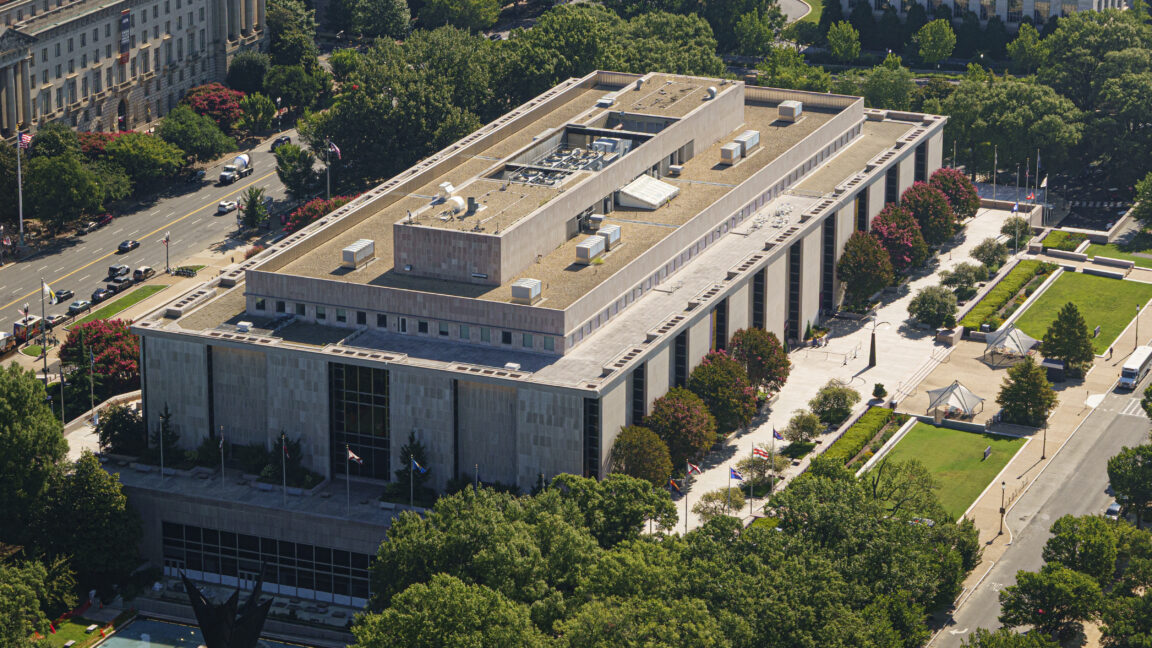
This would prove easier said than done. For one thing, the museum’s physical structure itself has never been coherent—“an awkward attempt to marry the classical and the modern, the building is legitimately neither,” wrote New York Times architecture critic Ada Louise Huxtable at its opening. “It’s a challenging space,” Brent Glass, who became director shortly after the blue-ribbon report in 2002, told ProPublica.
Above all, though, the commission’s recommendations faced resistance among the museum’s curators to the sort of great-man-of-history approach that Brooks and others were hankering for. There had been a trend in museum science away from this, and away from straight chronology. “There was this whole museum movement to get away from a march through time, to a more episodic or specific sort of story,” John Gray, who succeeded Glass in 2012, told ProPublica. “It wasn’t done to get away from the story; it was finding a way to get people interested.”
In addition, the museum’s curators tended to be specialized in material culture—collecting and studying the museum’s several million objects and artifacts—rather than in conceptual storytelling. To make up for this, Gray’s team tried to enlist several leading academic historians to instill more of an overarching narrative structure. But they declined, saying they were concerned that such an approach could seem triumphalist and provide fodder for an America-first agenda. “We tried to organize [the museum] around ideas and ideals, ideals that were aspirational,” Gray said. “And we failed many times.”
The museum’s eventual solution was to divide the national story into subject areas, each represented by a standing exhibit: “American Enterprise” on business and innovation, “American Democracy” on politics,” “Many Voices, One Nation” on immigration, “The American Presidency,” “The Price of Freedom” on the nation’s wars, “Entertainment Nation” on culture, “America on the Move” on transportation.
Developing these required extensive debate, said the former directors. Some donors supporting the enterprise exhibit were upset that it devoted so much space to the role of slavery in American business. In crafting “The Price of Freedom,” the museum consulted with veterans’ groups to try to avoid a backlash like the one that arose on the Enola Gay. This effort succeeded, Glass said, despite the exhibit’s candor about the darker elements of the nation’s military history. “People can handle complexity,” he said. “They don’t feel bad about the country when told the whole story, and they’re grateful that they have access to the information.”
The post-2020 shift extended to the various museums, which started to reopen to visitors in spring 2021. To cite just one example, the National Portrait Gallery revised the signage for a portrait of Henry Laurens, South Carolina’s delegate to the Continental Congress, to reflect that he had made his wealth through chattel slavery. “When Floyd was killed, everyone acknowledged that now is the time to ask: What are the stories that we’re telling and were we being honest and fair in recounting those stories? We all looked at it through this lens,” Kim Sajet, who became the director of the Portrait Gallery in 2013, told ProPublica. “Everyone felt energized by that. We can’t change the past, but we need to acknowledge what happened in order not to repeat it in the future.”
But the new direction caused misgivings for some conservative supporters of the institution, such as Graves, who joined the regents as one of the three Republican congressional appointees in 2023. Graves told ProPublica that he had high regard for Bunch—“his accomplishment with the African American museum was remarkable”—but that he became worried that the Smithsonian was operating within a bubble. Its staff were living in a metro area that had voted overwhelmingly against Trump (and museum employees are generally among the most left-leaning of any profession), yet they were charged with presenting exhibits to visitors from all over the country and the world, a disconnect that the institution seemed insufficiently aware of.
Many board meetings would kick off with tours of a certain museum, and Graves and a fellow Republican appointee, Adrian Smith of Nebraska, would often be taken aback by what they saw. “Seventy-five percent of the time Adrian and I would be walking around and say, ‘Are you kidding me?’” Graves said. “It wasn’t interpreting science or history. It seemed to have an agenda, and that’s not what a museum should be.” What was missing, he said, was a sense of the nation’s achievements. “This country is a remarkable experiment,” he said. “We’ve had some grave sins, but my gosh, America is a net victory for the world. It’s unbelievable what happened here in 250 years and it’s worth celebrating.”
Graves retired from Congress at the end of 2024. In his farewell address to the regents that October, he warned against allowing the Smithsonian to become seen as affiliated with one party or ideological bent. “I felt like they were causing sustainability problems for the institution,” he said. “Politicizing the Smithsonian is an awful, awful idea, because then you only receive funds when there’s a Democratic majority. This is America’s museum and there should not be anything partisan about it.”
One week later, Trump won the election to return to the White House.
In August 2025, the White House issued a 120-day ultimatum to replace “divisive or ideologically driven language with unifying, historically accurate and constructive descriptions,” but with little follow-up, and for nearly a year, it looked as if the storm may in fact have passed. Then came the White House report on the American history museum, with such an exhaustive litany against Hartig, its director since 2018, and Bunch that it made plain the authors had been scouring their public statements and the museum. (Through a spokesperson, Bunch declined to be interviewed. Museum representatives did not respond to requests to speak to Hartig.)
In addition to citing the Franklin exhibit, the report noted that an exhibit called “Girlhood (It’s Complicated)” had included “the pages of a 6-year-old girl’s diary where she expresses fear about ‘getting boobs’ and wishes for her nonexistent ‘penis to grow.’” Another exhibit, on gay history, had “included a two-piece chrome and rubber crotch harness designed for sadomasochism.”
For years, the Smithsonian had avoided major conflagrations partly by engaging in what one former official called the “care and feeding” of members of Congress on the two committees with purview over it, Appropriations and House Administration. If there was a potentially controversial exhibit, the museum would bring members over for a preview tour, so they had some context for complaints they might receive. But these efforts were on hold for a while because of the pandemic closures, and the Smithsonian’s government relations office experienced heavy turnover, as one of its directors had cancer and another died suddenly.
This context, combined with the fuel provided by the White House report, helped explain the level of vitriol that Hartig faced when she appeared at the two hearings in late July. Even by the standards of today’s decorum-less Congress, the hearings were wild affairs. At the first, held by the House Oversight Subcommittee on Delivering on Government Efficiency, Chair Tim Burchett, a Tennessee Republican, kicked things off by playing a lengthy string of video clips of Hartig offering tribal land acknowledgements at the start of her speeches. “I’m wondering, have you ever planned on deeding any of your personal property or property of the Smithsonian to any of these tribes?” he asked Hartig.
She adopted a conciliatory tone, saying the Smithsonian “takes the concerns raised in the White House Domestic Policy Council’s report seriously” but that “it does not fairly or accurately characterize the full body of work at the museum.” She assured the committee, “I love the United States of America. I consider it the privilege of my career to help preserve its treasures and serve the American people.”
This did not assuage committee Republicans. Burchett displayed museum images including the crotch harness and the diary mention of the 6-year-old girl wishing for a penis. “Ma’am, I mean, you have pictures of bondage. You have some overtly sexual things up there,” he said. “I’m not a fan.” Rep. Nancy Mace, a South Carolina Republican, pressed the point: “Are images of sexual fetishes appropriate for children? Yes or no?” Rep. Brandon Gill, a Texas Republican, noted that the toolkit that the museum used for staff training had referred to “politeness” as a feature of “white supremacy culture.”
Any large institution can benefit from reassessment, and the Smithsonian and the American history museum in particular may well be overdue, especially as yet another focus area is about to be cleaved off, for the National Museum of the American Latino, scheduled to open early next decade. What gives so many supporters pause is for that reevaluation to happen under Trump, who hasn’t shown a lot of interest in how the various museums interact, much less in the nuances and subtleties of history.
“There will be a moment,” Sajet said, “when the American people will have to stand up and decide, is this what they want?”
This story was originally published by ProPublica.