
Development
Contrary to some reports, you don't have two brains
September 24, 2026 Development Source: Ars Technica
Share this article



Neural cells form as a thickening of the ectoderm that runs down the center of the embryo from head to tail. The center of these thickly packed cells drops down, while the sides fold up, eventually forming an oval-shaped tube that pinches off from the rest of the ectoderm. All the signals that run up your spine, every sound and shape you process, every thought you will ever have—all of these and more depend on the descendants of these cells.
The new work builds on decades of studies that have identified many key regulators of early processes. One of those earlier findings was that the ectoderm of the early embryo activates two genes, one in the front half of the embryo, one in the back. So nerve cells can inherit at least some crude positional information from the ectoderm they form from.
The key to this work is that the researchers modified a copy of these genes so that it activated fluorescent proteins wherever the gene was translated into a protein. So, they engineered mice where half of the early ectoderm glowed red, and the other half glowed cyan. These colors were maintained as the embryo formed nerve cells and the cells started to develop into the brain.
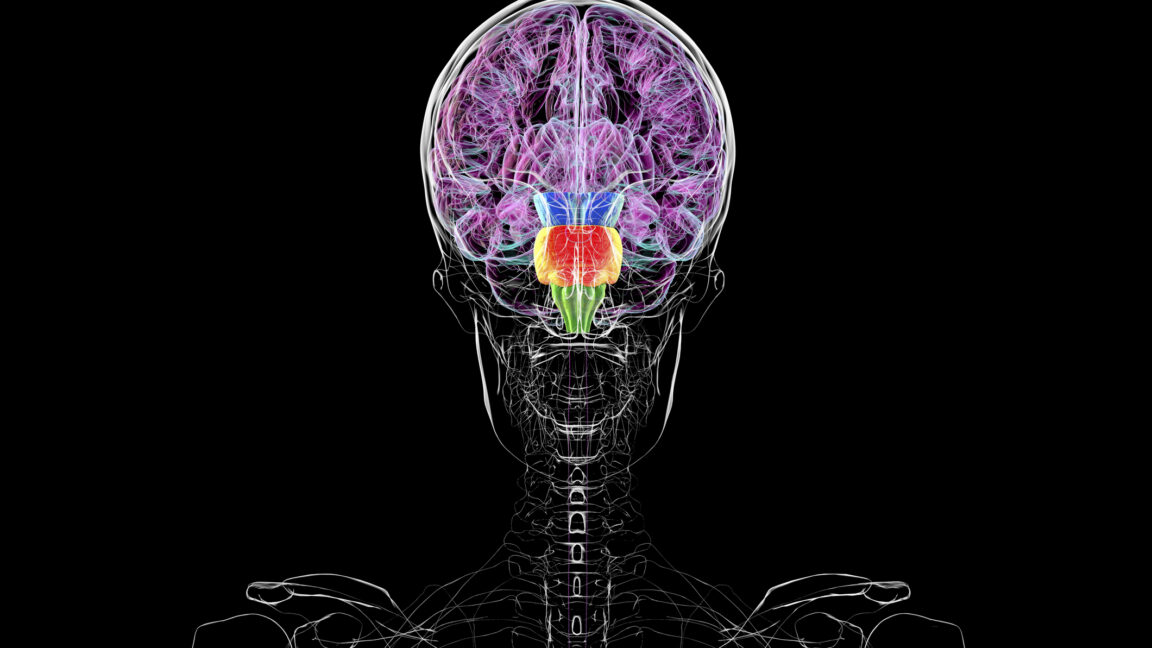
They found that while the hindbrain glowed red, the rest of the brain glowed blue. The inherited positional information set up one of the key boundaries in the brain. In other words, as soon as cells know they’re going to eventually develop into neurons, they know whether they can potentially form part of the hindbrain and not the mid- or forebrain. (This is, roughly, where the idea of “two brains” in the press release comes from.)
Other experiments expanded on this. Similar genetic tools let them activate a fluorescent protein in individual cells in the early ectoderm. They found that, in 96 percent of the cases, the descendants of these single cells were all in the hindbrain, or all in the midbrain and forebrain. They also worked with human stem cells and showed similar things were happening there: Exposure to the right signals would tell the stem cells where they were, and the nerve cells inherited that information as they formed. If you wanted to form neurons that are only found in the hindbrain, you have to first send the stem cells down the hindbrain path.
You might expect that, since all the cells of the tube are neural precursors, they’d respond to the same signals in the same ways. But they don’t. Instead, their segment identity directs these signals into overlapping sets of responses that differ in the different areas of the brain. In other words, when midbrain cells see BMPs, they respond in different ways than the cells of the spinal cord do. By dividing the nervous system up early, cells inherit a developmental history that allows a limited number of signals to trigger a great deal of complexity.
(The way that developmental history changes how things are interpreted also enables the signals to be recycled. BMPs initially tell cells whether to develop as neurons or not. Later, they tell developing neurons what identity to adopt once the neuron matures. Later still, BMPs help direct the migration of mature neurons in the developing spine. We don’t have to evolve entirely new signaling systems in order to do different things.)
The other thing is that the junction between segments can be a distinct environment, one where cells are exposed to influences from both of the neighboring identities. At the midbrain-hindbrain boundary, for example, cells activate a distinct set of genes that include signaling molecules that go on to influence the development of the neighboring tissues on both sides of the boundary. As you’d expect from the above, these signals made at the border trigger different responses in the midbrain and hindbrain, since those two segments have different developmental histories.
While the new work says nothing about how many brains you actually have (it’s one with several distinct regions within it), it provides another piece for the puzzle of how the incredible complexity of our brains gets generated from a flat sheet of cells that, just a few hours before, would have happily developed into our skin instead. And it provides a great window into how organismal development works in general and the sorts of experiments we can do to help however many brains we have understand these processes.