
Development
Neanderthal brains measure up to ours—literally
April 28, 2026 Development Source: Ars Technica
Share this article



“The inferred differences were not put into the context of modern human populational variation in brain anatomy,” wrote Indiana University cognitive scientist P. Thomas Schoenemann and his colleagues. In that same paper, they decided to take a stab at doing so. Schoenemann and his colleagues performed the same size comparison using MRI scans of 400 modern people’s brains: 200 US residents of European descent and 200 ethnic Han Chinese people who had volunteered to be scanned as part of the Human Connectome project.
It turns out that, when it comes to brain size, the differences between our species and Neanderthals are on par with the differences within our species. For nine of the 13 regions measured, Schoenemann and his colleagues found bigger differences in volume between some modern people than the earlier study found between Neanderthals and Pleistocene Homo sapiens. “Our analysis shows that Neanderthal differences in brain and cognition would fit comfortably within the range of differences seen among modern humans,” wrote Schoenemann and his colleagues.
In other words, we’re a diverse species, and the size and shape of Neanderthal brains fit into the range of that diversity (which arguably lends some support to the paleoanthropologist who argues that maybe we shouldn’t think of Neanderthals and Denisovans as separate species at all). And all of those size differences are too small to have any effect on cognitive ability, so Neanderthals could easily be on par with our species there, too.
(When we talk about “intelligence,” we’re describing something complex and, frankly, sort of nebulous; it’s impossible to really quantify, but that hasn’t stopped generations of scientists from trying. Researchers who study cognition break it down into specific areas: attention, inhibition, cognitive flexibility, speech production and speech comprehension, working memory, and episodic memory. Some of those abilities are associated with particular sections of the brain, but those relationships are often complicated.)
So, when looking at brain size and intelligence, the differences among human brains are relatively small compared to the differences between a human brain and any other great ape brain. For example, our closest relatives, the chimpanzees, have brains that average just 400 cubic centimeters; the average adult human brain takes up about 1,350 cubic centimeters. (And there’s a wide range, from about 1,100 to 1,500 cubic centimeters.)
So total brain volume is “empirically the best predictor of behavioral and cognitive abilities among primates,” but only if you’re comparing different primate species. Within species, the differences aren’t pronounced enough to matter.
If you’re comparing, say, crows to dolphins, you’ve got to factor in the size of the brain relative to the size of the whole animal, which scientists call the encephalization quotient; according to Schoenemann and his colleagues, that’s less relevant for primates, where it’s all about size.
With that in mind, a group of early hominins called Australopithecus afarensis, who lived about 3.2 million years ago, had about 500-cubic-centimeter brains. That’s a big enough difference that we can make some guesses that they were cognitively more like chimpanzees than like us. On the other hand, the average group of Neanderthals had a brain capacity that’s consistent with them scoring about the same on cognitive tests as their Homo sapiens neighbors.
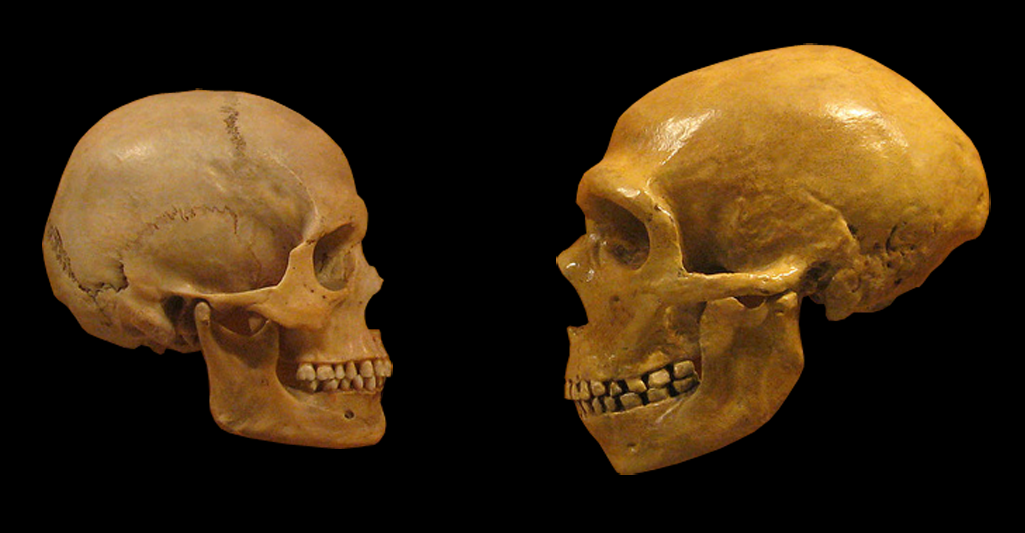
What about the difference in shape, with Neanderthals having longer, lower skulls and Homo sapiens having higher, more rounded ones? An earlier study suggested that it has more to do with the shape of our faces than the structure of our brains.
Schoenemann and his colleagues’ conclusion isn’t terribly surprising given our other source of information about Neanderthals’ brains: the objects they made and left behind. We know that Neanderthals were good at working memory and attention because they made complex tools that required planning, focus, and a set of skills that had to be taught and then practiced. We know they were capable of symbolic, abstract thought because they made art. We know they must have been decent at language and social skills because they met and organized themselves in large groups to hunt big game.
To some extent, we don’t really need to measure Neanderthal brain endocasts to know that they were our cognitive equals; they’ve already shown us. Today, we’re overcoming more than a century of bias against them and beginning to fully see our extinct cousins and better understand our relationship with them.
PNAS, 2026. DOI: 10.1073/pnas.2426638126