
Development
Saudi Arabia wants a car industry, launches Ceer with two EVs
September 22, 2026 Development Source: Ars Technica
Share this article



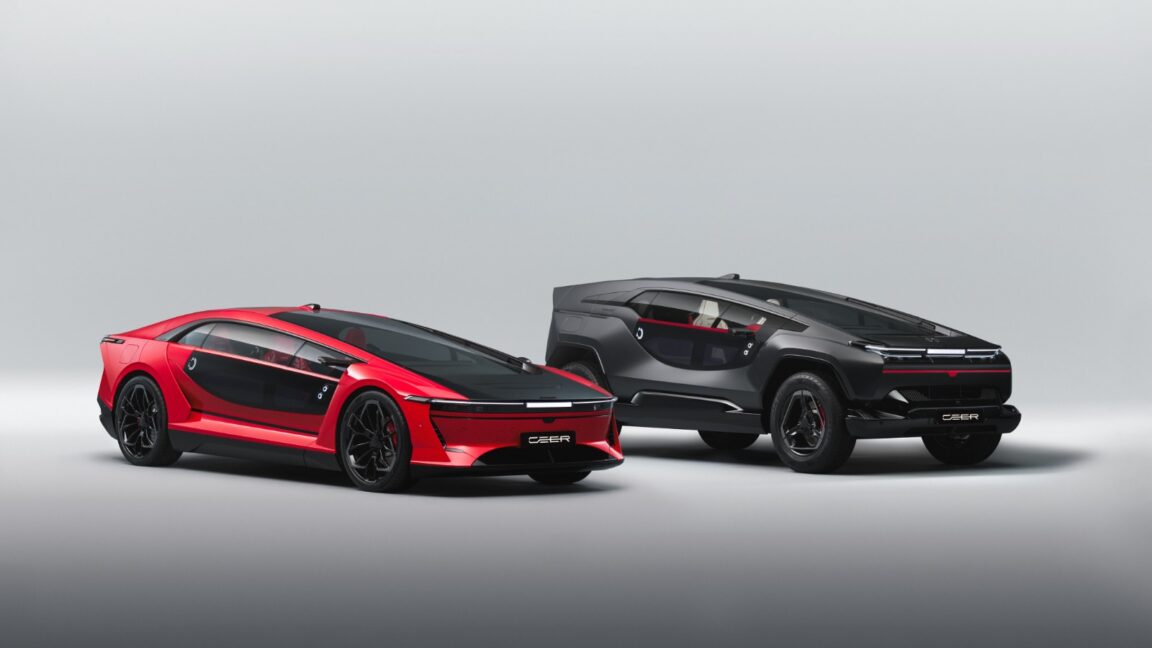
Not having a B-pillar makes access to the second row much easier, but I’d be surprised if those doors appear on any of the future cars the company is planning to build. The region’s extreme climate will certainly put the engineering of the doors to the test.
One unique feature of the doors is built into the glass. The lower portions of the door feature electrochromatic glass that can be dimmed at the press of a button. Especially useful in the SUV: If the driver needs more side visibility, the lower part of the door becomes clear at the push of a button.
During the reveal presentation, Ceer CEO James Deluca mentioned that during an early briefing on design, the Crown Prince inspired the team to look at what is already out there and take a different path. “If the world goes left, we go right,” he quoted the Crown Prince as saying.
Other design details call out Ceer’s national heritage. Both models have 32 independent elements in the front and rear light bar. Thirty-two, because 1932 was the year the Kingdom of Saudi Arabia was established.
Inside, a 48-inch digital instrument cluster stretches across the entire dashboard, running a custom infotainment system that is inspired by the Riyadh skyline. To help deal with the extreme climate of the Kingdom, there’s a new cooling mode for the cabin that creates a cool air barrier between the roof and the glass and the passengers’ heads that the company calls Halo cooling.
A 10-inch center cluster handles media controls, and there’s an 8-inch screen for rear passengers. Ceer believes in bringing your own device, and the vehicle should be able to integrate with a mobile phone. In an interview with Ars Technica, Chief Technology Officer Markus Leitner confirmed that Apple CarPlay and Android Auto will be available at launch. The infotainment system is unique Ceer intellectual property co-developed with Foxconn and the other partners. Of course, over-the-air updates will be available that can improve any aspect of the vehicle, including performance and range.
What is clear is that Ceer from the start developed these vehicles to be quickly homologated for global markets, including Europe and maybe even North America. That’s no guarantee, but it does mean it’s fair to compare these vehicles to the best of what the rest of the world is doing regarding EVs. To that end, I asked Leitner what he thought makes Ceer stand out.
Ultimately, the success will depend on how Saudi car buyers take to the products. The company admits these two products are aspirational, as they are an entirely new industry for the country. But what will matter is the upcoming more mainstream models, their affordability, and how well they compare to the offerings already on sale in Saudi Arabia, which are Chinese brands.
One additional factor to consider is that, as part of the Vision 2030 plan, Saudi Arabia is encouraging products to be made locally for the domestic market. This manifests in a “Saudi Made” branding initiative. Many products, including the Coke Zero I’m drinking while writing this story, carry a logo and a Saudi Made badge. When it comes to Ceer, the country will have a completely home-grown alternative to the established automotive brands, including even Lucid, that they’ll be able to buy from that will directly support local manufacturing and the economy.
If this sounds a bit familiar, it’s something that GM, Ford, and the North American arm of Stellantis spend a lot of time emphasizing. While Americans have had a local automaker for nearly as long as the automobile has existed, this is a new experience for Saudis. Ceer is more than just a car, but a point of pride for the Kingdom. While I can’t say for sure if Ceer will be successful, they do seem to have the basics figured out.