
Development
Apple Mac mini review: The new M6 impresses, but the price hike is rough
September 21, 2026 Development Source: Ars Technica
Share this article



The new Mac mini is the kind of Mac upgrade Apple has done a million times. It’s the same design as before but with new guts.
These play-it-safe updates aren’t very exciting, but they’re also usually all upside—you get a year or two’s worth of technological improvements for the same price you would have paid for the older version yesterday. Unfortunately, 2026’s unprecedented memory crunch has upended that standard operating procedure.
The new Mac mini starts at $899 for a version with 16GB of RAM and 256GB of storage, a $300 increase for the same memory and storage specs you could get in the $599 M4 Mac mini in 2024.
The M4 Mac mini was a great general-purpose desktop computer and one of the best values Apple had ever offered in a desktop Mac. The M6 Mac mini is only one of those things. I’ll let you guess which.
Note that this review is specifically for the M6 version of the Mac mini. We didn’t get an M5 Pro Mac mini to review, but we’ll talk more about how its pricing and performance fits in for our Mac Studio review.
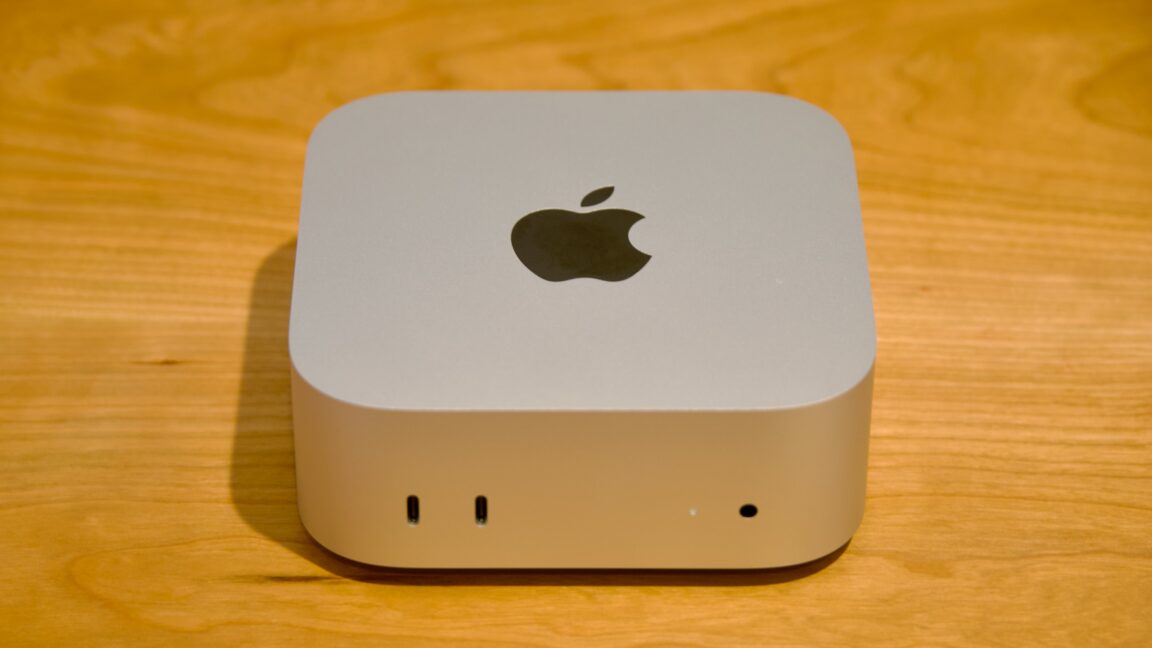
The M4 Mac minis gave the computers their first full redesigns in nearly 15 years, so it’s not too surprising that the new Mac minis don’t change anything. Compared to the older Intel and M1/M2-era versions, they’re slightly taller (2 inches, up from 1.4), but they have a smaller 5×5-inch footprint (down from 7.7 inches squared). The system is actively cooled, with a fan vent on the bottom to make sure that whatever chip is inside can run at high sustained clock speeds (passively cooled Apple Silicon Macs like the MacBook Air have always been a bit slower than actively cooled Macs with the same chip).
All Mac minis have two 10 Gbps USB-C ports and a headphone jack on the front, and a 2.5 Gbps (default) or 10 Gbps (optional) Ethernet port and HDMI port on the back. Both also have three Thunderbolt ports on the back, but these are Thunderbolt 4 on the M6 Mac mini and Thunderbolt 5 on the M5 Pro version. That means the M6 mini’s ports top out at 40 Gbps, while the M5 Pro mini supports up to 120 Gbps speeds.
The headliner is the presence of two of Apple’s so-called “Super” cores, Apple’s nomenclature for P-cores that are even faster than its typical P-cores. Those are added on top of four P-cores and six E-cores for a total of 12 CPU cores. M4 and M5 both had 10 CPU cores. In the M4, these were split between four regular P-cores and six E-cores, whereas the M5 split them between four super cores and six E-cores (the M5’s cores were referred to as P-cores when it launched but were rebranded later when the M5 Pro and Max came out). The M1, M2, and M3 generations all used four P-cores and four E-cores.
The M6 has fewer super cores than the M5 but the same number of E-cores and four additional P-cores. While they’re apparently no longer “super,” the P-cores still perform well enough to ensure that the M6’s multi-core performance is better than M5’s overall.
The new mini re-uses the launch strategy for last year’s Mac Studios, which used an M4 Max in the base model and an M3 Ultra in the top-tier configurations. The basic Mac mini uses the brand-new M6, while the semi-professional Mac mini tier gets the M5 Pro that we saw in MacBook Pros back in the spring.
For the M6, powermetrics doesn’t actually report CPU power levels. It appears in the tool’s logs, but the value is always “0.” I’ve asked Apple whether this is a bug or an intentional behavior change (it still works fine for M5-generation chips), and I’ll update this if I get a response.
The $599 M4 Mac mini was a tiny, affordable desktop computer with as much speed and memory as most people need for general-purpose computing. You could quibble with the 256GB base storage, but it was still the most usable the basic Mac mini had ever been.
The M6 mini’s $899 starting price sets us way back. That’s a $300 increase in just under two years for a computer that has a faster chip in it but otherwise shares the key specs and most of the capabilities.
One could argue that this merely resets Mac mini pricing back to where it was circa 2020. A base M1 Mac mini cost $699 to start, and upgrading to 16GB of RAM added another $200. It just feels like a big step back, given how great the M4 mini was.
If you need a desktop computer right now for anything from basic browsing to less-intensive local AI models, this is still Apple’s most affordable computer (chatbots and image generation should run pretty well on it; more intensive coding-centric models will be a bit squeezed for RAM and memory bandwidth, even at 32GB). And even the $599 M4 mini was undercut by the kind of lowest-common-denominator cheap mini PCs you could get on Amazon. It’s just hard to swallow the current price, given how much better it was not all that long ago.