
Development
Rocket Report: China wants a Raptor 3 engine; SpaceX set for big Starship test
September 18, 2026 Development Source: Ars Technica
Share this article



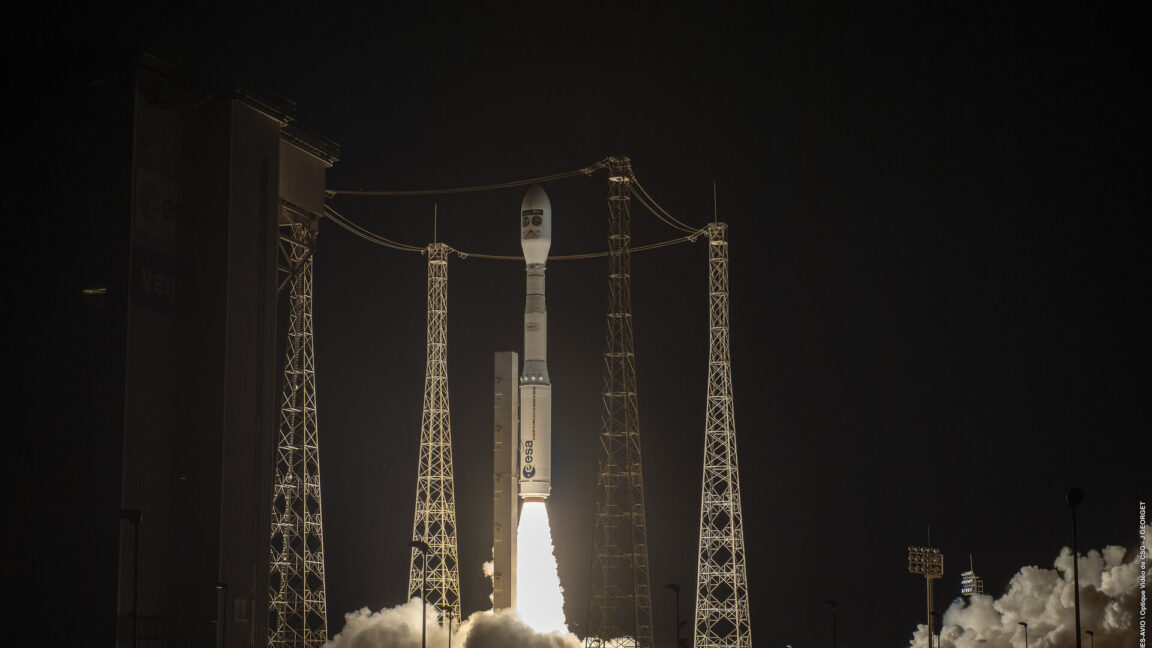
Vega C successfully lofts two satellites. Speaking of Avio, a Vega C rocket launched on Tuesday from French Guiana, successfully carrying the European Space Agency’s FLEX Earth Explorer satellite and the Copernicus Sentinel-3C into low-Earth orbit. It was just the second launch of the Italian-made Vega rocket this year. A new launch adapter called Vespa allowed both satellites to be stacked inside the rocket’s fairing, the European Space Agency said.
Two for the price of one … An evolution of Europe’s Vega family of rockets, Vega-C can launch 2.3 metric tons into low-Earth orbit. “Preparing and launching two satellites together is no easy task,” ESA’s director of Earth observation programs, Simonetta Cheli, said. “My thanks go to the many experts who have contributed throughout both satellites’ development, testing, and preparation for launch, and who have worked tirelessly to ensure that both satellites have reached orbit safely.”
A maturing commercial industry … Notably, three of the four launches were from commercial or quasi-commercial entities distinct from the Chinese government. This highlights the growth of the country’s commercial space industry and suggests that the buildout of constellations in China will no longer depend on the country’s traditional fleet of Long March rockets. The industry, as well, is moving rapidly from rocket test flights to operational missions.
SpaceX hits Falcon 9 milestone. SpaceX launched a trio of satellites for its oldest commercial customer, SES, on a Falcon 9 rocket flying Sunday afternoon from Florida. Notably, this was SpaceX’s 700th Falcon rocket launch to date, split between 687 Falcon 9 rockets and 13 Falcon Heavy rockets, Spaceflight Now reports.
A lot of missions for a single rocket … SpaceX launched the mPOWER-F mission using the Falcon 9 first stage booster with the tail number B1080. This was its 29th flight after launching four missions to the International Space Station, the European Space Agency’s Euclid observatory, SES’ Astra 1P, and 22 batches of Starlink satellites. This was also the 400th orbital launch to take flight from Space Launch Complex-40, of which SpaceX was responsible for launching 345.
Two launch companies spar over Mars mission. NASA finally reached a decision earlier this month on the development of a “Mars Telecommunications Network” spacecraft, selecting Blue Origin to develop, launch, and operate a $700 million spacecraft at Mars, Ars reports. However, the other main competitor for the award, Rocket Lab, was not happy—at all. The company filed a protest of NASA’s decision with the US Government Accountability Office.
A war of words … “The agency’s punitive review of Rocket Lab’s technical volume was inconsistent, making incorrect assertions and conclusions,” Rocket Lab said as part of the protest. In response, Blue Origin said the protest could potentially delay the mission’s goal of launching in 2028. “We remain confident in the strength of our proposal, in NASA’s rigorous selection process, and in Congress’s clear intent to support competition for the Mars Telecommunications Network program,” Blue Origin replied.
Chinese space company reveals Raptor 3-like engine design. The Chinese launch startup Space Pioneer, which has raised nearly $1 billion, showcased a new design for its Tianhuo-21 methane-liquid oxygen engine this week, which was subsequently shared on social media. From outward appearances, the engine looks strikingly similar to SpaceX’s Raptor 3 engine. Its thrust, 2,450 kN at sea level, is also virtually identical to that of the Raptor 3.
Would it be difficult to replicate? … In response to Space Pioneer’s engine design, SpaceX founder Elon Musk said copying Raptor 3 would not be easy. “I would recommend against a new company trying to make Raptor 3,” he said on X. “While it appears simple on the outside (necessary to survive extreme heat without a heat shield), the inside has very complex geometry that can only be manufactured using highly modified 3D metal printing.”
Falcon Heavy nailed Roman telescope’s launch. NASA’s Nancy Grace Roman Space Telescope is gliding toward its distant observation post on a pinpoint trajectory so precise that engineers estimate the spacecraft’s fuel load will last twice as long as their initial expectations, Ars reports. The $4.3 billion observatory’s designers originally planned to load enough propellant into Roman’s four fuel tanks for a minimum lifetime of five years, plus a potential five-year mission extension.
That was a conservative estimate … “As a result of exquisite planning by our orbital dynamics team, brilliant execution by the operations team, and a precise launch from SpaceX, Roman has fuel for at least 22 years of potential science operations,” Jamie Dunn, center director at NASA’s Goddard Space Flight Center, said. The Roman telescope launched August 30 from NASA’s Kennedy Space Center in Florida aboard a SpaceX Falcon Heavy rocket, kicking off a mission to widen our view of the Universe.
Blue Origin studying full-flow staged combustion. Blue Origin and the Rocket and Space Propulsion Division of the Air Force Research Laboratory at Edwards Air Force Base have announced an expanded private-public partnership to develop new rocket propulsion technologies, the company said this week. The new agreement comes as “we work to develop next-generation rocket propulsion technologies,” said Nicholas Robertson, senior vice president of engines at Blue Origin. “Studying these historic and technical artifacts grounds our engineering models in real government research.”
Also working on lunar-lander engine … The Blue Origin news release notes that the Air Force lab has done pioneering work in oxygen-rich and full-flow staged combustion technologies. The company said it would also continue to collaborate on testing and maturing the BE-7 lunar lander rocket engine with the Air Force at the Area 1-42 High Altitude Rocket Test Facility at Edwards.
September 19: Electron | Owl by the Dozen | Māhia Peninsula, New Zealand | 03:15 UTC
September 19: Long March 2D | Unspecified payload | Taiyuan Satellite Launch Center, China | 10:50 UTC
September 20: Falcon 9 | Starlink 15-27 | Vandenberg Space Force Base, Calif. | 01:47 UTC