
World
Viktor Orbán's Hungarian experiment runs out of steam
April 13, 2026 International Source: BBC World
Share this article



Péter Magyar's historic win offers peace for a country exhausted by the tensions of Viktor Orbán's rule, Nick Thorpe reports from Budapest.
Orbán's Hungarian experiment runs out of steam
Copyright current_year BBC. All rights reserved. The BBC is not responsible for the content of external sites. Read about our approach to external linking.
Copyright current_year BBC. All rights reserved. The BBC is not responsible for the content of external sites.
Read about our approach to external linking.
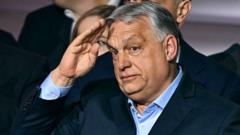
Hungarian Prime Minister Viktor Orbán salutes the crowd after losing the general election on 12 April 2026.
Viktor Orbán's Hungarian experiment runs out of steam
What Viktor Orbán did for the last 16 years in power was "an experiment" - but even he didn't know what to call it. "Illiberal democracy" sounded too negative.
His American friends liked to call it "national conservatism", which sounds better, but it was never strictly true. Unlike most conservatives, Orbán was a rebel.
He constantly radicalised himself. So what could he conserve?
He loved to thumb his nose at the mainstream, at the "Brussels bureaucrats". He was a thorn in their side, but whenever they hit back, he turned it to his own advantage.
He portrayed himself as an "anti-globalist" but invited German carmakers, and Chinese and South Korean EV battery makers, to Hungary.
He painted himself as the champion of national sovereignty, but refused to stand up for Ukrainian sovereignty against Russia.
Péter Magyar - holding the flag - won by a landslide
Péter Magyar, leader of the Tisza party, waves a Hungarian flag after winning the general election in Budapest, Hungary on 12 April 2026.
He railed against immigration, but quietly encouraged immigration from Sri Lanka, the Philippines, Ukraine and Turkey to build his new factories.
He poured money into encouraging couples to have more children, but by 2025, the fertility rate had fallen back to 1.31 - the same number he inherited from the Socialists in 2010.
The way he swiftly conceded defeat on Sunday night showed him with a strong eye on his image. He acted as a "majoritarian" democrat, meaning that he believed that "the winner takes all" - and that's how he acted in government.
One year after winning a two-thirds majority in 2010, he wrote a new constitution. He reshaped Hungary in his own image to suit his own party.
With his two-thirds majority in parliament he pushed through one law after another, to change the structure of the courts, the electoral system and the economy.
But finally, on Sunday, the Hungarians decisively told him "we don't want to be experimented on any longer".
Péter Magyar defeated him because he carried a Hungarian flag to every rally, because he proclaimed an inclusive, less exclusive national message, and perhaps above all because Hungarians felt exhausted by being constantly in conflict.
And they disliked the way the rich got richer, the poor got poorer, and the middle classes shrank.
Orbán often won his fights, but his people wanted peace and quiet. A normal country, but one with a voice.
That is what Magyar is promising. "Tonight we celebrate," he told the huge crowds, dancing on the shores of the Danube.
A man in the dark holding the flag of Hungary
Orbán era swept away by Péter Magyar's Hungary election landslide
A man with a blue sweatshirt holds a Hungarian flag with green, white and red stripes
Péter Magyar, the former Orban ally vying for power in Hungary
European leaders share Hungarians' joy over the ousting of Vladimir Putin's EU ally, writes the BBC's Europe editor.
Viktor Orbán's 16-year rule is over, defeated by a 45-year-old ex-party insider who convinced a majority of Hungarians to oust him.
Most polls favour Péter Magyar, who fronts a grassroots party, but the record turnout for any Hungarian election does not necessarily favour either party.
Who is the man who brought down Viktor Orbán after 16 years of continuous rule at the head of Hungary's Fidesz party?
Rajini Vaidyanathan broadcasts from outside Hungary's parliament as crowds hear about the prime minister's concession.
The BBC's Europe Editor Katya Adler reports from Prime Minister Victor Orbán's home town of Felscút.
Since 2010, Orbán has transformed Hungary into what the European Parliament has denounced as a "hybrid regime of electoral autocracy".
As Péter Magyar's opposition movement leads in the polls, tens of thousands of anti-Orbán supporters fill Heroes' Square in Budapest.