
Development
Scientists develop new method for deciphering ancient scrolls
September 17, 2026 Development Source: Ars Technica
Share this article



The team’s approach combined digital scanning with micro-computed tomography—a noninvasive technique often used for cancer imaging—and segmentation to digitally create pages, augmented with texturing and flattening techniques. Then they developed software (Volume Cartography) to virtually unroll the scroll.
Many of the inks used by Egyptian scribes contained large traces of metals, including lead, making them ideal for X-ray imaging. The older Herculaneum scrolls, however, were written with carbon-based ink (charcoal and water), so one would not get the same fluorescing in the scans; there is almost no difference in X-ray absorption between parts of the papyrus with ink and parts without ink. Searles was still able to capture minute textural differences, training an artificial neural network to do so.
Douglas Seiler, a retired inventor, was working with Berkeley SETI on a new telescope called Panoseti when he heard about the Herculaneum scrolls—as well as the poor signal-to-noise ratios that had been plaguing the efforts of Searles and others to digitally unwrap and decipher them. In 2016, scientists identified letters in two fragments of a scroll that contained lead, suggesting that some of the scrolls might be written in lead-based ink. So Seiler set out to test which of the scrolls were written with lead-based ink and put together an interdisciplinary team to help, including two retired Berkeley chemists and a Berkeley graduate student in archaeology with expertise in ancient Egyptian inks.
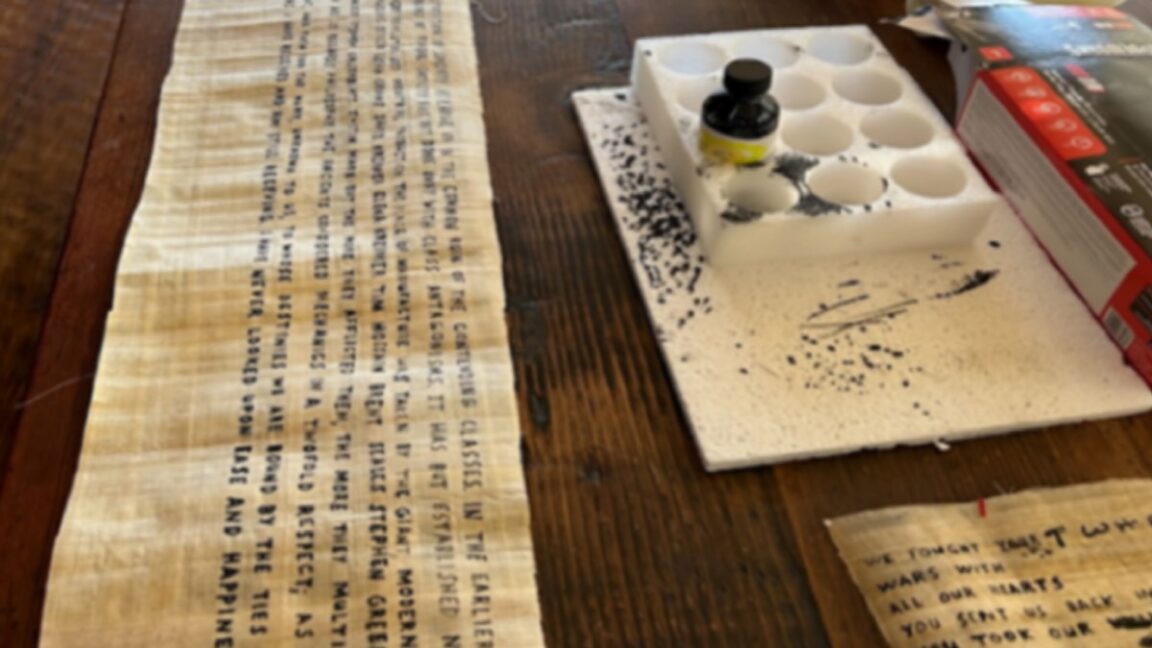
Then the team carbonized the scrolls in a high-temperature furnace to mimic the original Herculaneum scrolls, and co-author/physicist Jake LaManna created 3D X-ray scans of the charred models at NIST’s Center for Neutron Research in Maryland. “The letters lit up like a Christmas tree,” said Seiler, adding, “It’s amazing what you can get electrons to do.” Co-author Michael Cyrus Daugherty, also of NIST, adapted a software program he’d written to unroll CT scans of so-called “jelly rolls” inside lithium-ion batteries to digitally unwrap the model scrolls and reveal the text.
That’s good news for the Vesuvius Challenge, which made its first award for deciphering the first letters in 2023 and awarded the grand prize of $700,000 for producing the first readable text the following year. Last year brought the successful generation of the first X-ray image of the inside of a scroll (PHerc. 172) housed in the University of Oxford’s Bodleian Libraries. Earlier this year, PHerc. 1667 was read in full, revealing it to be a philosophical treatise on ethics and human moral progress. The work of Seiler et al. could help speed up this painstaking process.
“With lead in the ink, you would get a huge friggin’ signature, so you really need to be looking for scrolls with lead in them,” Seiler said. “They’re having problems reading a lot of them because of the low contrast of carbon ink on carbon paper. We’re relatively certain that if they start searching for lead, or they let us search for lead, it will help this whole process.” Even a handheld X-ray fluorescence scanner is sufficient to determine which scrolls would be the most promising candidates for further analysis.
“Honestly, getting here is, for me, just as unique as our research,” Seiler said. “I mean, inorganic chemistry, papyrus, X-ray tomography, AI—it’s really quite an eclectic group of scientists and methodology to get to the point that, yes, if there’s lead in those scrolls, you guys will be able to read the images much better. I’ll give you 10-to-1 odds. We’d like it to be our team, but if some other team is going to take this idea—which is OK—we don’t care.”
PLoS ONE, 2026. DOI: 10.1371/journal.pone.0353485 (About DOIs).