
Development
Researchers swap in human brain cells for a mouse's cortex
September 17, 2026 Development Source: Ars Technica
Share this article



One alternative has been to implant human neural stem cells into the brains of another species, where they’ll generally integrate into the nervous system and actively signal to their neighbors. But, given that those human cells are surrounded by the normally functioning neurons of their hosts, it’s not clear how much you can learn from this.
The obvious solution there is to get rid of the host cells and try to have the human cells take over their functions. But that option runs into all sorts of problems, largely related to the fact that the organism you’re implanting them into (generally a mouse) actually needs its brain cells. Human neurons mature much more slowly than those of mice and may not form the connections that are needed quickly enough for an animal that only requires 21 days of gestation. In the absence of normal mouse tissue, nothing would provide the human cells with the signals that help organize them into functional units.
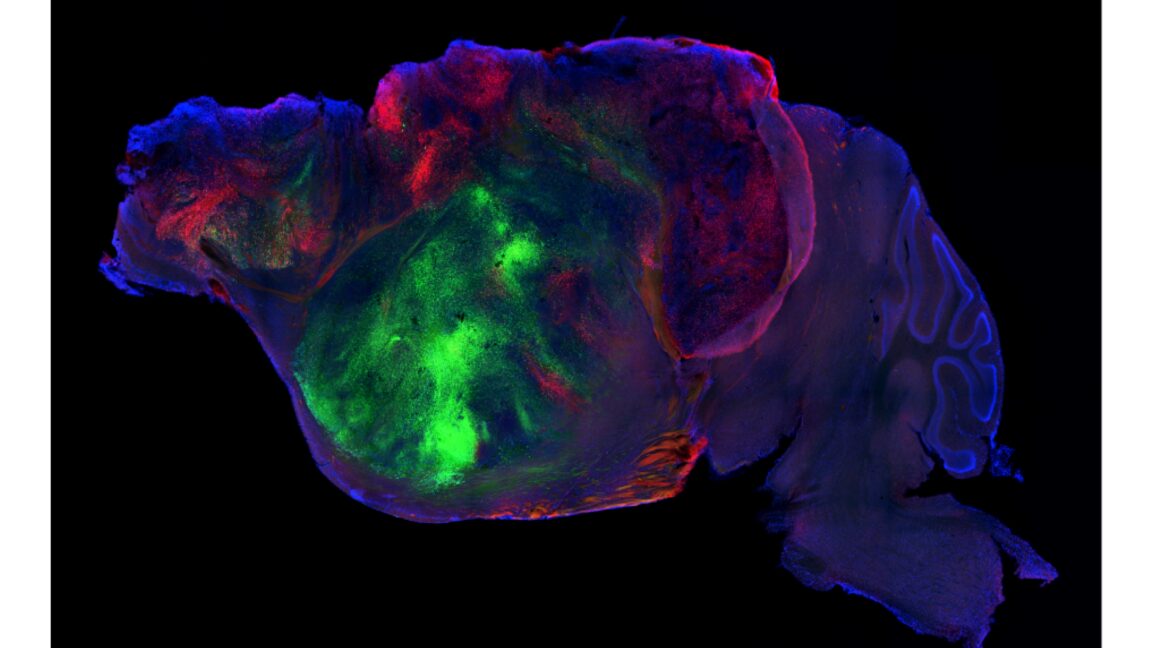
The Stanford team decided to test a compromise and delete a portion of the mouse’s brain and put human brain organoids in its place. But they took a bold step and chose the cortex as the portion they would delete. The cortex handles many of the complex features of the nervous system, such as decision-making and memory, and its disruption would be expected to have dramatic consequences. Still, the researchers found a gene that is active in almost all cortical cells and used it to drive the deletion of a key gene that’s needed to separate chromosomes during cell division.
Amazingly, despite killing off most of the cells that should go on to form the mature cortex and cutting the brain’s volume in half, it was possible for the mice to survive this. The researchers had to eliminate most of the other pups to ensure the cortex-free mice got enough nursing. They left them with their mothers to nurse longer and then provided them with very high-calorie food. But these steps allowed nearly full survival of mice without much in the way of a cortex. (The mice were also immunocompromised to avoid an immune reaction to human cells, but this is less of an issue in a sterile mouse care facility.)
With that in place, the researchers then started implanting human cortex organoids into the area where the mouse’s cortex was no longer developing.
Tested for memory in a simple maze, the mice without a cortex performed at a level consistent with random chance. Mice with the humanized cortex did better than chance, but not as well as normal mice. But on a test of the ability to form associative memories, the mice with a humanized cortex did no better than the mice with no cortex at all. On tests of fine motor coordination, the mice with the human implants were again somewhere between the normal and cortex-free mice.
The research team hasn’t described the sort of careful study of anatomy and development needed to draw any conclusions about what structures may be formed by the human cells once they’re within the mice, much less tried to quantify any variation among individuals that might give us some hints of what sort of capacity these animals might be expected to have. As a result, it’s impossible to associate the mild improvements that come from having the human cells present with any specific function they’re providing.
As a result, this isn’t yet the sort of model system that can help us understand the sorts of complex neural diseases that we might ultimately be interested in using this for. They do show that the human cells respond differently to brief periods of hypoxia, consistent with what we see in normal human cells. But that’s quite a bit different from showing that this is a great model for something like ALS.
There remains a chance that it ultimately won’t be—that the sorts of disorganized connections that do get formed in these brains will never make them a good model for human neural processing. But without further characterization of what the cells are doing in these humanized cortexes, it’s going to be difficult to know.
Nature, 2026. DOI: 10.1038/s41586-026-11032-2 (About DOIs).