
Development
The Roman telescope has enough gas for 22 years, double NASA's expectations
September 16, 2026 Development Source: Ars Technica
Share this article



“A spacecraft’s mass changes throughout the design and build process, so we base the propellant budget on a set maximum value so we won’t come up short,” said Alison Rao, the Roman propulsion lead at NASA Goddard. “We track the propellant needed based on actual mass throughout integration and testing as well, to make sure we have wiggle room. Since Roman’s was lower than we budgeted for, we were able to fill the propellant tanks to their capacity rather than only filling them as much as we needed to for the 10-year requirement.”
A second course correction planned for later this month will give Roman the last tiny boost to get into position for another maneuver in early December to slip into its final orbit at L2. “According to current projections, both maneuvers will use less fuel than planned, potentially saving even more for future science,” NASA said.
Roman’s thrusters will perform additional station-keeping burns roughly every 28 days. The observatory will also use its propulsion system to periodically unload momentum from its six reaction wheels, which normally control Roman’s pointing.
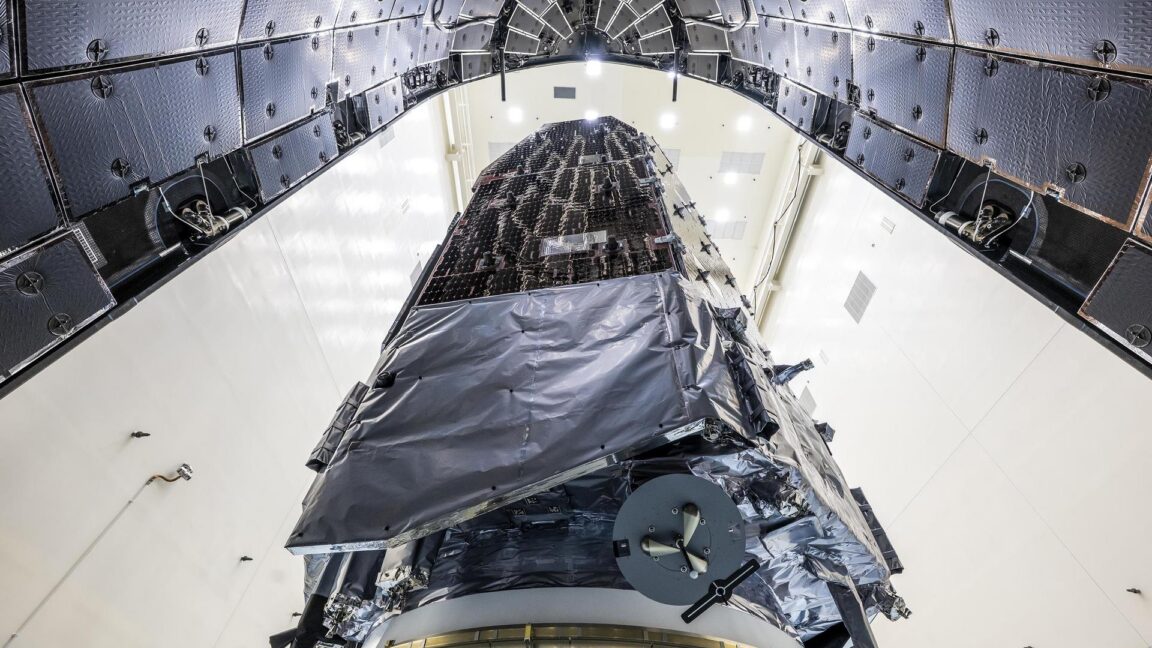
Officials prepared Roman to receive a potential uncrewed servicing mission. NASA attached a grapple fixture on the bottom of Roman similar to those used by the robotic arms on the International Space Station and the Space Shuttle. Roman also has navigation aids—a retroreflector and external reference points—to help guide a servicing mission on final approach.
“While Roman is nowhere near as serviceable as the Hubble Space Telescope was, we do have everything that’s necessary to enable the rendezvous and capture and docking with a hypothetical servicer; that’s the point of the grapple fixture,” said Jackie Townsend, Roman’s project manager at NASA Goddard. “Then, in 2020, when we were baselined, we were told that we would focus on refueling. So the blanketing around the fueling port has been designed especially so that it’s easier for a robot to get in there if we needed to refuel.”
The blanketing around the fueling port also has a magnetic closure to simplify opening and re-closing by a robotic servicer, Townsend told Ars.
There are no servicing spacecraft currently available that could travel out to Roman’s position a million miles from Earth. Several US companies are developing refueling satellites for use in low-Earth orbit and geosynchronous orbit, primarily for the US Space Force. Two Chinese spacecraft docked last year to conduct the first satellite-to-satellite refueling in geosynchronous orbit.
Everything else onboard Roman has been working well for more than two weeks since launch, according to Kshatriya, NASA’s highest-ranking civil servant. The telescope opened its aperture cover on September 1, allowing starlight to fall on its primary mirror for the first time.
“All the preliminary checks are good,” Kshatriya said. “In fact, we got some data on the Wide Field Instrument just a couple days ago. All the mirrors, all the CCDs are chilling down in the right way. We do false current tests to make sure that we’re getting the right connectivity, etc. All that’s green across the board on all 18 (detectors), which is awesome.”
Roman’s other instrument, a coronagraph designed for direct imaging of exoplanets, also performed well during preliminary checkouts.
“When we get first light, it’s going to be a big party,” Kshatriya said.