
Development
GM gives its most important trucks a new UI—and includes CarPlay
September 15, 2026 Development Source: Ars Technica
Share this article



General Motors is about to launch new versions of its bestselling Chevrolet Silverado and GMC Sierra pickup trucks for model year 2027, and among the changes are new user interfaces for the trucks’ digital displays. The automaker has gone for a more minimalist approach than we’ve seen from it in the past, and after a demo yesterday, it seems like it has been listening to constructive feedback to improve the products. And yes, unlike GM’s electric vehicles, these trucks still let you cast your Apple or Android phone to the infotainment system.
Although GM showed us video of the main instrument cluster—the gauges and info that’s presented to the driver—we don’t have any screenshots we can show you. But I was impressed with the restraint and lack of visual noise; instead, the background is always black, which should be dark even at night thanks to local dimming technology.
There are a number of different views. One with simple half-moon dials for speed and engine rpm; on the right side of the display is a user-configurable zone, where you can browse your music or audio feeds, display trip info, or turn-by-turn directions. Another is a driver assist display, with green as the highlight color to show when Super Cruise is active; this shows you a representation of what the car’s fused sensors are seeing around it. A third is for off-road driving, with your various angles and diff settings, and a fourth is for towing.
At the base of the main instrument display is a strip of information that’s permanently displayed regardless of the view mode you choose—this includes things like your fuel level, the drive mode, and any warning lights that may appear.
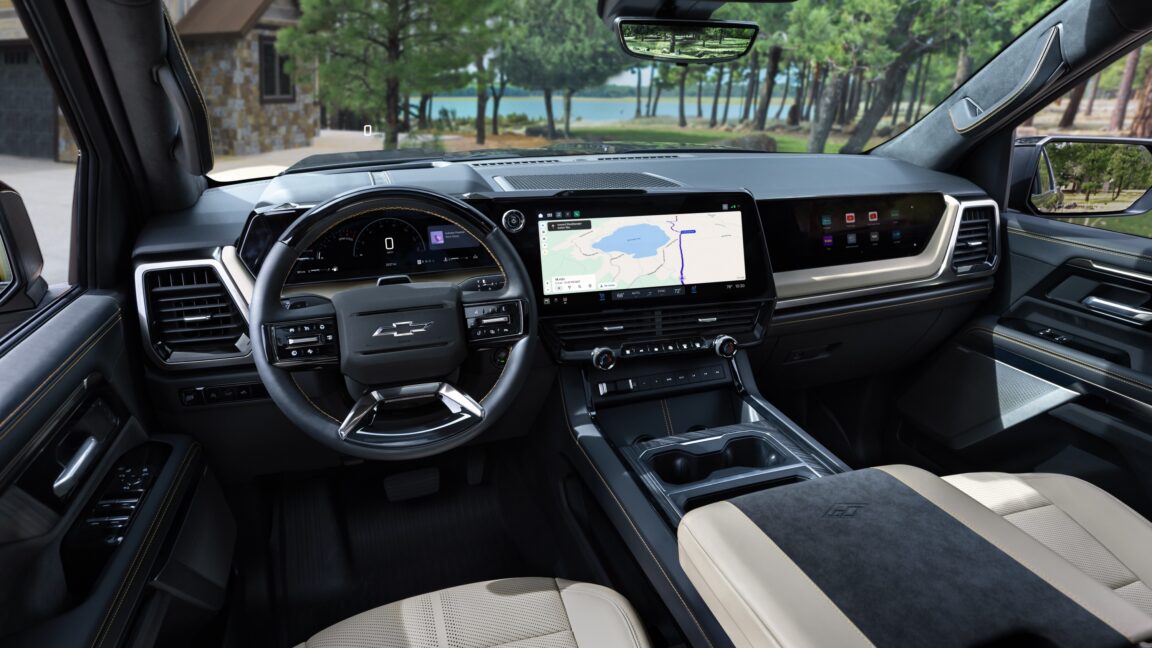
The central infotainment screen still runs on Android Automotive OS, but now the home screen is a more useful split view showing the music and navigation apps, with a full map view rather than the limited map that GM previously showed in its split-screen view. “If you wanted to search something or provide feedback on road conditions or something like that, when you tapped on the screen, it took you out of the home screen and took you to the full-screen maps. Here, you can do everything that full-screen maps can do right inside this window,” said Colin McCormick, group product manager at GM.
A dedicated row at the bottom of the screen is for the climate controls, although, as you’ll note from the photos, there are physical dials to change the temperature, as well as physical buttons for fan speed and demisting.
GM has also integrated more Android-like notifications into the infotainment system and included the ability to create quick actions. It has also changed the behavior of some of its apps—now, if you accept a phone call, it won’t switch you out of whatever app was active to dump you into the dialer app anymore.
And it has done a better job of integrating CarPlay and Android Auto into the experience, putting the casting apps in a large window or tile that takes up most but not all of the infotainment screen. To the left is another card that allows you to access other native apps, like towing or music (although you can still have CarPlay as the source for that native music app, should you start feeling a little Inceptionish). Porsche took a similar approach to working with, rather than against, users who enjoy CarPlay, and this looks like a welcome step from GM.
GM’s spokesperson wouldn’t be drawn on whether this means we’re going to see a corporate retreat from the previous stance on EVs, but I will note that the press release it sent Ars does say that the system was built “as a single scalable foundation across electric, gas and diesel-powered vehicles, it transforms time spent behind the wheel into an effortless, personalized journey,”—emphasis mine.
Complaining about the trend of OEMs putting an extra infotainment screen in the dash for the front passenger is evidently a losing battle now, because such a feature will be available on the Sierra and Silverado. The screen is coated in a polarized filter, so the driver can’t see what they’re doing or watch what they’re watching.