
Development
"Offensively cheap": Solar power is looking up
September 14, 2026 Development Source: Ars Technica
Share this article



In some countries, the rise of such domestic generation is starting to undermine the economics of power generation and distribution—just as utilities need to invest heavily in re-engineering grids to allow power to flow both to and from consumers.
The UK and several US states have now approved the sale of the low-cost “plug and play” solar panels already widely available in other parts of Europe. Some fear such equipment, which simply plugs into domestic wiring, will introduce yet more unpredictability to the already complicated task of forecasting and managing overall power demand.
That challenge was dramatically illustrated last year by a day-long blackout across much of Spain and Portugal. Professor Janusz Bialek, an expert in power systems at Imperial College London, said in a recent paper that while solar and other renewables did not directly cause the outage, Spain had failed to sufficiently adapt its power system to reflect their growth.
The concrete villas in Karachi’s wealthy Defence Housing Authority neighborhood below his office are covered in photovoltaic panels. “These are my best customers,” he laments, “and they’re opting for solar.”
At the turn of the millennium, solar panels cost $5-$6 per watt of generation capacity. Today, they sell for around 12 cents per watt, a level described as “offensively cheap” by Dave Jones, co-founder of think-tank Ember.
That reduction is entirely the result of an explosion in China’s production capacity, which, according to research firm Wood Mackenzie, stands at roughly 1.36 terawatts, even as Beijing tries to rein in output to combat price deflation.
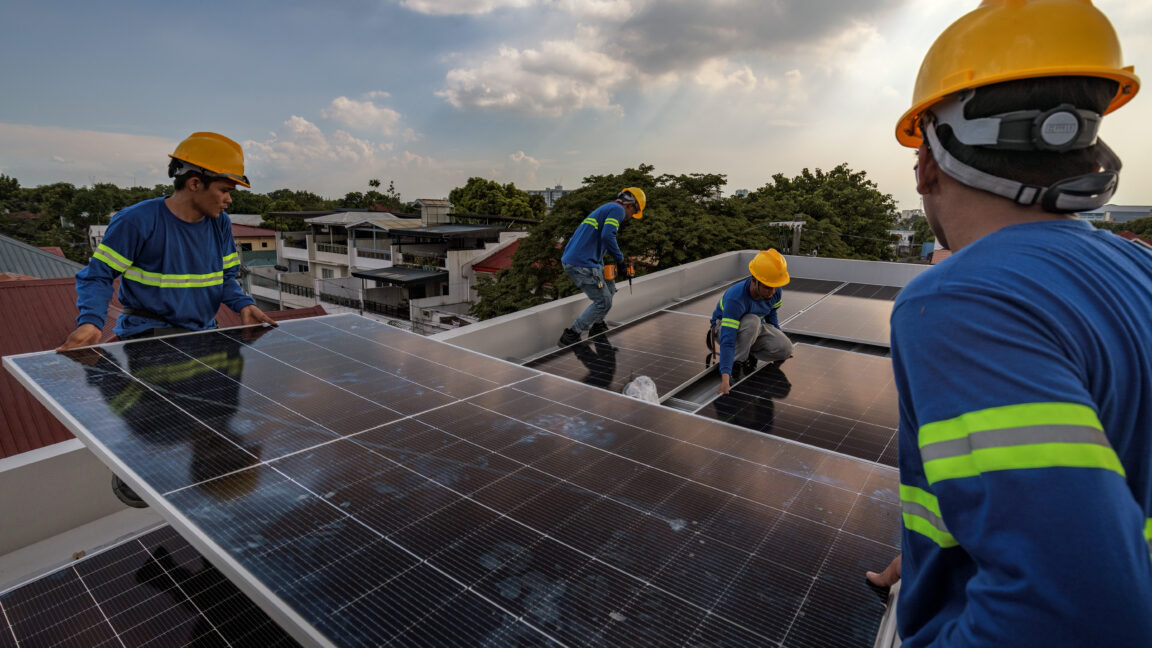
Cheaper panels enabled a vast rollout in China itself and helped solar generation evolve from a subsidized technology deployed mostly in markets looking to decarbonize to a vital source of electricity in areas where power is scarce, expensive or unreliable. That process started in countries like Pakistan, Brazil, and South Africa and has now spread to other parts of Africa and the Philippines.
Based on analysis of customs data, Ember estimates that Africa will install around 17 gigawatts of new solar this year. It believes most of that will be small-scale installations at factories or other businesses. “If you’re a business, you’re using electricity during the day—it’s a natural fit for you to use solar,” says Jones.
But solar is also a boon for households. “A home goes from burning two or three kerosene lanterns to a light that is 20 to 40 times brighter, [turned] on every day,” says Anish Thakkar, co-founder of Sun King, a Kenyan business which lends families money to pay for solar and battery installations.
In the Philippines, Ember estimates rooftop solar capacity may have almost doubled over the 12 months to April and its calculations suggest residential solar panels can now pay for themselves in just over three years. Meralco, the country’s electricity distributor, said rooftop solar generated 372 gigawatt hours in the first six months of the year.
The lower revenues come as Eskom needs to fund the upkeep of the grid, which allows households to export electricity during the day, and the power stations that fill the generation gap when it’s dark or cloudy, or when power stored in batteries is insufficient to meet demand.
“Everyone who has rooftop solar in any major city, they are still connected to the grid,” says its chief executive, Dan Marokane. “Three weeks ago… the whole country had to rely on Eskom generation for three days,” he adds, due to prolonged cloudy weather slashing output from rooftop panels.
The company is redesigning tariffs to distinguish between network and energy costs, which analysts hope will make pricing more efficient and help the market adapt to the shift in supply. But its overriding task is to avoid the kind of “utility death spiral” seen in Pakistan, where poorer people end up shouldering a greater proportion of the cost of power infrastructure.
The growth of rooftop solar in Africa raises broader questions about the wider role of utilities and grids in its future energy infrastructure. “What should your grid look like in five, 10 years if you suspect that more demand is going to go ‘behind the meter’?” wonders Berg, at S&P.
“Everyone is talking about the huge need for electricity grids,” says Jones, at Ember. “But in a distributed [energy] world, you would need less.”
Household batteries, which allow some of the power generated by rooftop panels to be stored rather than fed back into the grid, are also falling in price and will help ease the problem.
So too would better visibility over supply, with many companies and governments turning to AI to help with this. Lucy Yu, the UK government’s AI champion for clean energy, said in a report published last week that AI can learn the “underlying structure of the grid” and help speed up calculations to measure supply and demand. UK Power Networks has just finished a £389,000 study to develop machine-learning models that can better estimate the solar generation capacity connected to the network.
Jon Ecker, general manager for Europe at solar forecasting company Amperon, says the company’s machine learning models retrain every hour, assessing changes on the grid to get the most accurate forecasts. “They know that in springtime, they’re going to need to weigh what has happened over the last hour more heavily than in the last year,” he says.
New technology developed in Australia can increase the amount of power that grids absorb from households. “Engineers are moving very fast to respond [to the changes]. But the major lesson is: don’t wait until the last minute—you know this is coming,” says Mancarella.