Development
Orion helium leak no threat to Artemis II reentry but will require redesign
April 10, 2026 Development Source: Ars Technica
Share this article



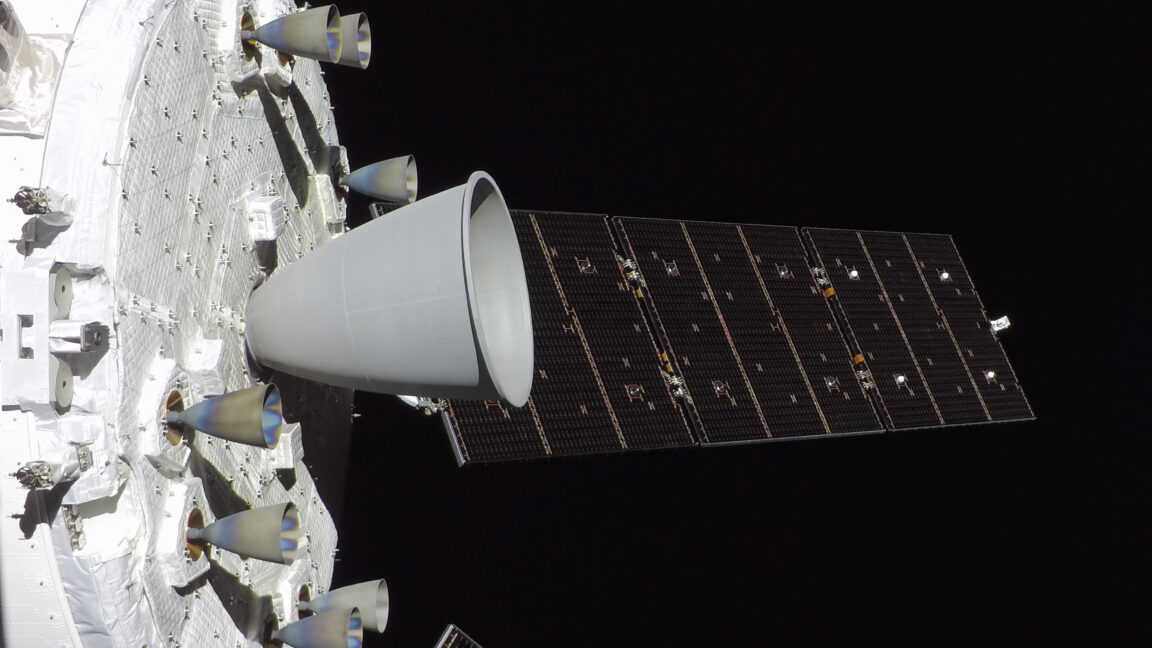
Orion’s trajectory is so close to preflight predictions that NASA has canceled some of the mission’s course correction burns. The midcourse burns that have occurred were all low-impulse maneuvers using the service module’s smaller jets, which don’t require the helium system to recharge pressure.
Amit Kshatriya, NASA’s associate administrator, said mission managers were aware that the Orion spacecraft had a “low leak rate” of helium before launch. Engineers also observed a helium leak during the unpiloted flight of the Orion spacecraft on the Artemis I mission in 2022.
Officials decided to proceed with the launch because the spacecraft did not need the full capability of its propulsion system on Artemis II, which followed a “free return trajectory” using the Moon’s gravity to slingshot the capsule back to Earth. This mission required no complex maneuvers to enter orbit around the Moon.
As of Wednesday, nearly 80 percent of the way through the Artemis II mission, the spacecraft had consumed just 40 percent of its fuel. “Clearly, we had put a lot of margin into this mission to make sure we could fly it properly,” said Debbie Korth, NASA’s deputy Orion program manager.
The only burn of the mission to use the service module’s larger main engine was the trans-lunar injection maneuver, or TLI burn, on the second day of the flight. This engine firing propelled the Orion spacecraft out of Earth orbit on a path around the Moon. That’s when the ground teams noticed the helium leak rate starting to rise.
Speaking with reporters Thursday, NASA officials said the leak is not a concern for the mission’s return to Earth because the Orion crew module has an independent set of tanks, valves, and thrusters to steer the spacecraft through reentry. The leaky valves will be discarded with the rest of the service module around 20 minutes before Artemis II hits the atmosphere.
NASA’s schedule currently puts the launch of Artemis III in 2027 and Artemis IV in 2028. Kshatriya said he was confident that NASA, working with the European Space Agency and Airbus, which builds the service module, will be able to fix the valve problem in time for Artemis IV. Manufacturing of the Artemis IV service module is largely complete.
“I’m pretty sure we’re going to need to, at a minimum, tweak the design to prevent the leak rate that we have, if not fundamentally change the way the valve works,” he said.
Valves are a common bugaboo on rockets and spacecraft. Nearly every US human spaceflight program has dealt with malfunctioning or leaky valves. Boeing’s Starliner crew capsule suffered helium leaks in its propulsion system, along with other issues, during a test flight to the International Space Station in 2024. Helium valves on the Space Launch System rocket had to be replaced in the run-up to the Artemis I and Artemis II launches. SpaceX has also scrubbed launches due to valve problems. The list goes on.
“There are a lot of options for how to take care of this problem,” Kshatriya said of the issue on the Orion spacecraft. “If anything, I’d characterize it as a production redesign risk for the Artemis IV mission, which I think we can get in front of, and which is why we put so much attention on it during this mission to make sure [we understand] what we’re seeing.”
The big lesson NASA learned on Artemis I involved the capsule’s heat shield. The ablative thermal barrier burned away unevenly as the craft reentered the atmosphere, but Orion still made it to a safe, on-target splashdown. NASA officials said they are confident the heat shield will hold up on Artemis II after adjusting the path Orion will take through the upper atmosphere. A new heat shield design will debut on Artemis III.
NASA engineers spent two years investigating the heat shield issue after Artemis I. Kshatriya does not expect the valve redesign to take as long.
“It’s not a safety of flight, safety of crew, must-work function like the heat shield investigation sent us down,” he said. “It’s going to take work to get it right, but it’s not of that magnitude.”