
Development
Rocket Report: Chinese version of Falcon 9 fails; Artemis depends on rapid heavy lift
April 10, 2026 Development Source: Ars Technica
Share this article



Seeking to be the first … The launch attempt from a site in Norway follows the initial flight of the Spectrum rocket about a year ago, during which the rocket cartwheeled upside-down and fell a short distance from its Arctic launch pad. Isar is attempting to become the first European launch startup to reach orbit. The Spectrum rocket is designed to have a lift capacity of up to 1 metric ton to low-Earth orbit.
Accumulating a lot of experience … Booster 1076 entered the SpaceX fleet in 2021 and since then has launched missions including CRS-22, Crew-3, Turksat 5B, Crew-4, CRS-25, Eutelsat Hotbird 13G, SES O3B mPOWER-A, PSN Satria, Telkomsat Merah Putih 2, Galileo L13, Koreasat-6A Crew-6, and USSF-124, plus 22 batches of Starlink satellites. (submitted by EllPeaTea)
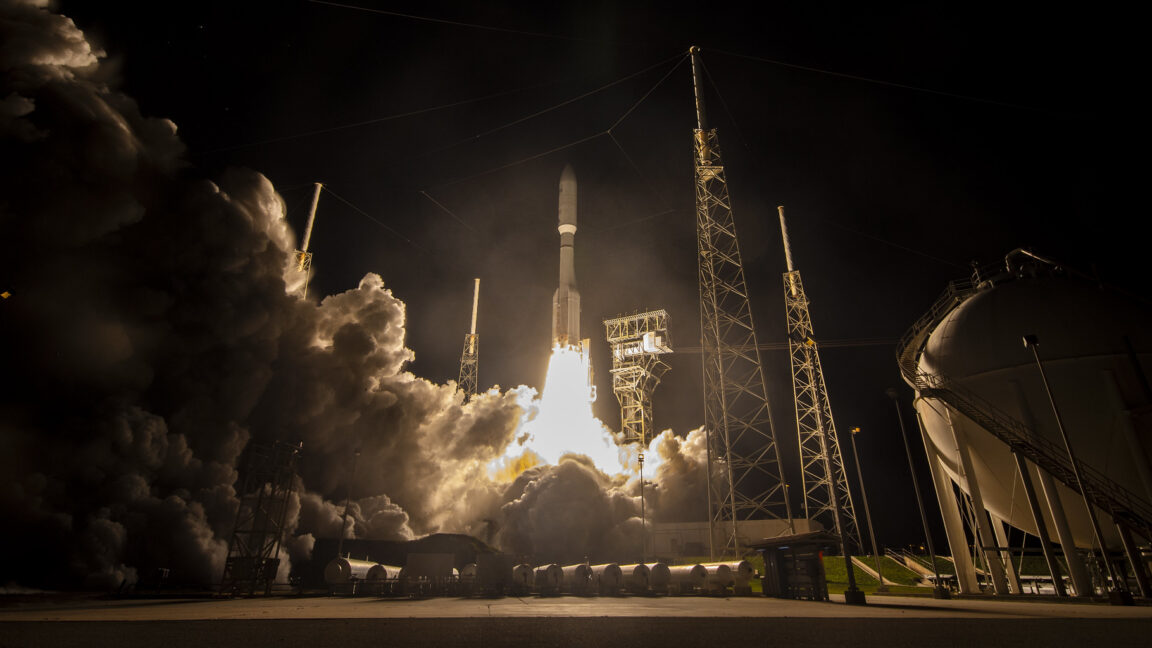
Atlas V launches heaviest payload. United Launch Alliance launched its latest Atlas 5 rocket, which carried a batch of 29 Amazon Leo satellites to low-Earth orbit early on April 4, Spaceflight Now reports. The mission was the largest and heaviest payload carried to orbit by an Atlas 5 rocket to date, according to ULA.
Upper stage performance is key … The previous four missions for Amazon Leo that launched on Atlas 5 rockets carried 27 satellites each. ULA and Amazon Leo were able to increase the payload stack to 29 as “a result of detailed engineering work between ULA and Amazon,” according to ULA. Amazon pointed to ULA’s use of the RL10C-1-1 engine on the rocket’s upper stage as a key reason why they were able to add two more satellites to the mission.
NASA’s Moon program depends on reusable launch. This is not the kind of talk you would hear from past NASA administrators, but it is entirely true. This week, the US space agency’s chief, Jared Isaacman, said almost off-handedly that the long-term success of the Artemis program depended on SpaceX and Blue Origin succeeding with their reusable launch systems, Starship and New Glenn, Ars reports.
Saying truths out loud … “A big key to our strategy—to not just return to the Moon but to stay and build a base—is the rapid reusability of heavy-lift launch vehicles,” Isaacman said during an Artemis II news conference. “The more they get experience doing that, the more options that are available to us for Artemis III.” One of the most refreshing things about Isaacman’s tenure has been his willingness to say true, but previously taboo things out loud.
Starship launch delayed until May. SpaceX’s next Starship test flight will take place in May and not April as previously scheduled, Reuters reports. SpaceX founder Elon Musk posted on social media platform X that the next flight of Starship’s V3 vehicle was four to six weeks away, or in the first two weeks of May. SpaceX’s debut of the V3 Starship iteration has been delayed for months as the company has packed dozens of upgrades into the vehicle to make it more reliable and suitable for NASA missions, like landing on the moon under the Artemis program.
Half a year since previous launch … SpaceX’s previous Starship test launch, its 11th, occurred in October. The final flight of the V2 version of the rocket, this mission was largely successful. The delay comes as NASA is pushing aggressively to accelerate its Artemis program, which will require either SpaceX’s Starship or Blue Origin’s Blue Moon vehicle to land humans on the Moon. So NASA really needs to see Starship flying frequently.
April 11: Falcon 9 | Starlink 17-21 | Vandenberg Space Force Base, California | 02:39 UTC
April 11: Falcon 9 | CRS NG-24 | Cape Canaveral Space Force Station, Florida | 11:41 UTC
April 14: Kinetica 1 | Unknown Payload | Jiuquan Satellite Launch Center, China | 04:00 UTC