
Development
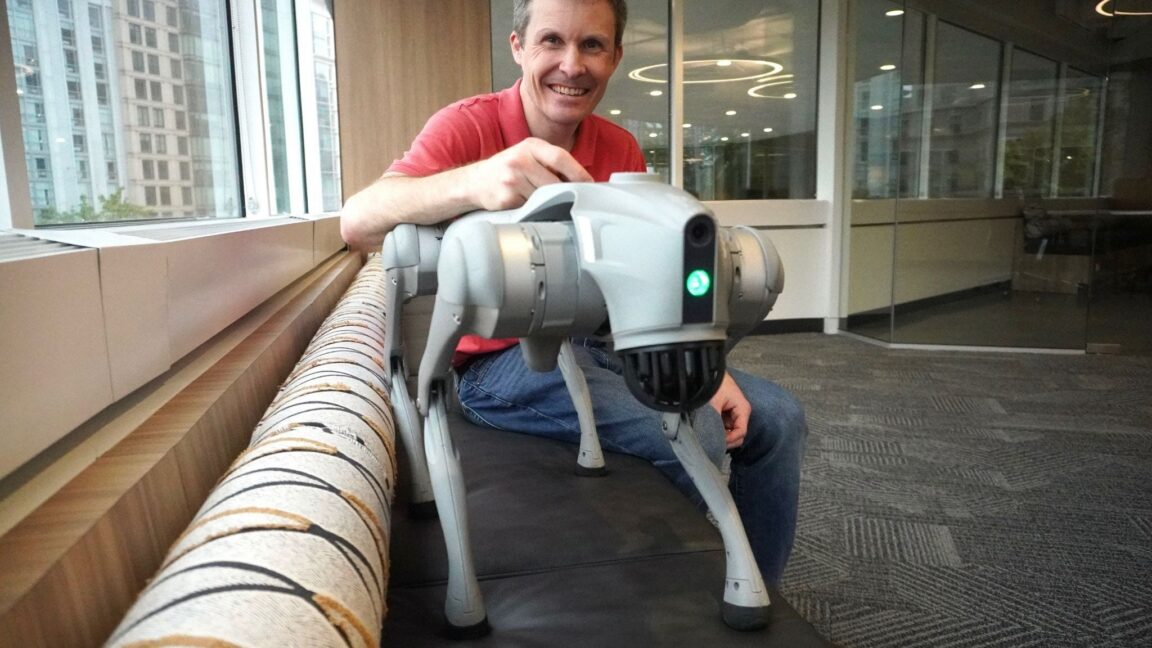
I spent $4,000 on a robot dog from China
September 12, 2026 Development Source: Ars Technica
Share this article



Unitree quadrupeds are widely used for academic research, and they are sometimes used for entertainment. But there don’t seem to be a ton of practical applications.
Wheeled robots are faster and more energy-efficient, making them better for deliveries. Flying drones are a better choice for a lot of surveying and inspection work. My robot has no arms or hands, making it mostly useless around the house.
But my robot did have one big thing going for it: It was astonishingly cheap.
I paid $4,017. That’s more money than I’ve ever spent to review a product. But it’s also far less than I would have had to pay for this type of robot a few years ago. And it’s cheap enough that people may find uses for it that wouldn’t have made sense at higher prices.
Sometimes what changes the world isn’t the invention of a new technology; it’s figuring out how to make it affordable enough for a mass market. Xerox built the first personal computer with a graphical user interface, but companies like Apple, IBM, and Microsoft made the technology mainstream. Perhaps Unitree will play a similar role for quadruped robots—though, as I’ll discuss later, Unitree’s robots now face legal restrictions in the United States.
Unitree has also used quadruped robots as a stepping stone to another market that could be much more important—humanoids. Unitree launched its first humanoid robot in 2023. Leveraging its experience making cheap quadrupeds, Unitree is able to sell humanoid robots for as little as $13,500.
That’s still way out of my price range, which is why I bought a robot dog instead. But it’s dramatically cheaper than any humanoid you could buy a few years ago. And the low cost has made Unitree a global leader in humanoid robots.
Financial markets are bullish. Unitree debuted on the Shanghai stock market on August 19. On its first day of trading, shares shot up more than fivefold. It has lost some altitude since then, but at Monday’s closing price, the company was still valued at $34 billion—more than triple its valuation before the IPO.
That created an opening for Unitree, which Wang founded in May 2016. The company’s first quadruped products—Laikago in 2017 and AlienGo in 2019—were powered by electric motors. Designed for research labs, they cost tens of thousands of dollars.
In 2021, Unitree launched the Go1 line, which started at $2,700 for the “Air” model. In 2023, Unitree unveiled the Go2, which was even cheaper—$1,600 for the Air and $2,800 for the more capable Pro.
Today, Unitree’s cheapest robot—the Go2 Air—is more than 97 percent cheaper than Spot. But this is not an apples-to-apples comparison; Spot is larger than Unitree’s Go2 line and can carry heavier payloads.
Still, the fact remains that Unitree made quadruped robots affordable to many people who could never afford Spot—including me! My wife never would have let me spend $75,000 or even $15,000 on a robot dog. But I convinced her to let me spend $4,017 (after tariffs and shipping costs) on a Go2 Pro.
Last year, the firm Simplexity tore a Go2 robot dog apart and made a video showing what they found.
Jakub Bartoszek, an expert on motors and legged robots at the startup MAB Robotics, argues that Unitree also saved money by using low-quality components. The motors in Unitree robots—many of which are made in-house—tend to wear out more quickly than those in some other robot brands, he told me. But the cost savings make the robots affordable to more people.
Unitree seems to have designed its robots for easy repairs when they wear out.
“They want these legs to be serviceable in the field,” Elenes said. Thanks to the simple way the robot’s legs are attached to its body, “you can swap out a leg pretty easily. I would guess it would take you less than a minute.”
Unitree also gets significant support from the Chinese government, including tax credits and large-scale purchases by public institutions. It’s hard to quantify the scale of this support because the Chinese system blurs the line between public and private, military and civilian. But a supportive policy environment clearly helped Unitree to scale up its manufacturing operations and thereby drive down the cost of each robot.
Traditional industrial robots require extreme precision, so they tend to have large reduction ratios.
A page on the Boston Dynamics website, for example, indicates that two of the motors in Spot’s legs are paired with reducers that have gear ratios of 51 to 1. In other words, the motor would need to do 51 full rotations in order to produce one full rotation of a leg joint.
This enables Spot’s movements to be very precise while magnifying the power of Spot’s motors. But it also has some disadvantages. One is cost. Reducers with 51:1 ratios are complex and—as a result—tend to be significantly more expensive than reducers with lower ratios.
Another is rigidity. When a robot’s arm encounters physical resistance, it should yield gracefully—a property called backdriveability. It’s also helpful if a robot can sense this kind of physical resistance electrically. Robots with higher gear ratios perform badly on both these fronts; their limbs feel stiffer and they are less sensitive to physical resistance.
In contrast, Unitree uses large motors combined with a simple 6.33-to-1 gearbox. This makes its robots more nimble and dynamic while reducing costs. The simpler design is also easier to simulate, making Unitree robots easier to train.
Unitree’s decision to use a lower gear ratio is part of an industry-wide trend. High gear ratios made sense for industrial robots that were programmed to perform simple, repetitive motions. In contrast, many modern robots perform complex actions in unpredictable environments. This requires sophisticated control software that can respond flexibly to changing conditions. The software is constantly making small corrections anyway, so it can compensate for less precise hardware.
So it was natural for Unitree to expand into humanoids. Unitree first debuted a humanoid called the H1 in 2023. The next year, Unitree unveiled a cheaper and more capable robot called the G1.
I got to see one when I visited Xiao’s lab in June. He paid around $50,000 for a research-grade EDU version. The consumer version starts at $13,500. This is shockingly cheap given the robot’s capabilities.
The SemiAnalysis authors draw a parallel to DJI, the Chinese company that dominates the global drone market.
“DJI’s Phantom 1 shipped January 2013 at $679, and was not a fully-fledged product at the time,” the SemiAnalysis team writes. “It had no built-in camera, no gimbal (stabilizer), ten minutes of flight, no live video feed, but it was roughly half the cost of the build-it-yourself drone.”
Like DJI in 2013, Unitree’s robots today have a lot of rough edges. Certainly mine does.
The app to control the robot is buggy. Features Unitree showcased in its launch video—like climbing stairs and following a human owner—don’t work well in real life. If I turn the robot on with its legs slightly out of place, they will often thrash around wildly and the robot will wind up on its back.
Then there was the time my robot collapsed just feet from my house. A more polished product might have detected the low battery (or high temperature) and shut itself down gracefully.
But for bleeding-edge technologies, this kind of polish may not be very important. Far more important is getting costs down.
“DJI chose to inhouse the most expensive and technically difficult component first: the flight controller,” SemiAnalysis writes. “Later on, DJI brought inhouse the gimbals, motors, and ESCs.”
DJI figured out how to make these components more cheaply than they could be purchased from external suppliers, which in turn allowed it to undercut other drone makers. And that expanded the market for DJI’s drones.
Before DJI came along, “professional aerial photography was the domain of helicopters and Hollywood second-unit teams, but now, small businesses could perform this on their own. As such, whole new markets were unlocked for DJI, like real estate listings, wedding videos, local news, agricultural surveying.”
There’s a flywheel here: The more units a company sells, the better deals it can negotiate with suppliers and the more money it can spend optimizing its manufacturing process. Larger sales volumes also allow a company to bring more components in-house. This allows the company to push costs even lower, which will mean more sales and even more money to invest in improving the production process.
Over a few years, this flywheel helped DJI to dominate the global drone market. SemiAnalysis argues that Unitree is on track to do the same thing for legged robots.
According to SemiAnalysis, Unitree has developed its own motors, gearboxes, lidar sensors, and cameras. “Unitree’s self-produced motors can run as low as 30-40% of equivalent Western motors,” SemiAnalysis reports. “They now make some of the cheapest humanoid gearboxes in the world.”
This could enable Unitree to take over the global market for quadruped and humanoid robots in much the same way that DJI took over the global drone market.
Of course that’s not guaranteed to happen. Unitree has a number of Chinese rivals. Unitree is the global leader in quadrupeds, but a Chinese rival, AgiBot, has sold more humanoid robots than Unitree in recent months. There are also many smaller robot companies in China that could challenge Unitree and AgiBot in the coming years.
But Unitree does not face much competition in the United States or the West more generally. Boston Dynamics sells excellent robots, but they tend to be significantly more expensive. There are a number of American startups aiming to build humanoid robots, including Tesla, Figure, and 1X, but consumers cannot buy a robot from any of these companies today.
That has alarmed some American policymakers. In June, a bipartisan group in the House introduced a bill to restrict importation of Chinese robots. The official press release for the legislation mentioned Unitree by name. Then in July, the FCC imposed broad new regulations on foreign-made robots that are likely to impact Unitree and other Chinese companies.
However, the robot market is global. Even if Chinese companies get locked out of the US market, Unitree or one of its Chinese rivals could still come to dominate the global market for humanoid robots.
There’s an obvious parallel here to electric vehicles, where Chinese companies like BYD are effectively banned from the US but are making rapid gains in the rest of the world. There’s a risk that a ban on Chinese robots could have a similar impact: rather than hampering the growth of companies like Unitree, it could make the US a robotics backwater.
Tim Lee was on staff at Ars from 2017 to 2021. He recently launched a new newsletter, Understanding AI. It explores how AI works and how it’s changing our world. You can subscribe to his newsletter here.