
Development
The complex corporate web behind a $3.2 billion AI data center
September 7, 2026 Development Source: Ars Technica
Share this article



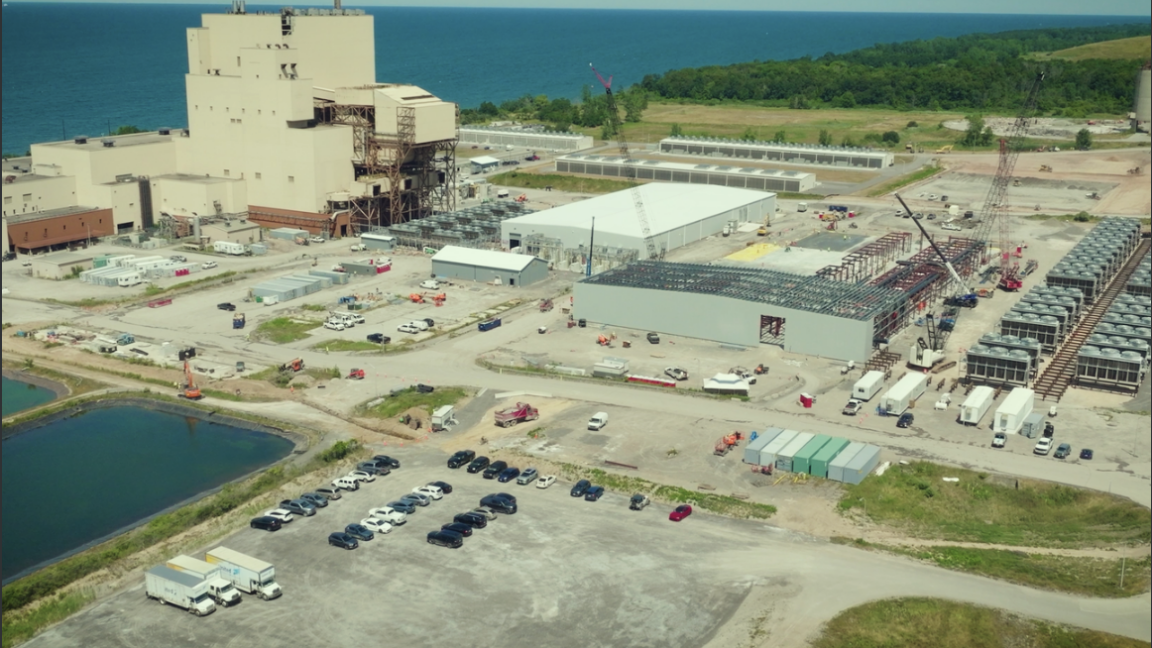
The fire did little to slow construction at the site, and no one was hurt in the blaze. But the Lake Mariner situation offers a glimpse into a system that is increasingly common across the AI buildout boom, one where responsibility itself is diffuse: legal responsibility for the next fire or safety failure, operational responsibility for what actually gets built and run, financial responsibility for keeping the project afloat, and reputational responsibility for its strain on the grid and water supply. When a data center’s energy use, environmental footprint, or safety record draws scrutiny, assigning responsibility may be surprisingly murky.
For instance, Somerset wanted more answers from TeraWulf after the fire, but the company’s communications team has remained unresponsive to community requests for a meeting, including from Jeffrey Dewart, the Somerset town supervisor. At town board meetings, residents have raised pointed questions about what the town is actually receiving in return for hosting one of the state’s largest AI data center buildouts.
According to a 2024 planning board presentation, TeraWulf’s project manager said the full buildout would bring employment to between 35 and 40 people at a facility drawing up to 500 megawatts. This was only a fraction of the 165 permanent jobs and $85 million in capital investment promised in 2019, when Somerset Operating Company, the landlord entity owned by TeraWulf CEO Paul Prager, applied for the site’s power discount under the same project scope. Prager did not respond to a request for comment on the discrepancy.
The New York Power Authority (NYPA) reviews compliance annually and can adjust the site’s benefits if the commitment isn’t met. New York Governor Kathy Hochul, who last month placed a moratorium on hyperscaler data center development, has acknowledged the gap between big promises and few jobs.
A source familiar with Anthropic’s thinking confirmed that Lake Mariner falls under the company’s direct ratepayer commitments but said they did not have details on what Anthropic would need to see from Fluidstack or TeraWulf to verify that clean energy commitments are being met at the site or whether Anthropic had ever asked.
The distinction between what’s covered and what’s verified matters because Anthropictreats direct and leased arrangements differently elsewhere. On July 6, TeraWulf announced a 20-year, $19 billion lease with Anthropic for a Kentucky facility, a deal that TeraWulf CEO Paul Prager told Bloomberg’s The Close the next day was “one of the first things they’ve gone direct on”: no Fluidstack, no Google backstop.
Anthropic’s contracting behavior makes the point: At a wholly owned site, Anthropic controls the terms directly. At a leased site like Lake Mariner, it may have no apparent mechanism to confirm the environmental and safety claims TeraWulf makes about the same facility.
Data centers often bring noise complaints with them, too, and that has been true in Somerset. Beth Staples sent two letters to the town board claiming that conditions have remained constant as the campus expands. “Hum is 24/7. Our 2-story home has been here since 1850,” she wrote. “It is fully insulated and has been updated throughout with new drywall and windows. I should not be hearing the constant hum to the degree I am in the house.”
TeraWulf’s own language on energy has shifted.
Its original 2024 CSR report described Lake Mariner as powered by “95 percent zero-carbon energy.” But its most recent board-approved Sustainability Policy, adopted in April 2026, never uses the term “zero-carbon” alone. Each reference pairs it with “low-carbon,” describing the company’s approach as citing infrastructure in regions “with abundant power resources and a meaningful contribution from low- and zero-carbon energy sources.” A separate 2025 sustainable finance disclosure shifts to “low-carbon energy” and puts the figure at 91 percent.
But the involved companies don’t appear to have a way to publicly verify how much of Lake Mariner’s electricity actually meets those standards.
Langlais, TeraWulf’s chief strategy officer, said the claim rests on the broader generation mix of the regional grid, not a contract tied to a specific power source. Lake Mariner draws from the NYISO Zone A grid, part of the New York Upstate region (Zones A-E), which was 87 percent zero-emission in 2025—primarily nuclear (42 percent) and hydroelectric (34 percent), much of it from the Niagara Power Project, according to NYISO’s Power Trends 2026 report.
That’s separate from the roughly 90 megawatts—about 18 percent of the site’s total interconnection capacity—that Lake Mariner will draw via NYPA’s High Load Factor Program, which Langlais said “is not a renewable energy product” but an economic development rate for large industrial users.
Under that program, the NYPA buys electricity on the wholesale market on Lake Mariner’s behalf—a blend of hydro, nuclear, natural gas, wind, and solar—and waives delivery surcharges in exchange. That’s a different arrangement than the preference power New York offers directly to 51 municipal utilities and cooperatives and to Native Nations like the nearby Tuscarora and Tonawanda Seneca Nation.
Langlais said TeraWulf does not purchase any renewable energy certificates at all to recharacterize the site’s grid electricity as clean, since “electricity consumed at a grid-connected facility cannot be traced to a particular generator.” That description lines up with what NYPA spokesperson Alex Chiaravalle told me separately.
Neither TeraWulf, Anthropic, nor Google appears able to verify how much of that blend is actually clean. A source familiar with Anthropic’s thought process said the company did not have details on what it would need to see from TeraWulf or Fluidstack to confirm clean energy commitments are being met at the site or whether it had ever asked.
Google, which holds a financial stake in the facility through its TeraWulf warrants, has set one of the industry’s strictest standards for what it counts as clean power, requiring electricity matched to its usage in real time, not simply offset with credits purchased elsewhere. Whether Lake Mariner’s market-procured blend meets that bar is unclear. Google did not respond to two requests for comment sent to its press office after Michael Terrell, the company’s head of advanced energy, directed inquiries there.
The question isn’t hypothetical for Somerset. Google’s warrant stake—the same kind as the one described in TeraWulf’s arrangement at Lake Mariner—was tested directly when federal regulators were asked whether the stake should have been disclosed in a separate proceeding over TeraWulf’s purchase of a Maryland power plant. TeraWulf claims that unexercised warrants confer no real ownership or control at this moment and so didn’t need to be disclosed.
The deal in Maryland was opposed by Public Citizen, a public interest advocacy nonprofit, the NAACP, the Port Tobacco River Conservancy, and the Independent Market Monitor, which acts as a neutral watchdog for the regional power market.
“They’ve got this deal on the books where a company has a right to acquire your shares to the point where they would control 14 percent of your company, and you don’t disclose that,” said Tyson Slocum, Public Citizen’s energy program director. “That seems like a pretty big loophole.”
When Public Citizen pressed TeraWulf to commit to meeting publicly with the community around its Maryland facility, the company said it has no such obligation and declined.
“We’ve got them on record saying FERC [Federal Energy Regulatory Commission] rules don’t obligate us to meet in person with the community, so we’re not going to,” said Slocum.
This was the same attitude seen in Somerset, New York. And that difficulty with accountability operates at every level of the data center tech stack.
In early June, the New York State Legislature passed the Responsible Data Center Development Act, an omnibus bill addressing data centers’ energy and environmental footprint. It would require a Department of Environmental Conservation environmental impact analysis, set energy efficiency rules, establish prevailing wage labor standards at data center construction sites, mandate a transition to renewables by 2040, and require host communities to receive tangible investments from data center stakeholders—alongside a one-year moratorium on new permits for facilities drawing 20 megawatts or more.
Three months after passage, the bill remains unsigned. In July, Governor Hochul signed a narrower executive order creating her own one-year moratorium on hyperscale data center permits, but she left the legislature’s broader framework untouched. In any event, neither policy reaches Lake Mariner. The executive order pauses new permits for facilities exceeding 50 megawatts, but Lake Mariner’s 500-megawatt buildout was already permitted before the order took effect.
“I think the executive order is a good start and a step in the right direction, but I think the legislation is more comprehensive,” said Assemblyman Patrick Carroll, a Democrat and the bill’s co-sponsor, at a rally in Rockland County urging Hochul to sign it.
In Somerset, two months after the fire, the water supply problems that forced firefighters to shuttle in tank water haven’t been fixed. Construction hasn’t slowed down, either.
“If there’s no hydrant for me,” Matisz said, “that fire is going to burn under their asses.”