
Development
After 8 years, Europe's BepiColombo mission is on final approach to Mercury
September 5, 2026 Development Source: Ars Technica
Share this article



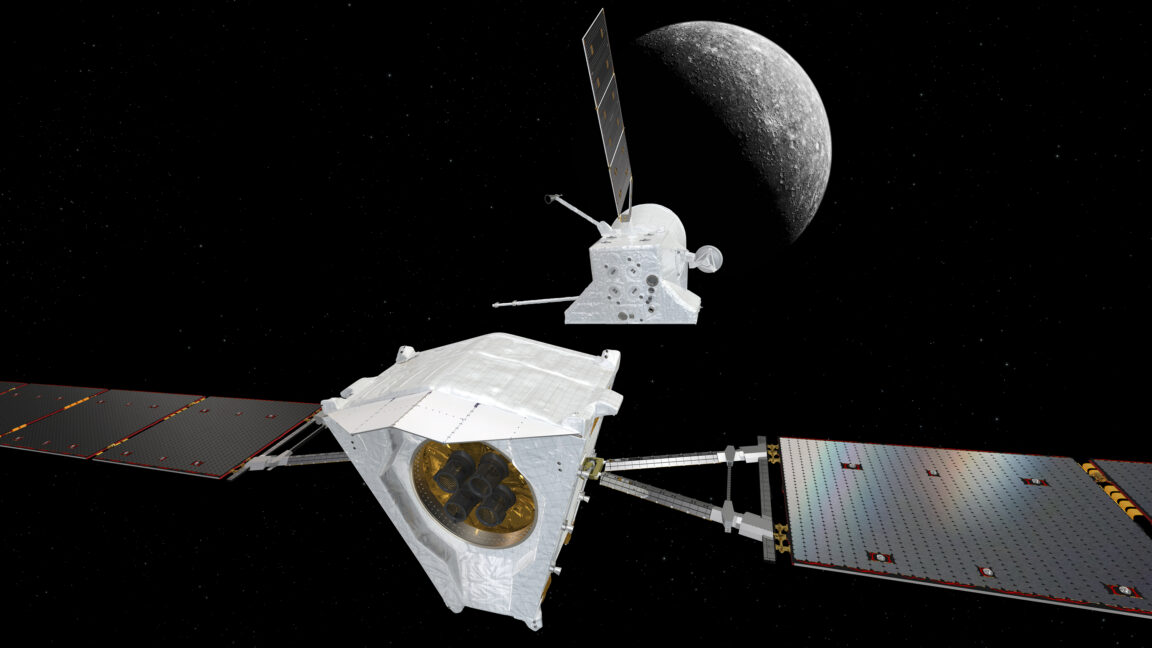
But the propulsion module was no longer required, and BepiColombo needed to get rid of it before slipping into orbit in November. BepiColombo is unusual in that it is actually a stack of three spacecraft: the Mercury Transfer Module and the Mercury Planetary Orbiter, built by Europe, and the Mercury Magnetospheric Orbiter from Japan, nicknamed Mio.
The separation of the propulsion module Thursday leaves the European and Japanese orbiters still traveling together. The two spacecraft will release from one another in December, soon after they arrive in their initial orbit around Mercury. The orbiters each have their own instruments for scientific observations at Mercury, while the transfer module is dead mass.
BepiColombo is named for Italian mathematician and engineer Giuseppe “Bepi” Colombo, a pioneer in orbital mechanics who helped NASA design a trajectory using planetary flybys to allow the Mariner 10 mission to encounter Mercury three times in the 1970s. NASA’s MESSENGER spacecraft became the first probe to enter orbit around Mercury in 2011, completing the first global map of the airless world before ending its mission in 2015.