
Development
Nearly impossible? How Fairphone built the ethical, repairable Fairphone Gen 6+.
September 4, 2026 Development Source: Ars Technica
Share this article



“Our goal is that every single person that purchases a Fairphone uses it for at least five years, and we track that as a KPI [Key Performance Indicator],” said Hatton.
The standard way to design a modern smartphone is to cram as much as you can into an aluminum and glass sandwich, with the expectation that it will be assembled once in a factory and never opened by the buyer. Devices rely on glue and awkwardly placed screws to accomplish this, making the internals a little like metal spaghetti.
The Gen 6+ is designed so that anyone can replace parts, reducing e-waste and potentially saving consumers a lot of money. If you’ve had, say, a Samsung Galaxy phone for a couple of years and need to replace the screen or USB port, the cost might be higher than just buying a new phone.
“There is an incentive in terms of planned obsolescence to replace your device,” said Hatton. “On the one hand, it’s a good way to keep selling devices, but that’s simply not the proposition that we have.”
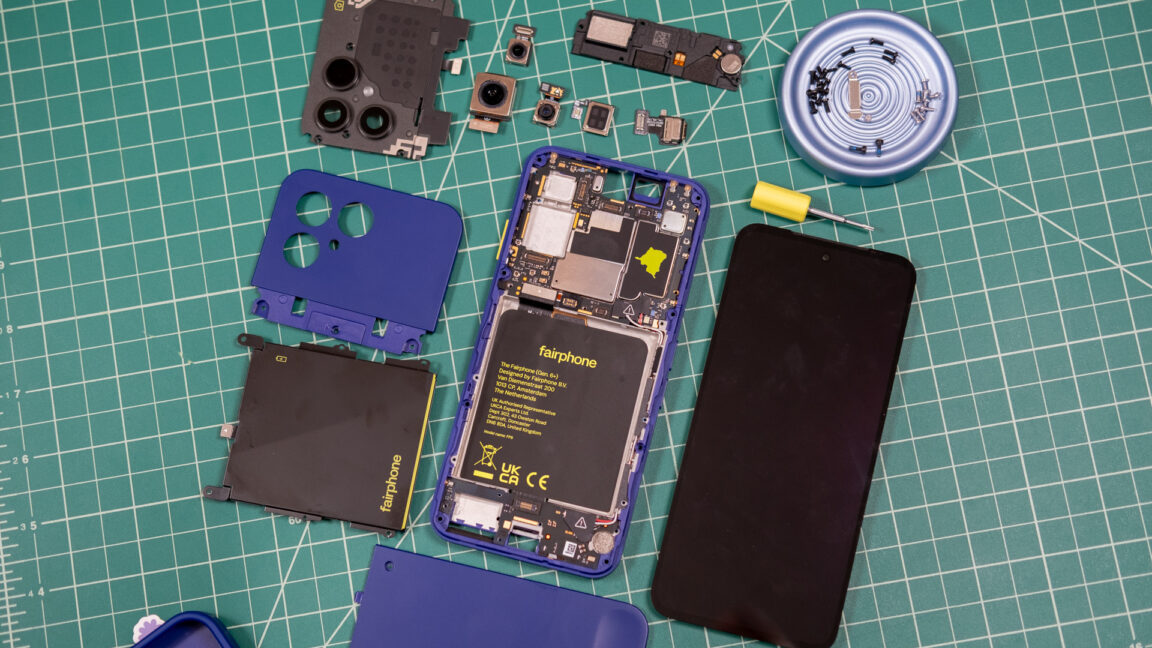
That means designing the phone differently—it’s not just a matter of skipping the glue. Inside, the Fairphone Gen 6+ is clean and orderly. It starts with a pair of T5 Torx screws exposed on the back of the phone. After removing those, the back cover slides off. With the same driver, you can extract the battery, camera modules, USB-C port, display, and more. In all, the phone supports user replacement of 12 different parts with just that one (included) screwdriver. One drawback is that the modular approach makes the phone a millimeter or two thicker than most glued-together phones.
“We know that after about three years, it will be wise to replace your battery with a new one,” said Hatton. “Batteries aren’t meant to last forever, but your phone on the whole can last a lot longer than a battery.”
While the Fairphone is designed to be disassembled, what about the long haul? The Fairphone 6+ is mostly plastic rather than metal like a Pixel or iPhone. The phone still manages to feel solid, though, thanks to its internal metal frame, and the company has worked to ensure the device doesn’t become progressively less sturdy as you tinker with it.
“When we’re in our product development cycle, we introduce tests that are specifically dedicated to disassembly and reassembly,” said Hatton. “So we’re looking in part at the robustness.”
Robots work the assembly line, but humans are less predictable. Hatton pointed to tests that examine, for example, what happens when someone over-tightens screws while servicing their device. Does it warp the casing? Damage any nearby components?
Hatton said it takes her 15 minutes to fully disassemble a Fairphone Gen 6+, but she did have a hand in designing it. That said, it shouldn’t take a novice much longer. After a couple of minutes perusing Fairphone’s documentation, I was able to take the phone apart and remove all of the user-serviceable components in about 20 minutes. Everything went back together without issue and still works perfectly, with no new gaps or wobble.
The process is pretty intuitive, with most of the parts held in with flat board-to-board cable connectors. Just pop them off with a spudger or your fingernail, and the component lifts right out. There are a good number of screws to remove to get all the way down to the metal frame and screen, but again, they all use the same T5 Torx bit.
While it might be comforting to think you could drop your phone in a pool, that’s still risky. OEMs don’t warranty the water-resistance of their phones, and if you’ve made any repairs, it’s possible the sealing of that difficult-to-open device was compromised. Hatton notes that it wouldn’t be impossible to make a repairable phone that’s also IP6X, but you’d have to design around that in numerous ways.
“There are a number of things that you need to weigh against a higher IP rating,” Hatton said. “You can achieve it in a very small form factor with higher costs, or you can achieve it with a larger form factor—you could increase the Z dimension and perhaps also the other dimensions, and that way you could create all sorts of gaskets and other things. But we assess the whole landscape and say, ‘Hey, the customer doesn’t want a phone that’s a brick.’ They also don’t want a phone that’s incredibly expensive. So within those boundaries, what IP rating meets their needs?”
It’s a trade-off, but it’s one that many people would probably make in the name of repairability if given the choice.
The Fairphone Gen 6+ is similar to the Gen 6 that launched in Europe last year, but there are a few notable changes. The new phone has a slightly upgraded Snapdragon chip, and it has more memory than the last Fairphone at a time when AI has driven up costs considerably.
“We decided to increase the RAM to 12 gigabytes,” said Hatton. “This is something that I think is a little bit unique, given the current circumstances in the consumer electronics industry. But the reason that we did is that it really underscores the value proposition of longevity that we’d like our customers to enjoy when they purchase the Gen 6+.”