
Development
Just like a fruit fly, a new algorithm never forgets old scents
September 3, 2026 Development Source: Ars Technica
Share this article



What these noses are bad at is generalizing. A device with software that is tuned to sniff out spoiled olive oil isn’t the same as a device that flags a specific explosive at an airport checkpoint. Retooling one for a new task usually means retraining its software almost from scratch.
Two technical bottlenecks sit behind that limitation. First, these systems typically need a mountain of hand-labeled examples before they can reliably tell one smell from another. Second, teaching them a new odor tends to scramble what they already knew, a problem researchers call “catastrophic forgetting”—the electronic equivalent of forgetting how to ride a bike right after learning to swim.
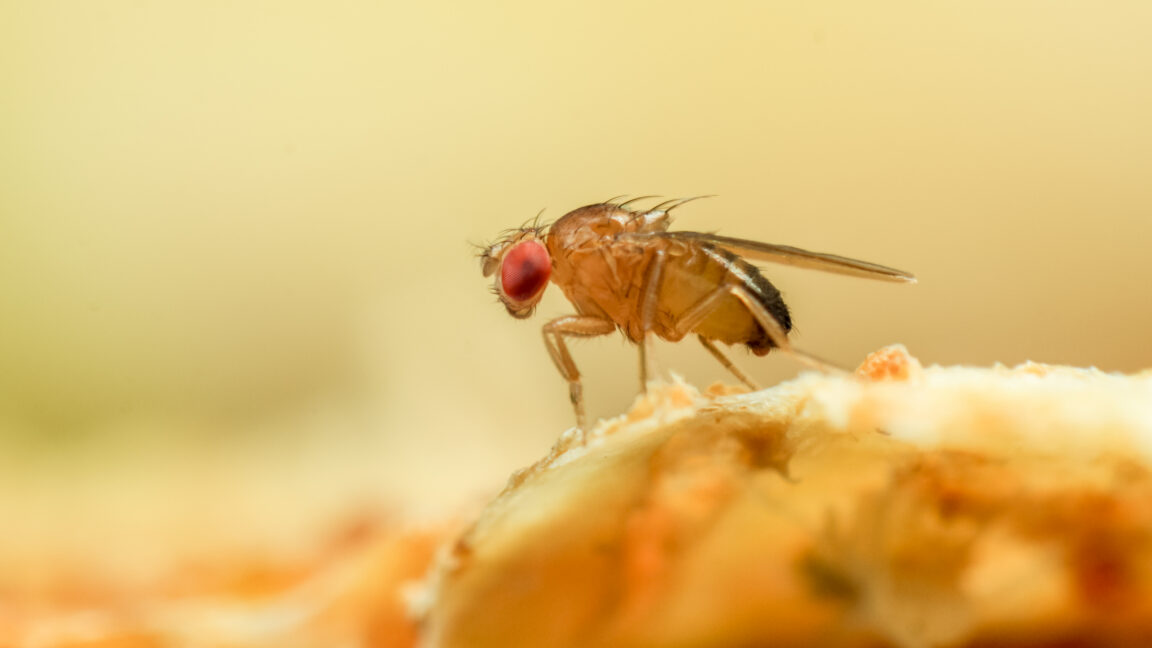
Fruit flies—and plenty of other insects—don’t have this problem, despite their minuscule brains. How do they tell odors apart and remember them with so little brainpower to work with? The secret, according to the paper’s authors, is something called sparse coding.
Think of it as the fly’s brain assigning a barcode to every smell. Its olfactory system relies on roughly 2,000 specialized cells, called Kenyon cells, that receive sparse, randomly wired signals passed on from the fly’s odor receptors. Those Kenyon cells all report to a single relay point: the anterior paired lateral neuron, or APL (actually a symmetrical pair of them, one per brain hemisphere). The APLs respond by firing strong, global inhibition back at every Kenyon cell at once, silencing nearly all of them. The cells that remain active after that crackdown are what Max and Shen call the barcode for that particular odor.
Spi-Fly picks up the story only after a sensor has already done its job—everything here happens in simulation, using pre-recorded sensor data, and the algorithm itself has nothing to do with capturing the smell in the first place.
In Max and Shen’s work, sensor readings become a stream of spikes, projected sparsely and randomly onto a hidden layer that stands in for the Kenyon cells, with neurons inhibiting each other instead of relying on a single APL-like referee. From there, the hidden layer connects to an output layer, one neuron per labeled odor, waiting to learn which barcode belongs to which smell.
Same story with the tests themselves: Every one of them, like the rest of the study, ran entirely in simulation, using single, isolated odors—nothing like the tangle of competing smells a device would meet in an actual kitchen, forest, or airport terminal. There’s no guarantee Spi-Fly would hold up once real molecules start interfering with each other outside a computer.
Then there’s EPL net, which the paper singles out as its closest competitor. It manages middling results on the gas sensor dataset, but performs poorly on the synthetic Drosophila data. Max attributes that gap to, among other reasons, timing: EPL net samples odors in discrete snapshots, mimicking how animals actually sniff, while Spi-Fly reads a continuous stream, discarding nothing.
Thomas Cleland, a Cornell psychology professor who co-designed EPL net, disputes the comparison itself. In his account, EPL net and Spi-Fly were never built to solve the same problem. EPL net is meant to filter out sudden, unpredictable background odors, the smell equivalent of a stranger’s cigarette smoke drifting into the room, for example. It does so by using one-shot learning rules and wasn’t designed to learn the gradual, repeatable variation Spi-Fly is trained on. “EPL and Spi-Fly are based on different layers of the olfactory system and are built for different noise models,” he writes in an email. He’s blunt about the upshot: In his view, the comparison doesn’t tell you much of anything.
Spi-Fly exists purely as code, tested against prerecorded datasets rather than an actual whiff of anything. The next step is folding it into the odor-sensing hardware Max and his collaborators are building at TU Eindhoven and Kiel University—real, physical neuromorphic chips, manufactured with all the tiny inconsistencies that come from actually being built rather than simulated.
Max does not put a date on it, only promising that there’s more to come soon. For now, though, the fly you watched drown in your wine glass still wins.
Neuromorphic Computing and Engineering, 2026. DOI: 10.1088/2634-4386/ae9177
Federica Sgorbissa is a science journalist; she writes about neuroscience and cognitive science for Italian and international outlets.